
1. Product & Industry Overview
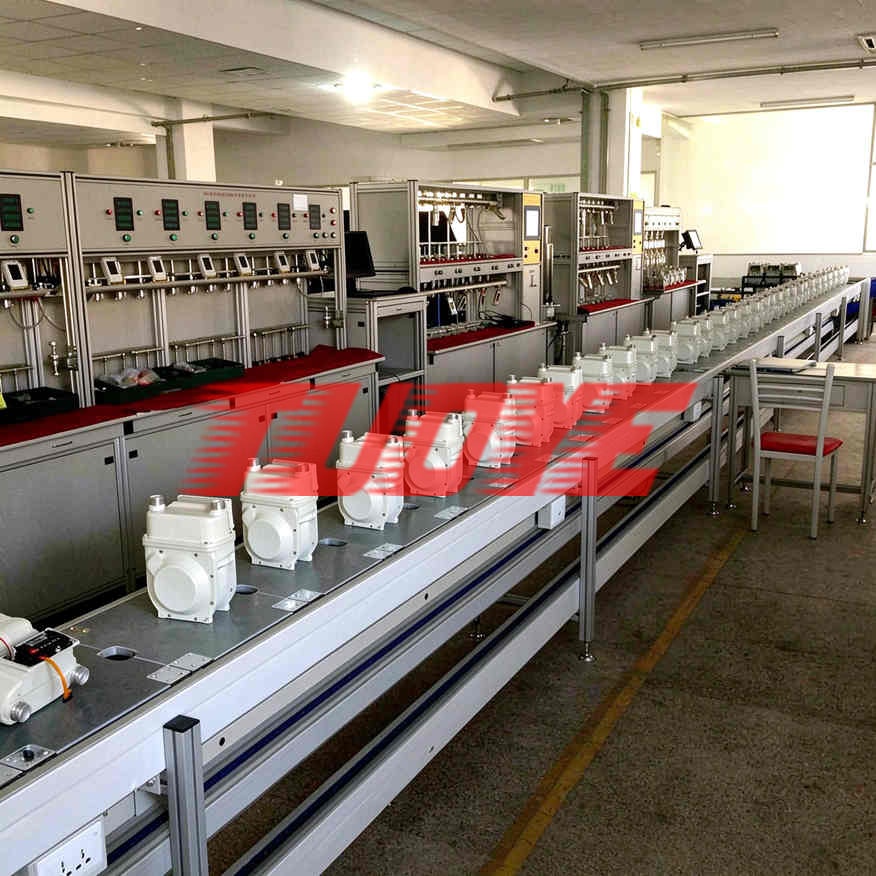
A gas meter must pass verification before leaving the factory, so a gas meter assembly line has to plan its test stations from day one of design — bolt a verification section on after the line is built and the workshop may not even have the space. The gas meter assembly line (also called a gas meter production line or diaphragm gas meter assembly line) completes mechanism, valve seat, counter and case assembly plus factory verification; Tuoye's gas meter production lines in Wenling, Taizhou, Zhejiang, China handle both diaphragm and smart remote-reading meters.
First, the diaphragm meter principle, stated plainly: gas drives a diaphragm back and forth, a slide-valve mechanism turns that reciprocation into the charge-discharge cycle of the measuring chambers, and gear trains accumulate the count. Household meters are dominated by diaphragm types; the standards set explicit limits on maximum working pressure, maximum flow and ambient temperature. Factory verification per the diaphragm meter verification regulation covers appearance, seal integrity, pressure loss and indication error, with bell provers or master-meter benches as the usual apparatus; smart meters add remote-reading function tests. Assembly precision of the diaphragm and valve seat decides metering error and pressure loss outright — on a gas meter assembly line, process discipline in the mechanism section outweighs everything else.
2. Process Flow (see photo)
The photo shows an aluminum-extrusion speedchain gas meter assembly line: white pallets carry diaphragm meters straight down the center line, fifteen to twenty stations in a row; along the right runs a long strip of calibration stations with meter-clamping fixtures and piping, where finished meters pass seal and error checks; on the left, control cabinets with digital display instruments and pushbutton lamps make every station's state obvious at a glance; at the line end, the inspection zone marks passed meters for storage. Assembly sequence: mechanism on line (diaphragm, valve seat) → slide-valve mechanism → counter and gear train → case closing and fastening → seal test (air-pressure leak check) → pressure loss test → indication error verification (bell prover or master-meter comparison) → remote module assembly and function test (smart meters) → lead sealing and tagging → packing and storage. Verification data should be recorded and uploaded automatically — hand-copied sheets are slow and barely traceable, and showing up at an audit without electronic records is a weak position to be in.
3. Customization & Service
Customization on the gas meter assembly line: station count and line length follow the capacity program; seal, pressure-loss and error-verification stations are engineered jointly with the prover supplier; bar-code traceability, automatic reject discharge and assembly poka-yoke are selected by quality-control class. To propose a diaphragm gas meter assembly line, Tuoye needs three inputs — meter models (G1.6 through G6, smart remote), capacity and workshop conditions — then delivers floor layout, equipment list and quotation. Equipment is pre-assembled and trial-run in our plant, commissioned on site through trial production, training included. Warranty one year; pallets, meter clamps and speedchain parts supplied long-term. Smart gas meter assembly-and-test lines are where demand has concentrated these two years; twin parallel lines with automatic verification have been engineered several rounds. For a gas meter production line quotation, send meter models and capacity, and lead time comes with it.
More detail on prover docking: the bell prover is stable and precise but large and slow; the master-meter bench is compact and fast — choosing for a gas meter assembly line comes down to capacity and floor space, and plants above a thousand meters a day almost always go master-meter with parallel stations. In the gas meter assembly line proposal, the verification section's floor area, air supply interfaces and vent piping must all be planned in one pass — retrofitting them later is expensive. One more note on smart meters: the remote module assembly and function-test stations are the fastest-growing sections on gas meter production lines, with NB-IoT meters programmed, activated and read-verified in one on-line flow. The row of digital display instruments on the left-side cabinets in the photo does exactly that — what each station on a gas meter production line is doing and how far it has gotten scans past in one look, the layout line leaders love most.