
1. Product & Industry Overview
Rice cookers run cheap and iterate fast — one rice cooker assembly line carries three or four models mixed all year, and changeover speed is the competitiveness. The rice cooker assembly line (also called a rice cooker production line) covers final assembly from shell on-line to whole-unit packing; safety follows GB 4706.19 for liquid-heating appliances, efficiency filed per GB 12021.6. The types: 3 L and 4 L mechanical models hold the base volume, electronic pre-set-timer machines the middle; IH induction cookers heat the inner pot directly — a strong selling point on rice texture — adding coil-disk and air-path stations to assembly; electric pressure cookers share the platform, adding pressure control and lid-safety parts with double the test items. Quality control on a rice cooker assembly line sits in heater-plate-to-pot contact and the magnetic limit thermostat's action temperature — undercooked or scorched rice traces, nine times in ten, to those two.
2. Process Flow (see photo)
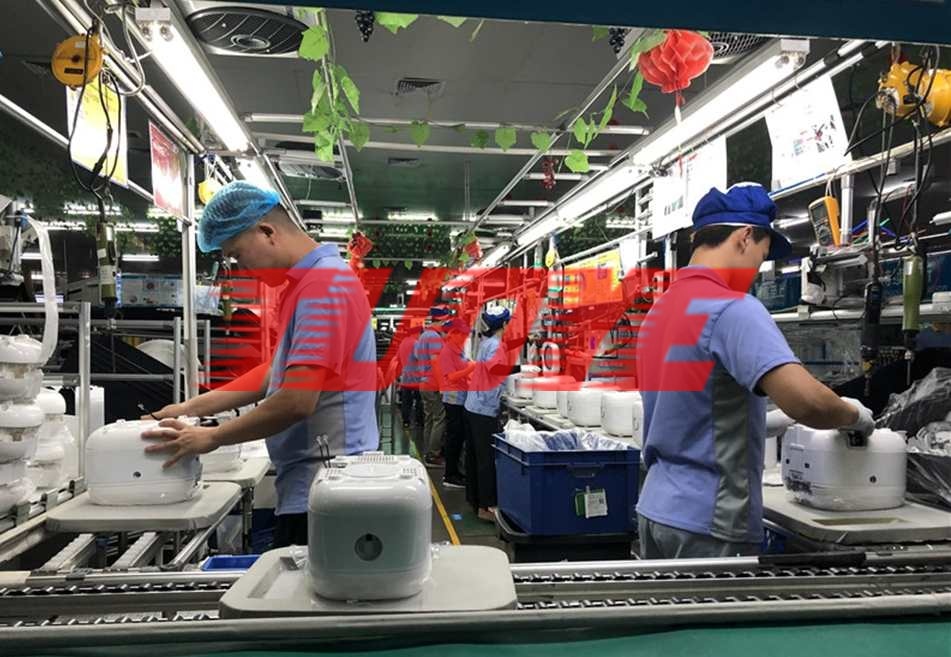
Look at the photo of this rice cooker production line's final assembly: dual parallel speedchains, white rounded shells flowing on pallets, some stations already at lid and steam valve; yellow spring balancers on the columns hang electric drivers, the yellow instrument on the right rack is a withstand-voltage tester, SOP boards and totes complete at every station, blue boxes relaying between stations — an estimated 15-25 stations at 15-30 seconds a unit. Assembly sequence: shell (insulated body) on line → heater plate fitted and fixed → magnetic limit thermostat and thermal controller → power cord and coupler → steam valve and lid hinge → inner pot positioning check → insulation withstand test → cook test (water in, powered, cooking curve and keep-warm temperature recorded) → appearance and nameplate → accessories (measuring cup, steamer) boxed. Cook testing on the rice cooker production line runs by sampling or full check per setting — the test section's steam exhaust and electrical load budgeted separately.
3. Customization & Service
Customization: pallets located by shell diameter, rice cookers and pressure cookers sharing the line; IH coil-disk stations with insulation and air-tightness checks; cook-test water supply, power and steam venting sized to station count. Tuoye — in Wenling, Taizhou, Zhejiang, China — delivers the rice cooker assembly line from in-plant pre-assembly and commissions through trial production, warranty one year, pallets, speedchain and balancer parts supplied long-term; peak-season densification and speedchain upgrades on old lines are common. For a quotation, send the model range (heating type, capacity band) and daily program — the price gap between sampled and full cook-testing configurations gets listed plainly in the proposal.
One more word on IH models: the coil-to-pot coupling gap is the assembly-sensitive item — this station on the rice cooker production line gauges every unit, out-of-tolerance machines pulled on the spot, never shipped with hidden risk. Pressure models get action checks and lead-seal records on the lid-lock and relief valve — certification audits always visit these safety-part stations; silicone parts in the steam valve take poka-yoke orientation, because a reversed valve boils over and the complaint lands directly in after-sales. Multi-model changeover runs "swap the board, not the line" — pallets and boards bound to model QR codes, changeover held inside half an hour on the rice cooker assembly line, and the capacity saved across a year adds up to real money.