
1. Product & Industry Overview
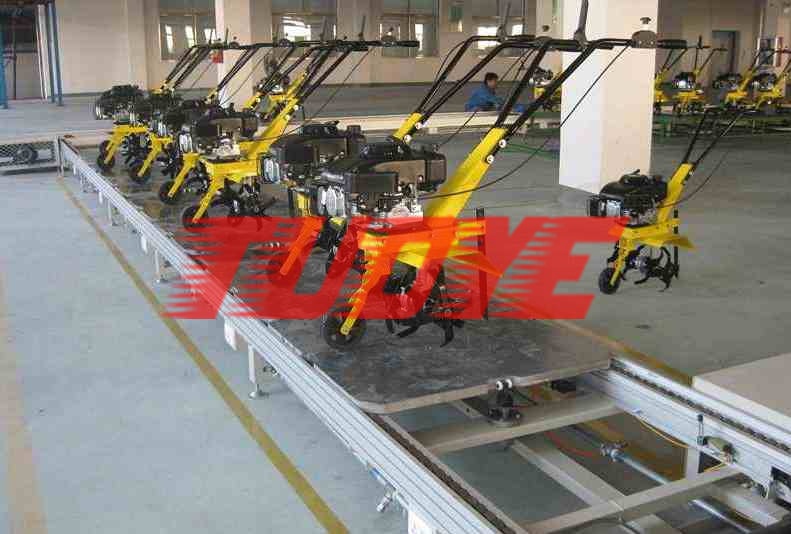
Farm machinery lives on sharp seasons — a rotary tiller assembly line must carry peak-season volume without idling to death in the slack, and flexibility beats looks. The rotary tiller assembly line (also called a rotary tiller production line or power tiller assembly line) completes whole-machine final assembly of tillage machines, with power tillers and garden management machines sharing the platform; Tuoye's farm machinery assembly lines in Wenling, Taizhou, Zhejiang, China are designed to this industry's rhythm.
Run the model range once: the power tiller is a walking-behind small machine, a gasoline or diesel engine driving the blade shaft directly, handling tilling, weeding and ditching — the workhorse of greenhouses and hilly small plots; the garden management machine is one size up with interchangeable ridging and ditching implements; tractor-mounted rotary tillers pair with 12-to-120 hp tractors in mid-gear-drive series for open-field work. Landed on a rotary tiller assembly line, the quality control points are exactly two: gearbox gear mesh (which decides reliability) and blade direction plus tightening torque (assembled backwards or loose, they become a field hazard) — the station plan of a rotary tiller production line is built to reinforce those two.
2. Process Flow (see photo)
The photo shows a plate-chain rotary tiller assembly line with pallets: complete yellow power tillers (gasoline engine, handlebars, gearbox, tiller blades and gauge wheels all aboard) sit on metal pallets running straight along aluminum-extrusion track, six to eight stations in single-side layout; work platforms ease fitting the big parts like handlebars and wheel axles; building columns carry the roof, daylight windows give plenty of light, yellow floor paint zones the concrete, and finished machines park at the line end. Assembly sequence: frame on line → engine hoisting and fixing → gearbox assembly (gears, oil fill) → clutch and shift controls → handlebars and throttle cable → blade shaft and tines (torque fastening, direction check) → gauge wheels and guards → start-and-run test → appearance check and storage. Never skip the run-in station — one lap with engine and gearbox turning surfaces any rattle or oil weep on the spot, far cheaper than warranty returns from dealers.
3. Customization & Service
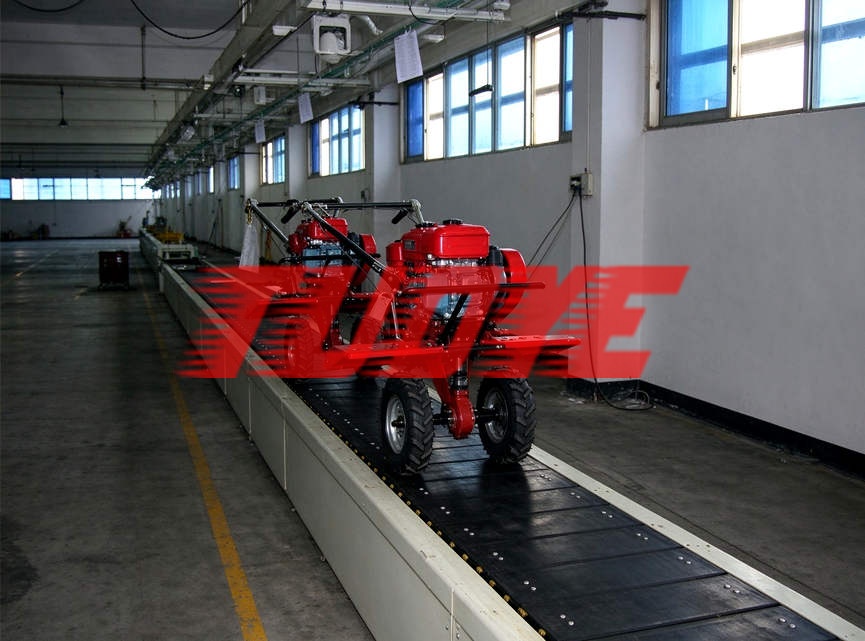
Customization on the rotary tiller assembly line: pallets built to each model's locating points, power tillers and garden machines sharing one line; engine hoist points, torque-controlled tools and the run-in station per the process; the line end extends into a run-off zone and packing. To propose a power tiller assembly line, Tuoye needs the model range, capacity and workshop conditions — with peak-season single-shift capacity calculated first; line speed is VFD-adjustable, so the slack season simply runs slower. Equipment is pre-assembled and trial-run before shipping, commissioned on site through trial production, with operation and maintenance training. Warranty one year; pallets, aluminum track parts and pneumatic components supplied long-term. Subsidy-catalog models turn over fast in this industry, so the rotary tiller production line leaves headroom for quick-change tooling — new models board without major surgery. For a rotary tiller assembly line quotation and lead time, send models and capacity over.
One more word on the blade station: blade direction and tightening torque are the only link on a rotary tiller assembly line with real safety history — left- and right-curve blades swapped or bolts not torqued, and the machine becomes a hazard the moment it bites soil. The blade station on a tiller line should carry torque-controlled tools plus a visual direction board (pictograms mounted face-on at the station), so neither veterans nor new hires get it wrong. Capacity follows the industry calendar: deliveries peak ahead of spring and autumn tilling, so installation and commissioning of the rotary tiller production line must be scheduled backwards to hit full output before the season; the slack season takes maintenance and tooling upgrades, with air lines, fixtures and the run-in station on the power tiller assembly line serviced in rotation. The subsidy catalog adjusts yearly — a rotary tiller assembly line that keeps quick-change tooling and station margin ready takes new models in stride; anyone who has built farm machinery lines knows this one by heart.