
1. Product & Industry Overview
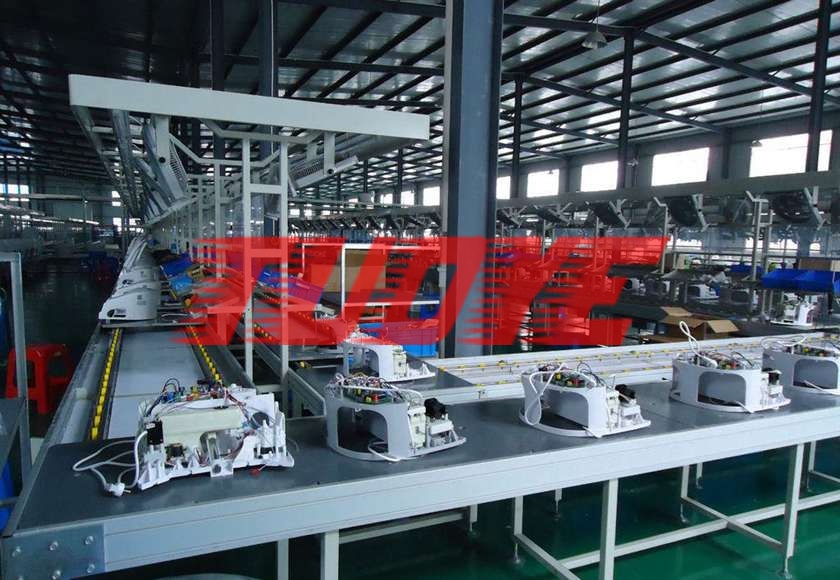
A medical device line follows more rules than an ordinary electronics plant — from fixture materials to data records, a ventilator assembly line has to stand up to a quality-system audit. The ventilator assembly line (also called a ventilator production line) completes whole-unit assembly, adjustment and burn-in; Tuoye's ventilator assembly lines in Wenling, Taizhou, Zhejiang, China are ESD-designed and can be laid out for ISO 7 (Class 100,000) cleanrooms.
Sort the products first: non-invasive ventilators breathe through a mask, for home and clinic both; invasive ventilators ventilate through intubation for critical care; portable transport models form a third group. Core components fall into three families — gas-path modules such as blower turbines and proportional valves, flow and pressure sensors, and the main board plus display. The medical specifics live in the details: gas-path parts get ultrasonic, oil-free degreasing and high-temperature drying before assembly, and ordinary lubricants are banned on the whole line — oil mist in the air path is a patient incident. Every unit runs a full-length burn-in with flow accuracy, pressure control and alarm functions verified item by item before release. So the station design of a ventilator production line cannot miss three things: ESD protection, dust control and process records.
2. Process Flow (see photo)
The photo shows a ventilator assembly shop in parallel-line layout: several plate-chain/belt pallet lines run side by side, white pallets as carriers and yellow stop pins parking each pallet precisely at its station; ESD workbenches line both sides with lighting frames row after row; blue bin trolleys deliver cleaned and dried gas-path parts along the lines; green lane lines are painted crisp on the epoxy floor, with the carton packing zone pressed right at the line end. Each single line runs fifteen to twenty stations with testing and packing at the tail. Assembly sequence: gas-path module pre-assembly (after cleaning and drying) → shell on line → blower turbine → proportional valves and sensors → main board and harness → display and control panel → air-tightness check → power-on self-test and sensor calibration → whole-unit burn-in → performance test (flow, pressure, alarms) → appearance check, packing, storage. Every machine binds its SN by bar-code scan and archives test data per unit — that is the granularity a medical traceability system demands.
3. Customization & Service
Customization on the ventilator assembly line: parallel-line count and stations follow capacity; ESD and cleanliness levels follow the room class; burn-in room, performance benches and bar-code tracing are integrated as a package with test data archived by SN. To propose a medical device assembly line, Tuoye takes three inputs — product format, capacity and cleanroom conditions — with documentation aligned to the medical quality system. Equipment is pre-assembled and trial-run before shipping, commissioned on site through trial production, training included. Warranty one year; pallets, ESD accessories and stop-locate parts supplied long-term. Home respiratory device lines and medical ventilator production lines sit at different compliance classes — align the product positioning before configuring the line. For a proposal and quotation on a ventilator assembly line, send the product documentation over.
Two more paragraphs on burn-in: the burn-in duration on a ventilator assembly line executes the process file registered with the product; the burn-in zone is laid out separately with independent power metering, and burn-in completion status is bound to the SN — do this solidly on the ventilator production line and release reviews stand on firm ground. Cleanroom class needs aligning early too: home respiratory devices and medical ventilators differ in compliance level, and the ISO 7 layout — separated personnel and material flows, gowning and shoe-change buffers — is engineered together with the design institute, so the equipment does not arrive to find the room routing in conflict. The parallel-line layout in the photo suits ramp-up perfectly: open one line first, add the second as volume rises, with utilities (air, grounding, data ports) on the ventilator assembly line reserved for two lines in the first build — a classic small-money-big-effect spot.