
1. Product & Industry Overview
The water dispenser is a classic "cheap machine, precious water path" product — one leak loses one customer for good — and the craft of a water dispenser assembly line turns entirely around water circuits and sealing. The line (also called a water dispenser production line) covers final assembly from shell on-line to whole-unit packing; products follow QB/T 4100, the heating side checked per GB 4706.19 for liquid-heating appliances. The types: floor-standing hot models taking bottled water with heater tanks move the biggest volume; hot-and-cold types add electronic or compressor cooling, bringing refrigeration stations; countertop units stay compact for offices; and tea bar machines — bottle below, pump-and-heat on top — grow fast, their pumped, valve-driven water circuits carrying a longer assembly and test list than the classic machines. Quality control on a water dispenser assembly line sits in three places: silicone tubing connections and clamps, heater-tank sealing and temperature control, and whole-unit leak testing — one leaker at ex-factory costs a neighborhood of reputation.
2. Process Flow (see photo)
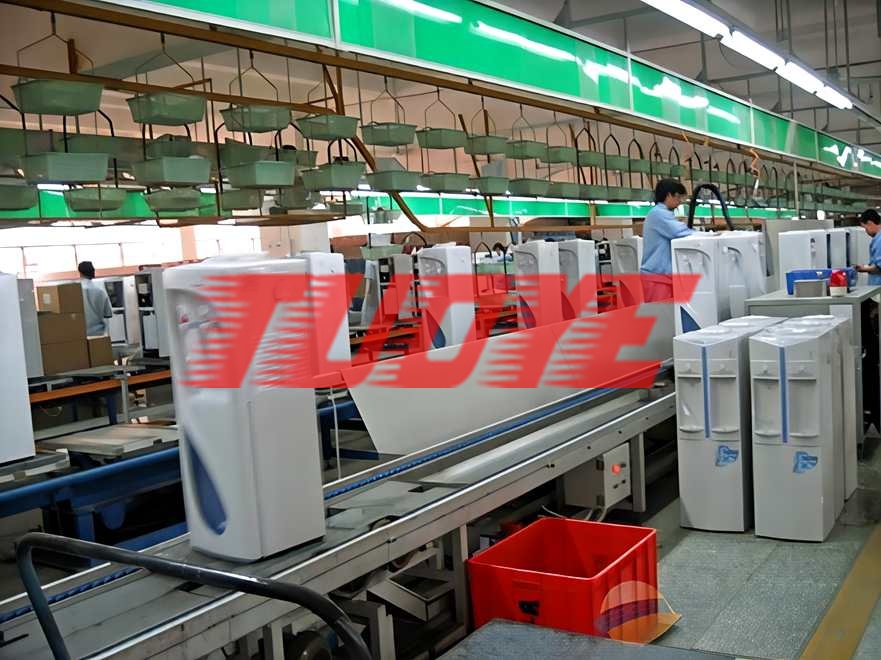
Look at the photo of this water dispenser production line's final assembly: a speedchain carrying white floor-standing units (about a meter tall, smart seat on top, tap bay up front), some models with blue trim; most striking is the overhead chain — green parts boxes strung along the aerial track, injection-molded parts flying from the molding shop straight to station tops, operators reaching up for parts with zero floor traffic; the line-tail zone holds test vessels and fixtures where powered water testing happens, 6-10 stations overall. Assembly sequence: shell on line (top and bottom joined) → water circuit assembly (silicone tubing, clamps, tees) → heater tank and thermostat → cooling vessel (hot-cold models) → taps and drip tray → smart seat and float valve → dry-burn protection and thermostat test → powered water test (heating speed, flow rate, seal check) → appearance and nameplate → packing. The water-test stations on the water dispenser line run recirculating water loops, blow-drying units before they enter packing.
3. Customization & Service
Customization: pallets in dual specs for floor-standing and countertop; water-test sections with supply, drain and power per station count, leak testing by air hold or helium per the customer's standard; tea-bar-machine pump and valve stations extended per model. Tuoye — in Wenling, Taizhou, Zhejiang, China — delivers the water dispenser assembly line from in-plant pre-assembly and commissions through trial production, warranty one year, pallets and speedchain parts supplied long-term; adding water-test sections or converting to overhead feeding are taken too. For a quotation, send the model mix (hot / hot-cold / tea bar shares) and daily program — the test section's recirculating water system comes designed in.
One more word on overhead feeding: molded parts delivered by air straight to the stations is mature practice in the dispenser trade — no floor trolleys, no porters, and once logistics flow clean on the water dispenser assembly line, the beat holds; parts boxes numbered per station, missing-part boards obvious at a glance. Silicone joints take unified specs with double clamping, and water-pressure hold tests pass unit by unit — push leak rates below a few per thousand on a water dispenser production line, and the after-sales savings buy the line back within a year. Heater-tank stations run grounding and insulation double-tests with dry-burn protectors sampled for action temperature — safety items whose ex-factory records stay filed by batch, ready for any check.