
1. Product & Industry Overview
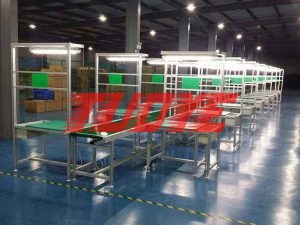
Never look down on a belt line — the "capillaries" of an electronics workshop are almost all belt conveyors. A belt conveyor assembly line is the most basic and most universal assembly carrier: motors, small appliances, lamps and instruments are assembled and tested, nine times out of ten, on a belt line plus workbench combination. The trade also calls it a belt conveyor line; the forms split several ways: flat belts for straight conveying, ESD belts for electronics stations, bench belts for assembly work, and curve and incline belts as the connectors of a workshop layout — one shop's material flow is stitched together from these belt assembly lines.
Choosing comes down to three things: belt surface, speed, workbench. Light loads within 50 kg per meter take light PVC belt; electronics plants use ESD PVC/PU; food plants switch to food-safe PU. Speed commonly spans 0.1-10 m/min with electronic or VFD control set to the beat; benches go single or double side, with width, lighting and boards following the process. Belt width follows the product lying across plus margin — 150-500 mm covers most electronic and mid-small appliance parts, wider on request; heavier loads move up to multi-ply belting or closer idlers, with width and thickness following the load.
2. Process Flow (see photo)
The photos show two states of a belt conveyor line. First: green PVC belt on silver aluminum-extrusion frames, lighting trusses overhead with one process board per station, white ESD workbenches along the line taking assembly work, multiple lines extending side by side into the shop — the classic electronics assembly configuration. Second: the bare line — aluminum frame, green flat belt, gear motor at the end, adjustable feet on the floor, freshly installed and not yet wired: the structure plain to read.
In use, a belt conveyor assembly line does far more than convey: lay fixtures on it for assembly stations, feed an inspection-packing bench at the tail, link lines as transfer sections, and with stop-and-locate units it becomes a paced production line. Electronics plants' insertion lines, touch-up lines, conveying before and after burn-in, and finished-goods packing lines are all variations of the belt conveyor; for small products, a properly speed-controlled belt line is the most economical production metronome there is.
3. Customization & Service
Tuoye's belt conveyor lines, built in Wenling, Taizhou, Zhejiang, China, are made to order: length to the process plan, width to the product, speed to the beat, with workbenches, lighting, process boards and ESD mats selectable. Standard sizes ship on short lead times, and workshop layouts needing curves and incline connectors are handled too. Warranty one year; belts, idlers and speed controllers supplied long-term; small retrofits — re-beltting, extensions, speed-ups — taken as they come. For a quotation, give three numbers: length, width, speed — pricing comes back the same day.
Two notes from belt lines. First, the splice: order belts with margin and splice by hot vulcanization or mechanical fasteners — a casually cold-glued splice starts curling in a few months, and from then on the belt tracks crooked forever; how honestly this one joint is made largely decides how the belt conveyor line runs. Second, the order of tensioning and leveling: level the feet first, then tension evenly — uneven tension sends the belt wandering three times a day. Correcting drift is routine; preventing it is craft — get these two right and a belt assembly line runs ten years without a temper.