1. Product & Industry Overview
A cabinet plant cuts dozens of mixed orders a day, and whether the line stays sane depends entirely on panel flow. The job of a kitchen cabinet assembly line — really a conveying backbone — is chaining nesting, edge banding, drilling, sorting and order grouping into one never-grounded stream: from the nesting saw to the packing truck, panels ride rollers the whole way, because every time a panel touches the floor it gains one dent and one handling. The trade also calls it a panel furniture production line, and the order mix sets the shape: whole-house custom work (wardrobes, tatami, bookcases) is mixed-order production — panels are nested in batches to save board, then must be sorted back to orders after drilling; project batches (apartments, hotels) repeat cabinet types and belong on a high-volume lane. Lane count and sorting scale on a custom furniture conveying line follow the ratio of those two order types.
The panel-furniture chain runs: nesting (CNC saw or machining center) → edge banding → drilling (line drill or six-side drill) → sorting → packing. The six-side drill is the link pin: it scans the panel's bar code and drills all six faces in one clamp, while sorting stations group by scan — an order packs only when all its panels have gathered. The conveying system of the cabinet production line is this chain's skeleton: rollers sized to panel dimensions and stack weight, docking heights aligned to each machine's outfeed.
2. Process Flow (see photo)
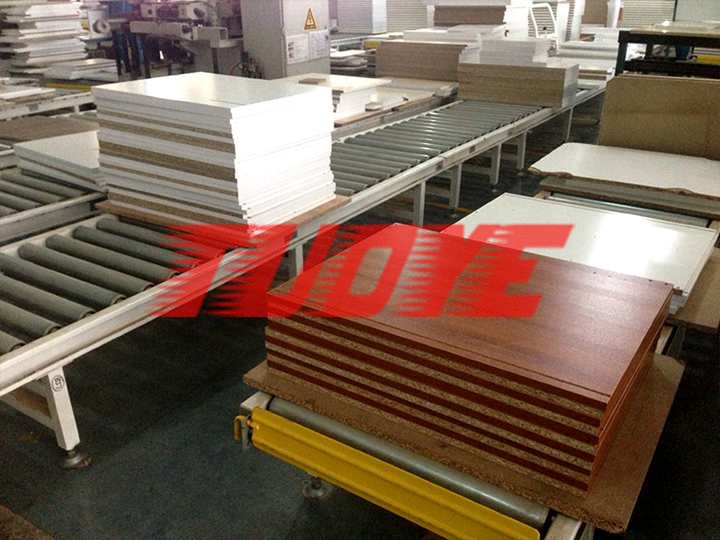
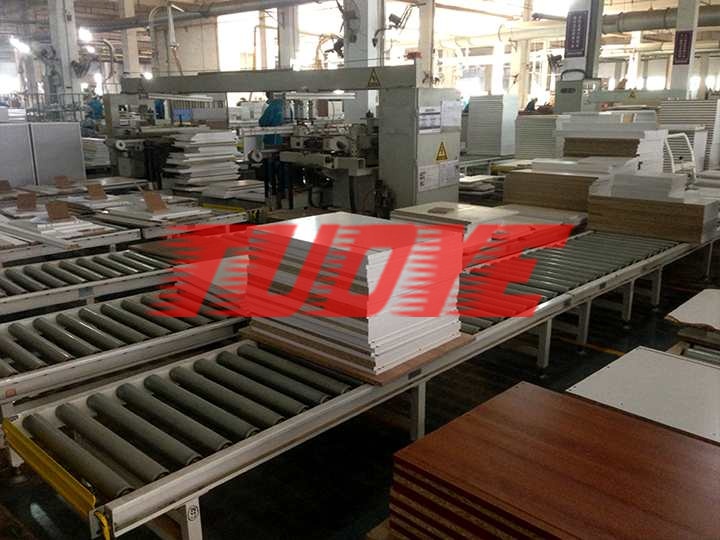
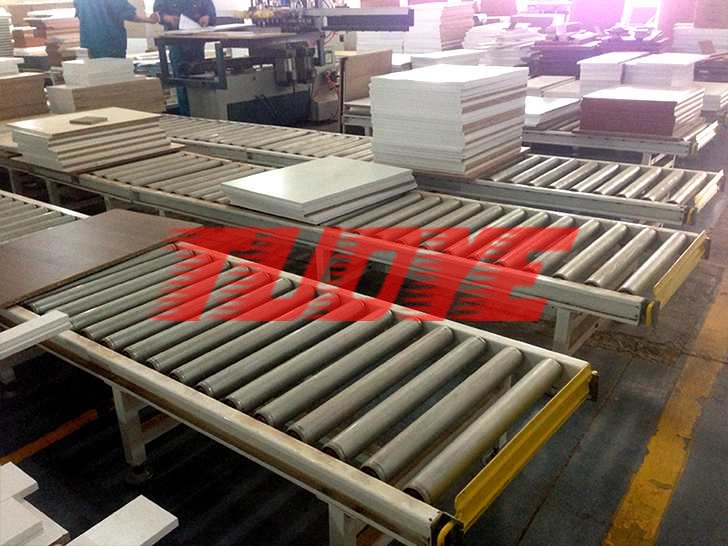
The photos show three states of the panel section. First: three roller lanes docking a CNC drilling-class machine, panel stacks buffering on the line and feeding sheet by sheet, workers in blue loading and unloading on a deep-green wear-proof floor. Second: multiple roller lines extending side by side, feeding the edge banders, white stacks and wood-grain stacks zoned in buffer, 18 mm panels gliding flat along the rollers. Third: an inspection position with a single panel laid flat for edge-quality check, the yellow end section doing transfer and stacking, wooden pads separating stacks against scratches, and adjustable feet leveling the line. Panel flow sequence: nesting outfeed (bar code applied) → rollers to edge bander → back through inspection (edge check, scraping) → six-side or line drilling → sorting station scanning to order groups → stacking and packing → carcase assembly positions. On a cabinet conveying line the sorting station carries the highest technical content: fit it out with scanners, screens and pick-to-light, and sorter error rates drop immediately — the rework saved on missing or wrong panels far outweighs the cost of that kit.
3. Customization & Service
The kitchen cabinet conveying line is engineered to the workshop column grid and machine list: docking heights to the outfeeds of nesting saws, banders and six-side drills, lane count to daily order volume, roller spec to stack weight and smallest panel. Tuoye, in Wenling, Taizhou, Zhejiang, China, delivers the panel furniture production line layout with in-plant pre-assembly and on-site commissioning through acceptance, warranty one year, rollers and leveling feet supplied long-term; docking retrofits for new six-side drills are frequent work. For a quotation, send the machine list and workshop dimensions.
Two rules from panel lines. First, check roller pitch against the smallest panel — with standard 16/18 mm panels, oversized pitch lets small pieces drop through and jam the line, and one emergency stop costs a whole order batch its schedule. Second, never let stacks dwell on the rollers — a cabinet production line is flow, not warehouse: a stack sitting on rollers for a week presses marks into the roller faces, and every panel after that rattles through. Plan stack positions beside the rollers, never on them.