
1. Product & Industry Overview
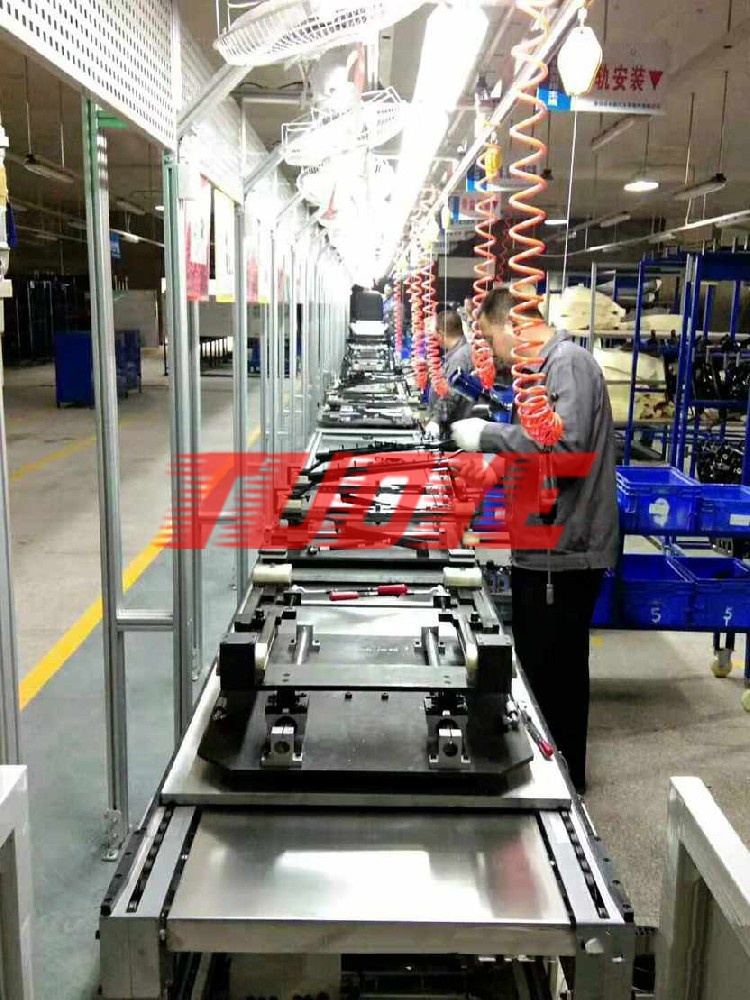
Supplying seats to an OEM plant runs on JIT — line-side inventory is counted in hours, and if the cycle on the car seat assembly line does not hold, the whole supply chain suffers. The car seat assembly line (also called a car seat production line or automotive seat assembly line) carries frames, foam cushions, trim covers, headrests, slides and recliners through to the finished seat; Tuoye's seat production lines in Wenling, Taizhou, Zhejiang, China are designed for multi-model mixed production.
A seat looks simple until you open it up: frames are mostly rolled profiles or welded steel plate, anchored to the body through slides and recliners; cushions and backrests are polyurethane foam parts, foamed in molds from two-component material; a premium seat set carries a thousand-odd parts, with heating, ventilation, memory adjustment and occupant sensing all inside. Seats are also fiercely model-specific — one car seat assembly line often mixes parts from three to five models, and unless pallets and traveling fixtures are built quick-change, changeover time alone eats the capacity alive.
2. Process Flow (see photo)
The photo shows an aluminum-extrusion speedchain seat line: black pallets carry seat sets along the chain, traveling fixtures and locating blocks holding each seat in assembly attitude; fluorescent strips overhead push lighting to working level, red spiral air hoses feed pneumatic balancers, and electric tools hang weightless in the air — hundreds of tightenings a day without wrecking the operator's arm. Ergonomics done well or poorly shows up directly in output and in missing-part rates. Blue stackable bins and foot-pedal trolleys wait at the line side, and a finishing bench closes the line end. Assembly sequence: frame on line → slides and recliners → motors and harness (power seats) → foam cushion and backrest → trim cover fitting and clips → headrest, belt buckle → function test (adjustment, heating, ventilation) → appearance inspection → packing and off-line. Seat assembly lines commonly run 45-120 seconds per set; once the cycle presses down, tightening quality has to be backstopped by smart electric screwdrivers with archived torque data — whatever the OEM's traceability audit asks for, it is there.
3. Customization & Service
Customization points on the car seat assembly line: traveling fixtures made to each model's locating points, quick-change by design; powered stations with reserved outlets and harness test ports; the line end extendable into function test benches and a packing section, docking AGV feeding. To propose an automotive seat assembly line, Tuoye takes three inputs — seat product range (row 1/2 complete seats, passenger seats, commercial vehicle seats), cycle-time target, workshop conditions — then returns the full-line layout, equipment list and quotation. Equipment is pre-assembled and trial-run in our plant, commissioned on site through trial production, with operation and maintenance training. Warranty one year; speedchain parts, pallets and traveling fixtures supplied long-term. Frame lines and foam lines can be planned in the same project. Plants building seat frame lines or upgrading old seat production lines for speed: send current photos and the pain points, and the diagnosis comes before the proposal.
One number says it all: changeover time. A car seat assembly line mixing three to five models lives and dies on its traveling fixtures — quick-change fixture sets switch a model in a dozen-odd minutes; old bolt-down designs burn two hours. In Tuoye's car seat production line proposals, fixture quick-change is a default, not an option. Another routinely underestimated item is lighting: at the trim-cover inspection station, insufficient lux lets color shift and wrinkles slip through — then the OEM's claim note arrives. The lamp over the end-of-line inspection point on a seat assembly line is worth spending extra on. One more note on capacity matching across frame, foam and final lines: if frames cannot keep up, the fastest seat assembly line idles — the three lines' cycles must be calculated together, and that is the biggest difference between a seat production line project and a single-line quotation.