
1. Product & Industry Overview
Bus fleets are bought in whole batches of a single model, and the production rhythm has nothing in common with car plants — one line runs one model for months, so the flexibility of a city bus assembly line lives in quick-change tooling. The bus assembly line (also called a coach final assembly line) covers the whole final assembly from body marriage to whole-vehicle off-line; vehicles follow GB 7258, with battery-electric buses adding GB 38032 — battery compartment protection and insulation monitoring checked item by item. The types: 8, 10 and 12 meters are the city backbone, with battery-electric taking most new orders and hybrid plus hydrogen filling in; BRT variants add door positions, and low-floor models change the chassis layout entirely. The process center of an electric bus production line is the "three electrics": battery pack hoisting and high-voltage connection, drive motor and control unit seating, whole-vehicle insulation and charging checks — these blocks set the delivery rhythm.
2. Process Flow (see photo)
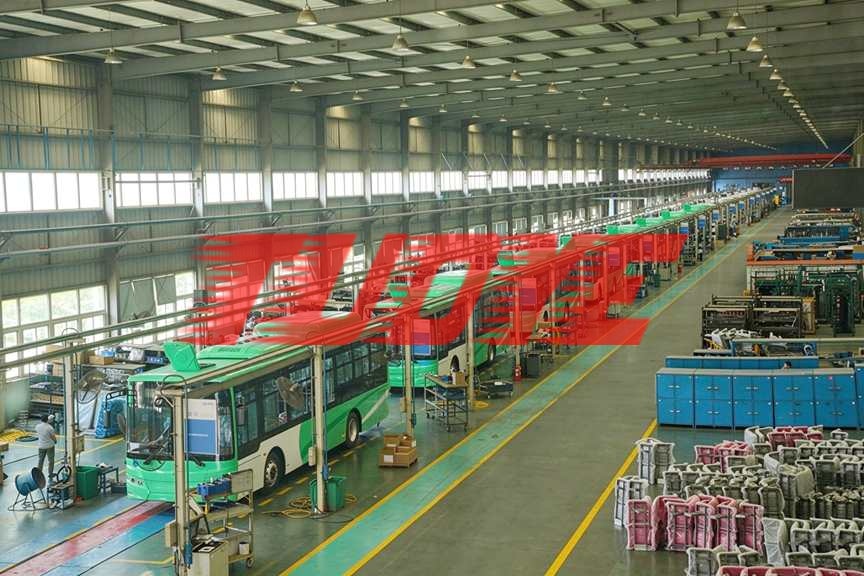
Look at the photo of this bus production line's final assembly: floor-embedded rails run the shop, and the red pit beneath each body lets workers climb under to fit piping and battery compartments — the classic pit-type station practice of the coach industry; light-green 12-meter buses queue in file, roof air-conditioning units seated, some vehicles mid-way through dashboards and tires; on the right, seat assemblies in pink wrapping stand stacked for fitting, blue tool and test cabinets line the lane, and a bridge crane at the end handles heavy lifts, yellow markings zoning the logistics lane — an estimated 10-14 stations. Assembly sequence: body lifted on line → chassis powertrain (battery packs / motor / controls) → high-voltage harness and piping → roof air-conditioning and electrical bay → side windows and windshields → trim (headliner, light strips, handrails) → seats and guardrails → pneumatics and door tuning → whole-vehicle insulation and charging check → water test → road test and off-line.
3. Customization & Service
Customization: station spacing by vehicle length (a 12-meter and an 8-meter differ by nearly a third), pit construction per the site's geology, battery hoisting and charging-check stations per the three-electric process. Tuoye — in Wenling, Taizhou, Zhejiang, China — issues the bus line's station steelwork, pits and hoisting as one drawing package, ships from in-plant pre-assembly and commissions through trial production, warranty one year, station tooling and hoist parts supplied long-term; electrification retrofits of existing coach lines (added battery hoists, insulation checks) are frequent work. For a coach final assembly line proposal, send model range, annual program and workshop span — pit depth and hoisting tonnage come calculated in the plan.
Heavy-part logistics on a bus assembly line deserve their own paragraph: body, battery pack and roof AC — all three run over-wide and over-tall — so line-side lanes are sized for full-unit transfer carts, and hoist points split duties: bodies by bridge crane, batteries by fixed-point hoists; cross the two and the work tangles. The water test is the hard gate of coach delivery — the spray room on a bus production line works to side-spray intensity, door and window seal failures surfacing on the spot; battery-electric models finish insulation resistance and charging commissioning before off-line so the road test passes first time — the delivery cycle of an electric bus production line is clawed out day by day exactly here.