
1. Product & Industry Overview
Micro EVs now sell tens of thousands of units a month per model, and the questions facing a compact EV assembly line differ from the big plants — small vehicles, fast cycles, and the line investment still pressed tight. The compact EV assembly line (also called a small electric car or micro EV production line) covers body conveying and storage between welding, paint and final assembly; the vehicles follow GB 18384 electric vehicle safety and GB 38031 traction battery safety. The types: A00 two-box micro cars around three meters serve city commuting and ride-hailing; A0 compacts a touch over four meters step up in range and trim; below them, low-speed EVs are entering standardized administration, and upgrade conversions of their lines are surfacing as demand. The signature of a small electric car production line: light bodies and fast model turnover — on the overhead storage section, carrier quick-change and flexible buffer slots matter more than load rating.
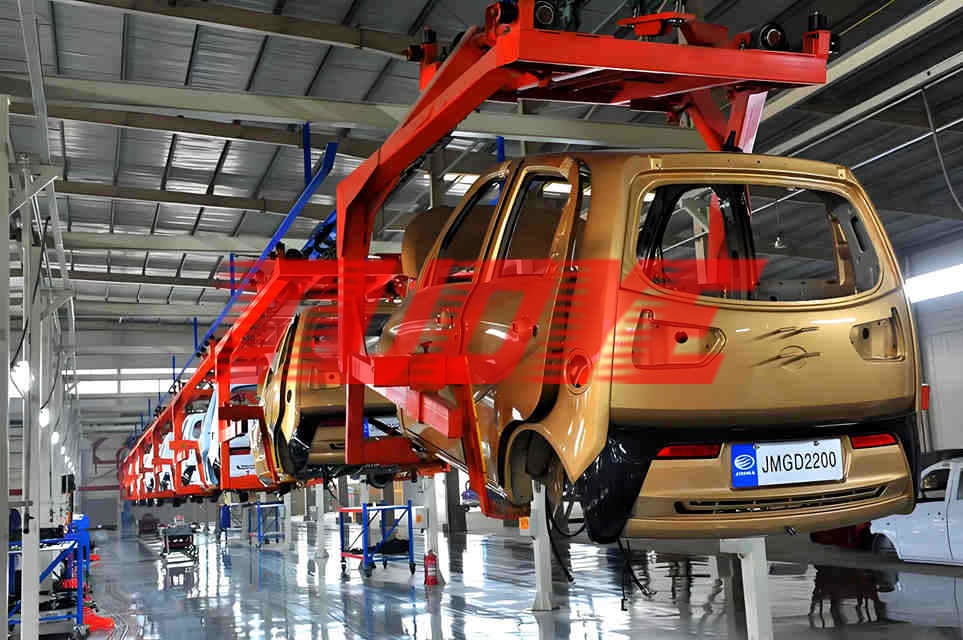
2. Process Flow (see photo)
Look at the photo of this compact EV production line's body storage section: a power-and-free conveyor on high track, red C-carriers cradling gold-painted bodies in queue — two-box micro cars around 3.5 m long, model tags hanging at the tail, the PLC reading tags to sort body and color; the red lift gantry in the foreground moves bodies between high track and floor stations, blue track columns running the length, the floor left whole for work lanes and auxiliary stations — six-plus bodies in view and thirty-odd buffer slots beyond. The flow of such handover sections: BIW off welding onto carriers → power-and-free conveying into paint pretreatment → e-coat and topcoat sections → painted-body buffer → lift gantry down to the trim section → trim and chassis marriage → test line and out. On a micro EV assembly line, the storage section is conveyor and reservoir at once — when the shops on either side beat out of step, it absorbs the waves.
3. Customization & Service
Customization: carriers built to body locating points with quick-change component sets (micro platforms restyle yearly — quick-change is a requirement, not an option); track routing, lift sections and switches drawn to the workshop and process; conductor rail and collectors sized to live-work needs; hybrid docking with floor plate chain, EMS trolleys or AGV configured per project. To propose a small electric car production line and its storage section, Tuoye — in Wenling, Taizhou, Zhejiang, China — takes vehicle platform, JPH and plant steelwork conditions, with track point loads cross-checked against the building designer; that step cannot be skipped. Equipment ships after in-plant pre-assembly and trial runs, load-tested on site after track installation and accepted with trial body production, warranty one year, carriers, collectors and chain spares supplied long-term.
One piece of account-keeping from micro-EV lines: size the buffer count to the beat difference between paint and trim, with margin — never to the average cycle. Densifying slots on a compact EV assembly line after it is built costs far more in steelwork and stoppage than building full-size once. Give the body-recognition system a redundant tag reader ahead of each switch — a misrouted body wastes more labor than anything else on the line. And make the carriers' locating blocks serialized to each model's pin holes: on the micro EV assembly line, a model change swaps only the locating set, done inside two hours — write that flexibility figure into the acceptance terms and sleep better.