
1. Product & Industry Overview
A harvester works one season a year, and a combine harvester assembly line plans capacity backwards from that peak — a single month's deliveries before wheat harvest can equal half the year. The combine harvester assembly line (also called a combine harvester production line) completes whole-machine marriage; performance follows GB/T 8097 for combine harvester test procedures and evaluation, with corn harvesters additionally governed by GB/T 21962. The types: wheel-type wheat harvesters take high feed rates and speed, built for the big North-China plains; tracked rice harvesters bring the passability that deep paddy mud demands; corn harvesters split into ear and grain-direct classes; rapeseed and soybean specialists round out the family. Quality control on a combine assembly line concentrates in the balanced assembly of threshing cylinders, the header-lift hydraulics, and the drive alignment of the straw-walker and cleaning mechanism — a machine down during harvest costs far more than the repair bill.
2. Process Flow (see photo)
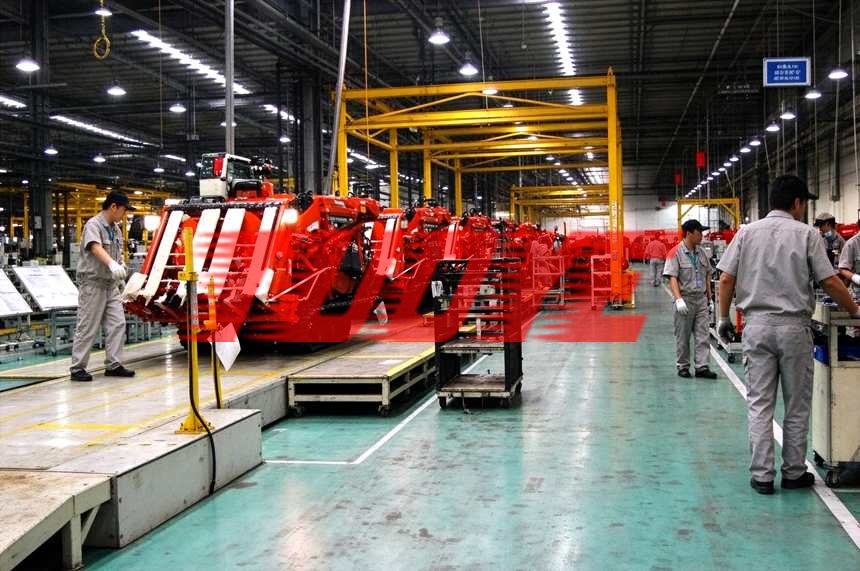
Look at the photo of this combine harvester production line's late marriage section: a raised bench-style line, steel deck with yellow-black edging, heavy machine parts riding the surface; a red tracked combine sits in late marriage — header reel, threshing body and cab all partly assembled, and the yellow gantry spans the line for heavy-part lifts; 8-15 stations blocked by assembly, headers of two-to-three hundred kilograms landed by the gantry. Assembly sequence: frame and tracked chassis on line → engine seated → drives (belts, chains, unloading auger) → threshing cylinder and concave assembly → cleaning sieve and augers → cab mating → hydraulics (header lift, unloading cylinders) → header marriage and docking → electrics and controls → whole-machine idle trial run → appearance check and storage. The trial-run stations on a grain harvester assembly line let the threshing, cleaning and unloading mechanisms run in unloaded — rattles and leaks surface on the spot.
3. Customization & Service
Customization: deck loading rated to machine weight (tracked combines run 5-8 t), gantry tonnage and span set by header/cab marriage, trial-run stations loaded per model. Tuoye — in Wenling, Taizhou, Zhejiang, China — schedules combine harvester assembly line delivery backwards from the farming season, ships from in-plant pre-assembly and commissions through trial production, warranty one year, benches, hoists and hydraulic parts supplied long-term; pre-season emergency expansions of existing lines are taken too. For a quotation, send the model range and peak-season daily capacity — whether delivery lands before wheat harvest gets a straight answer in the proposal.
Heavy-part logistics on a harvester assembly line deserve dedicated design: headers and unloading augers, the over-length parts, never cross the line by crane — run a dedicated lane along the shop edge, and let the gantry handle only the fixed-point lifts at marriage stations, so on-line and off-line flows never cross. Trial-run experience: idle tests load in two steps — low speed first to catch leaks and rattles, then working speed to trim drive balance — with quick-change parts per model family so switches don't stop the grain harvester assembly line. Before delivery of a combine harvester production line, disclose the peak figures of both harvest seasons — station and trial-run counts sized to the peaks, and running half a line off-season loses nothing.