
1. Product & Industry Overview
The power tiller's home ground is hills, greenhouses and orchards, with demand bunching before two farming seasons a year — a power tiller assembly line is sized to the peak and must retool for something else in the slack. The power tiller assembly line (also called a mini tiller production line) completes whole-unit final assembly from frame on-line through start and run-in; products follow GB 10395.10 walk-behind tiller safety and JB/T 10266 for mini tillers, the class covering all hand-guided machines below 7.5 kW. The types: gasoline models (168F, 173F power) sell light and easy; diesel versions carry torque and endurance; electric tillers scale up with lithium going rural; by structure, front and rear blade shafts split, and garden management machines swap on ridging, ditching and backfill implements for one-machine-many-jobs. Quality control on a mini tiller assembly line sits in gearbox gear mesh and engine-coupling concentricity — a machine that shakes and roars in the field owes it, nine times in ten, to those two assemblies.
2. Process Flow (see photo)
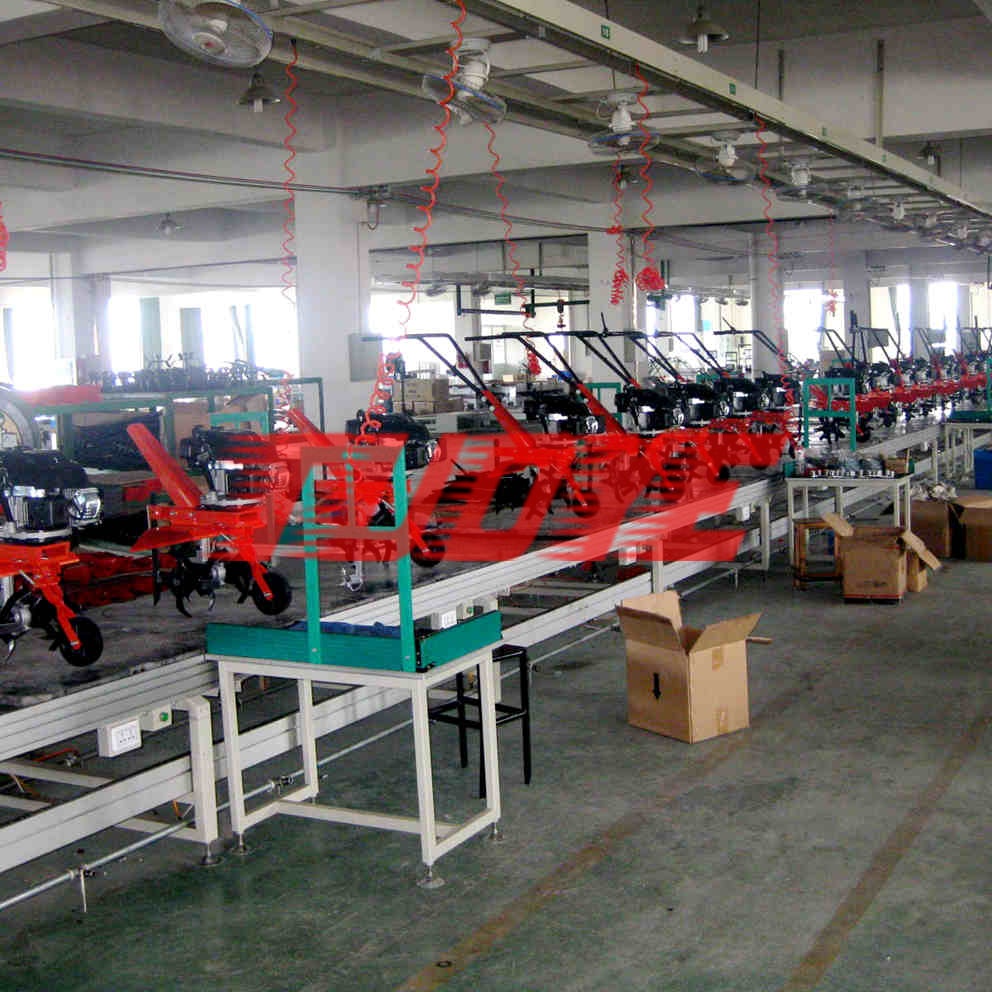
Look at the photo of this power tiller production line's final assembly: a white-frame plate chain running thirty-odd meters straight, red-framed complete tillers (black single-cylinder engines, adjustable handlebars, rotary blade shafts, gauge wheels) seated on pallets at even spacing, an estimated 15-20 units on line; white bridge decking overhead carries lighting and junction boxes, red spring balancers every two meters hanging an air tool each, green-top benches and racks at the side, packing cartons on the open floor at the tail, 18-25 stations overall. Assembly sequence: frame on line → engine hoisted and fixed (belt or direct-coupled) → gearbox assembly (mesh check, oil fill) → clutch and shift controls → handlebars and throttle cable → blade shaft and tines (torque fastened, left/right blade direction verified) → gauge wheels and guards → fuel filled, start and run-in → rattle and leak check → washing, nameplate, packing. Never skip the run-in station on a mini tiller production line — a few minutes of engine-and-blade-shaft turning surfaces gearbox burr-noise and joint-face seepage on the spot.
3. Customization & Service
Customization: pallets made to frame locating holes, engine hoist positions compatible across gasoline and diesel; air-tool suspension, balancers and racks per station; the tail run-in zone designed separately for exhaust and fire safety, the packing section running straight to finished goods. Tuoye — in Wenling, Taizhou, Zhejiang, China — delivers the power tiller assembly line from in-plant pre-assembly and commissions through trial production, warranty one year, pallets, plate chain and balancer parts supplied long-term; pre-season station additions and model-change tooling rework are taken at short notice. For a quotation, send the model range (power type, blade shaft width) and peak daily capacity — run-in station counts come calculated in the proposal.
A word for export models: the power tiller assembly line lists a dedicated check item for target-market safety markings (warning labels, e-stops, guard interlocks) — European and American orders specify different guard and stop configurations than domestic, and one missing piece means a whole container returned. At the gearbox station, oil filling goes metered and recorded — volume deviation writes straight onto gear life; a metered oiler at this station costs little and saves a drawer of rework. Lock the pre-season delivery peak into a backwards schedule with plenty of run-in margin — when the busy season opens at full throttle, a mini tiller production line that never stops is what makes the year's account balance.