1. Product & Industry Overview
The subsidy catalog for plant-protection drones rolls over yearly — models iterate fast, single units carry high value, and on a drone assembly line flexibility outranks speed. The drone assembly line (also called a UAV assembly line) completes multicopter assembly from frame to flight test; quality evaluation of plant-protection machines follows NY/T 3213, the same code behind subsidy-class testing. The types: 22-50 L tank electric multicopters are the plant-protection backbone, folding arms and modular tanks; fuel-burners carry more and fly longer; in industrial applications, surveying machines bring RTK and five-lens rigs, inspection machines carry infrared and zoom gimbals, logistics machines go heavy-load short-haul. Quality control on a multicopter assembly line sits in three places — motor/ESC consistency, propeller balance, and flight-control/RTK calibration; nine crashes out of ten trace back to the assembly section.
2. Process Flow (see photo)
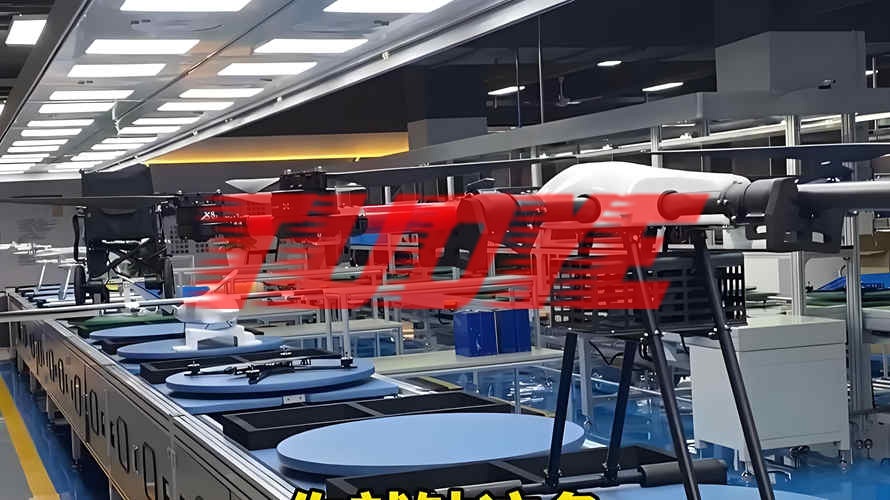
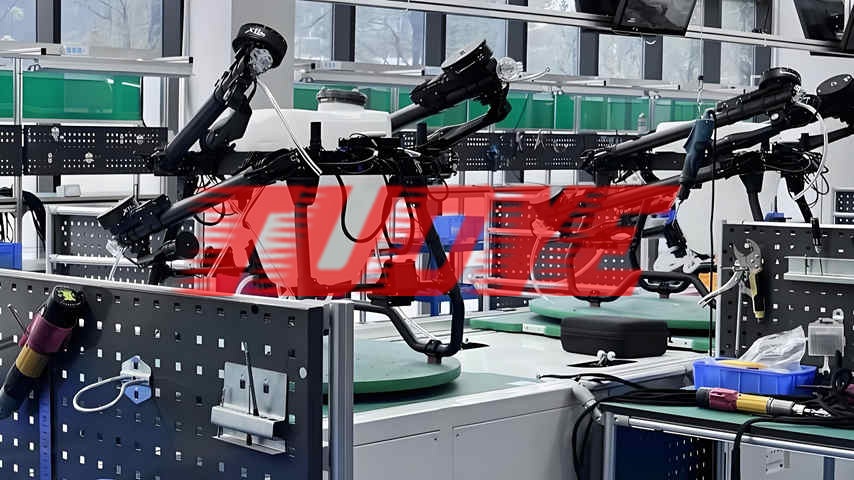
The photos show two sections of one drone production line. First: speedchain with blue-green round pallets that rotate for four-arm working; industrial multicopter bodies build from frame and motors through to cowling, the black three-point stand on the right a whole-unit bench test position locking the props nose-down for power testing; blue ESD flooring and pegboard racks at every station. Second: mid-late final assembly, the white spray tank on the green rotary pallet unmistakable — a plant-protection model with folding carbon arms spread, props off; electric drivers hang from balancers for zero-gravity work, MES terminals and SOP boards at the stations. Assembly sequence: center frame assembly → motors and ESCs mated (torque-uniform) → flight control / GPS / RTK installed and wired → arm-folding mechanism → tank and spray system (pump, nozzles, plumbing) → cowling and landing gear → whole-unit bench power test → flight-control calibration → flight test → cleaning and packing. The spray system on a plant-protection drone assembly line gets flow calibration, each nozzle's flow deviation written into the ex-factory record.
3. Customization & Service
Customization: pallets made to wheelbase, rotary tables optional; the test section sized with bench slots and flight-ground connection; ESD configured to finished-electronics class (pallets, wrist straps, ionizers). Tuoye — in Wenling, Taizhou, Zhejiang, China — delivers the drone assembly line from in-plant pre-assembly and commissions through trial production, warranty one year, pallets and test stands supplied long-term. For a quotation, send machine parameters and monthly capacity — test-section and assembly-section beat balancing comes calculated.
The test section is the capacity throat of any drone line: bench slots get quick-change fixtures by wheelbase, and the flight-test ground's connection to the shop flow is drawn on the layout before anything else. ESD on the multicopter assembly line goes full finished-electronics class — floor, pallet and wrist strap on three-point grounding, ionizers set at the propeller stations, because the static dust-attraction of carbon and plastic parts writes straight onto appearance yield. The spray-flow calibration bench on a plant-protection drone assembly line carries adapters per nozzle type, with calibration data fed to MES for archive — subsidy inspections want the records callable. And when a drone production line expands, expand the test section first: assembly grows quickly, the test section lags, and that is the classic jam of this trade.