
1. Product & Industry Overview
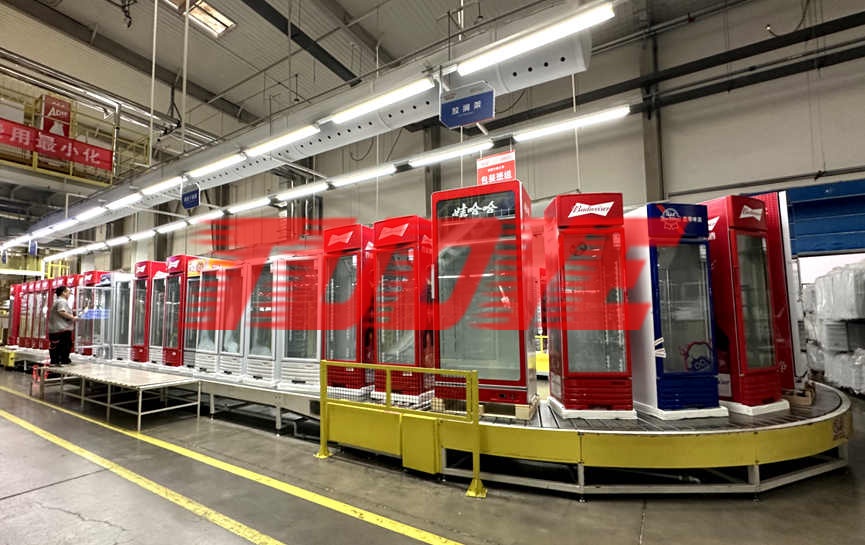
Commercial refrigeration rides on chain retail and the cold chain — every convenience store opened grows cooler demand a notch, and inquiries for commercial display cooler assembly lines have tilted visibly toward custom models these two years. The commercial display cooler assembly line (also called a refrigerated display case assembly line) completes cabinet, refrigeration system, electricals and whole-unit powered testing; performance follows GB/T 21001.2 for refrigerated display cabinets, with temperature band and heat rejection measured before ex-factory. The types: vertical glass-door cases for beverages and dairy run the biggest volumes; open-front multidecks trade convenience for demanding air-curtain performance; horizontal freezers take sliding glass lids; and fresh-food, cake and pharmacy cool-room cases each carry their own temperature bands. Quality control on a display cooler line sits in three places — the insulation performance of the polyurethane foam layer, the welding and sealing of refrigeration piping, and the precise control of charge weight; charging deviation writes itself straight into the pull-down curve.
2. Process Flow (see photo)
Look at the photo of this commercial refrigerator assembly line: a loop slat-top chain with 90-180° curves, yellow guardrails along the way, heavy cabinets riding the loop with stations blocked out by system; the shot catches the late final assembly of vertical glass-door beverage cases in custom red — appearance parts complete, flowing toward final check, labeling and packing, 8-12 stations. Assembly sequence: cabinet on line (foamed body incoming) → refrigeration system assembly (compressor, condenser, evaporator, capillary welding) → nitrogen hold & leak check → vacuum evacuation → metered refrigerant charge (electronic scale) → thermostat and lighting electricals → powered pull-down test (curve recorded) → appearance final check → labeling and packing. Test stations on the showcase cooler line carry temperature recorders per case type — the time to pull down into the set temperature band is a hard ex-factory figure.
3. Customization & Service
Customization walks three lines: the model size spread, test-station count, and charging equipment — loop pitch sized to the largest case, test slots counted as daily program times single-case test duration, charging machines split by refrigerant type (R290, R600a, R404A). Tuoye — in Wenling, Taizhou, Zhejiang, China — delivers the commercial display cooler assembly line from in-plant pre-assembly and commissions through trial production, warranty one year, slat chains, guardrails and charger parts supplied long-term; loop-to-straight conversions and test-section expansions are taken too. For a quotation, send the case list, daily program and refrigerant types — the proposal even counts the test room's electrical load for you.
Cooler lines have an industry habit in layout: charging and leak-check sections go against the wall, nitrogen bottles, vacuum pumps and charging machines in one row, with dedicated safety ventilation — and when refrigerant types switch, the model tooling switches with them. The test section deserves a temperature-zone display board: every cabinet's pull-down curve scrolls on screen with over-time units auto-flagged — one post saved and fewer misses than hand-copying tables. If the commercial refrigerator assembly line takes export models, reserve the voltage-standard and nameplate stations early — 110 V/60 Hz test power configured before mass production, not after. Raise these details at proposal stage and Tuoye draws them into the layout.