
1. Product & Industry Overview
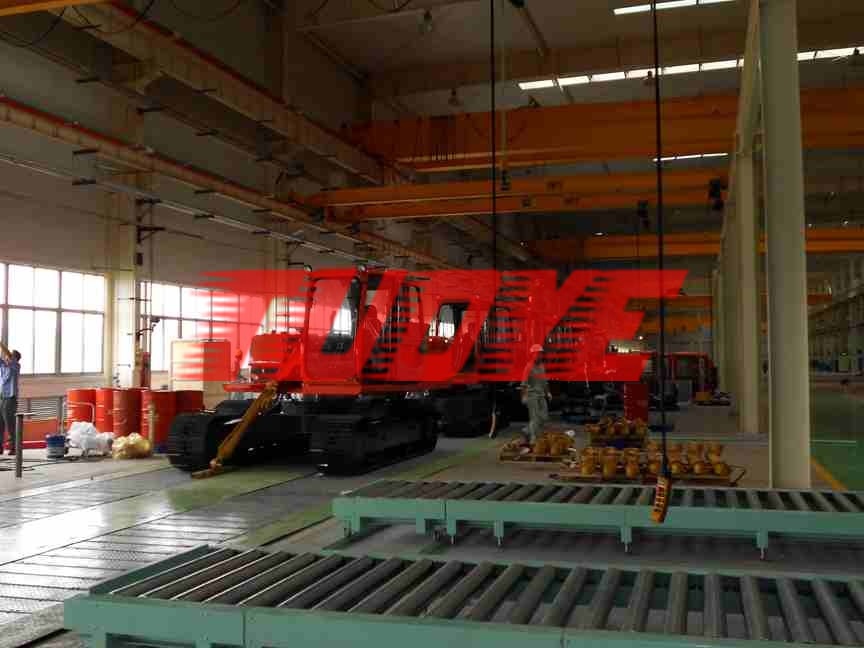
An excavator assembly line is one of the heaviest jobs a conveyor system can take on: machines from 6-ton minis to 36-ton tracked models all have to move down the same line. The line carries the complete build — undercarriage, swing platform, work equipment, hydraulics and electrics — and its takt time sets the plant's annual output. Crawler and wheeled excavators run on different build sequences, and mini excavator assembly lines are laid out very differently from heavy excavator production lines, so almost every line we ship is engineered around the customer's tonnage range and target capacity.
2. Process Flow (see photo)
A typical excavator assembly line runs in four stages: undercarriage, upper structure, work equipment, and testing. The chassis goes on first — drive sprockets, idlers, track rollers, carrier rollers and track shoes are fitted station by station, with track tension adjusted in line. The swing bearing is then torqued in diagonal passes to spec, with torque values recorded for traceability. Once the upper structure is married on, the engine, hydraulic pumps and cab drop in, and the boom and arm go on with pinned joints. The photo shows the line we build for this duty: a heavy plate conveyor carries finished machines nose to tail, a roller conveyor runs alongside for parts, and chain hoists plus an overhead crane handle the swing bearing and engine lifts. Hydraulic cleanliness is controlled to ISO 4406 / NAS 1638 through pipe flushing and filtered filling, and finished machines are tested against GB/T 9139 and GB/T 7586 before release, with engine emission and noise limits covered by GB 20891 and GB 16710.
3. Customization & Service
Most of the customization happens in five places: plate width and load rating follow the heaviest model on the line; station count comes from the takt you need — one machine every 20 minutes and one every 40 minutes are two different lines; lifting can be chain hoists, jib cranes or pneumatic balancers; the test end can grow hydraulic benches, electrical checks and a run-in station; and controls scale from simple interlocks to full PLC line control with MES reporting. Plants with an existing crane and foundation can often keep them and replace only the conveyor and affected stations. We also support SKD / CKD projects — the complete line, tooling and spare parts packed for container shipping, with our engineers doing assembly and commissioning on your site.
Send us the tonnage range, target capacity and building dimensions, and you get a layout draft and a budget band first. Every excavator assembly line ships after dry-run and load tests, with on-site commissioning until the line holds takt and spare parts held through the warranty period.