
1. Product & Industry Overview
Gas stoves are compulsory-certification products — since October 2020 nothing ships without 3C — and the test-station layout of a gas stove assembly line decides whether the certification audit passes. The gas stove assembly line (also called a gas hob production line) completes assembly and testing from hob base and valves to burners and finished unit; the product standard is GB 16410 for domestic gas stoves, with gas tightness, heat load, combustion condition and flame-failure protection all mandatory ex-factory items, and energy efficiency graded per GB 30720. The types: built-in double-burner hobs lead household sales, tempered-glass and stainless tops splitting the market; tabletop stoves serve the value segment; integrated-cooker stove bodies link with range hoods and need sheet-metal feeding at the front of the line; gas sources split natural gas, LPG and manufactured gas, with valves and nozzles classed accordingly. Quality control on a stove line sits in two gates — gas tightness, with every pipe joint passing the detector one by one, and combustion sampling for flame lift, flashback and flue-gas CO.
2. Process Flow (see photo)
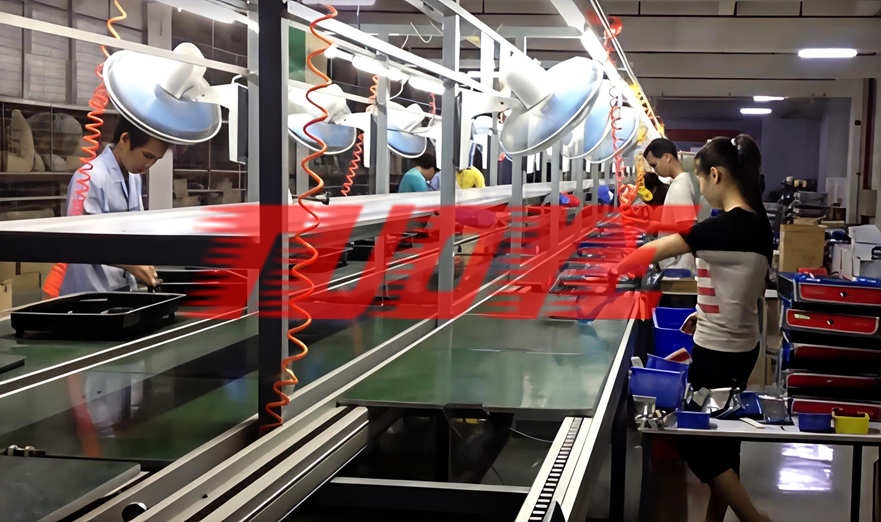
Look at the photo of this gas stove production line: dual-lane mixed plate-chain and speedchain, green worktops wearing well against scratches, built-in hob bases and valves flowing through pre-assembly; over the stations, lighting discs and extraction hoods form one unit — stove assembly involves live flame trials, and extraction is a hard requirement; orange spiral air hoses run the elevated line, gas cylinders and test benches set apart, 5-7 stations tightly spaced, a mezzanine above holding packing materials to save floor. Assembly sequence: hob base on line → valve and knob mechanism pre-assembly → burner and grate assembly → gas pipe connection and fixing → leak test (detector on every unit) → ignition and flame-failure device tuning → combustion sampling (heat load, CO) → panel cleaning and labeling → packing. The flame-test stations of a domestic gas stove line take separate enclosures with gas-concentration alarms — safety and process requirements alike.
3. Customization & Service
Customization: gas-source interfaces and flame-test stations to the local gas types, test benches selected against GB 16410 ex-factory items, dual-lane cycles computed from the daily program. Tuoye — in Wenling, Taizhou, Zhejiang, China — delivers the gas stove assembly line from in-plant pre-assembly and commissions through trial production, warranty one year, worktops and test-bench parts supplied long-term; adding leak-test stations or rebuilding flame-test enclosures on existing lines are done jobs. For a quotation, send models, gas types and daily capacity — the test-equipment list goes into the proposal.
Safety design on a stove line ranks ahead of output: flame-test stations independently enclosed, gas alarms interlocked with shut-off — both hard items at audits. Distributed leak-test benches beat one central unit on pace; every-unit checks on a gas stove assembly line run inside thirty seconds with bar-coded data archived, traceability down to the single unit. Model changeover on a stove line is mostly panels and valve modules: A/B-face locating on the worktops, swaps without stopping the household gas stove line. And when export models come aboard, reserve the nozzle-swap and nameplate stations in the layout — export lead times run tight, and on-site improvisation costs the schedule.