
1. Product & Industry Overview
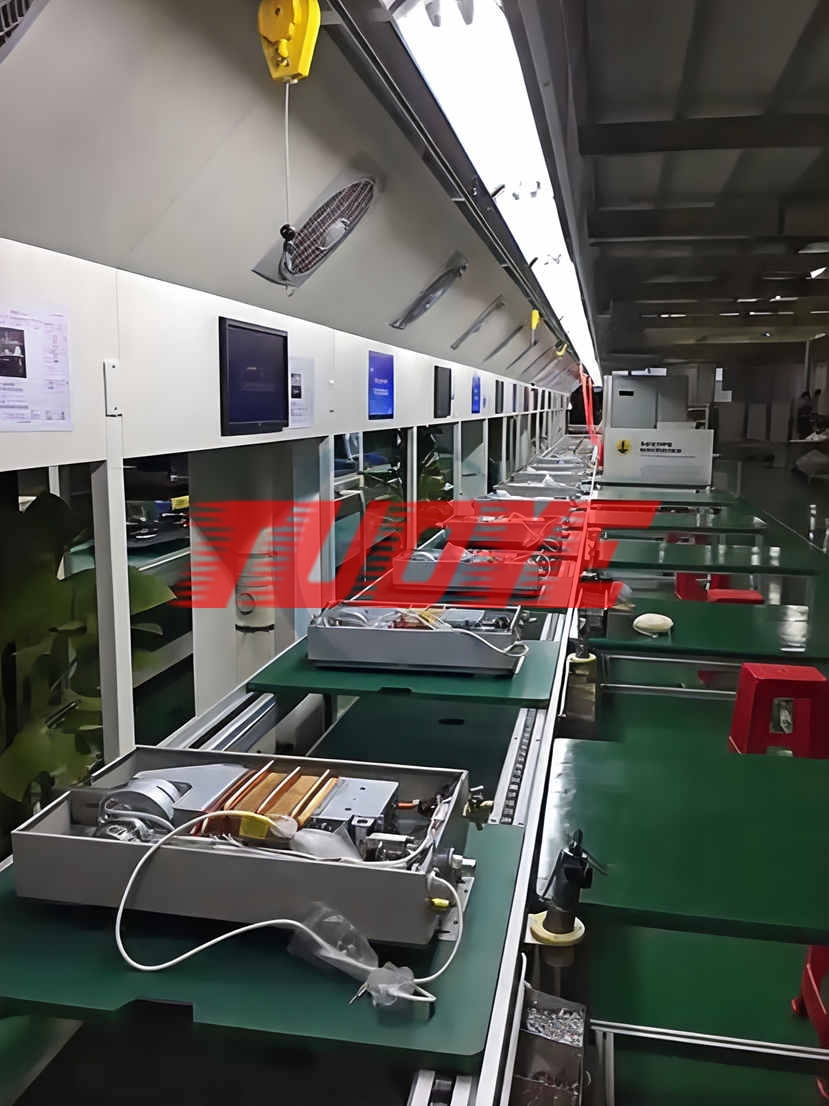
Stripped to its bones, a gas water heater is a heat exchanger plus a combustion system — but not one safety part can be spared, and on a gas water heater assembly line the test stations are worth more than the assembly stations. The gas water heater assembly line (also called a gas geyser production line) completes final assembly and tuning from shell, heat exchanger and burner through gas and water circuits to the whole unit; the product runs under GB 6932, with gas tightness, water-circuit pressure, electric strength, thermal efficiency and hot-water output as the heavyweight ex-factory checks, and efficiency graded per GB 20665. The types: 8-13 L forced-exhaustion units are the household volume models; constant-temperature machines add gas proportional valves and water servo valves holding temperature within ±1 °C; zero-cold-water models build in circulation pumps; 16 L-and-up units serve villas and multi-point supply. One distinction worth stating plainly against wall-hung boiler lines: heaters make hot water, boilers do heating plus hot water through a plate exchanger — the water circuits and test benches differ completely, and a water heater manufacturing line has no space-heating loop debugging at all.
2. Process Flow (see photo)
Look at the photo of this gas water heater production line in mid-to-late final assembly: speedchain with green pallets, thin-shell heaters building vertically on the boards; the copper finned heat exchanger already sits in the shell, the gray centrifugal fan mounted on the flue side, and the operator is wiring the harness — the electrical section; MES data runs on the station displays, SOP boards hang above, 15-20 stations blocked by system. Assembly sequence: shell on line → heat exchanger in and fixed → burner and nozzles → fan and flue pipe → gas and water connections (proportional valve, water valve) → igniter and control board wiring → gas-tightness test → water-circuit pressure test → whole-unit ignition tuning (efficiency and hot-water output sampled) → appearance check and packing. On the gas appliance assembly line, tightness runs unit by unit and water circuits hold standard pressure on the clock — both figures go into the ex-factory file.
3. Customization & Service
Customization: pallets by capacity class, test benches by gas type (natural / LPG) and inspection items, ignition-tuning stations with extraction and gas alarms. Tuoye — in Wenling, Taizhou, Zhejiang, China — delivers the gas water heater assembly line from in-plant pre-assembly and commissions through trial production, warranty one year, pallets and test-bench parts supplied long-term; retrofits adding constant-temperature tuning stations are taken too. For a quotation, send the capacity range and daily output — the test section's gas supply and extraction plan comes configured with it.
Gas supply on a heater line is a system: main line, distribution tanks and station-level metering in three tiers, with extraction interlocked at flame and tuning stations — configured once at design time on the gas appliance assembly line, it satisfies both the audits and the safety inspections. Test data on the water heater manufacturing line archives unit by unit — pressure-hold time, water-circuit pressure value and ignition success rate form the core of the ex-factory file, the evidence when after-sales disputes arrive. When the gas water heater assembly line expands, expand the test benches first: assembly stations speed up with people and tables, but test benches involve gas and water interfaces with long retrofit cycles — reserve test positions at 1.3 times the program and the later expansion never touches civil works.