
1. Product & Industry Overview
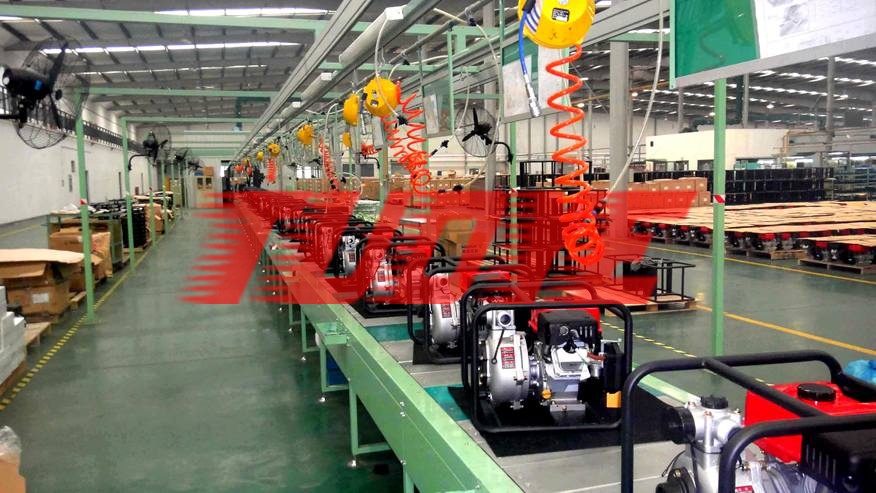
A genset that leaves the factory without a load test was assembled for nothing — that is the consensus of the generating-set industry, and the reason a generator assembly line must keep a test section. The generator assembly line (also called a generator production line or genset assembly line) builds engine, alternator, base frame and fuel tank, radiator and control system into complete sets; Tuoye's generator set assembly lines in Wenling, Taizhou, Zhejiang, China cover both open-frame and soundproof-canopy gensets.
Know the genset classes: by duty, prime power, standby (emergency) and mobile plants; by construction, open frame, soundproof canopy and trailer type. The number-one process node on a genset assembly line is the docking and alignment of engine and alternator — shaft concentricity out of tolerance brings vibration, and bearings fail sooner or later; alignment is verified with dial indicators or laser, and this station cannot be compressed. After assembly comes the hard rule: leak testing first (fuel, oil, coolant), then no-load and step loading (25%, 50%, 75%, 100%, and 110% overload where required), verifying voltage, frequency, power and protection functions item by item, with noise emission measured alongside — no pass, no warehouse.
2. Process Flow (see photo)
The photo shows a straight-through double-sided plate-chain generator assembly line of real scale: on the green line, gensets travel on conveying pallets through an estimated twenty-to-thirty stations with operators working both sides; yellow pneumatic balancers suspend the tools, orange spiral hoses supply air, and station fans blow straight at the crews — genset assembly is physical work, and the environment has to give; lighting bridges hold the illumination, cartons and racks replenish to the beat; at the line end sit the finished-set inspection and packing zone, with pallets docking trucks directly. Assembly sequence: base frame on line → engine hoisting and positioning → alternator docking and alignment (laser or dial-indicator check) → coupling fastening → radiator and cooling system → fuel tank and piping → dampers and control cabinet → wiring and protection circuits → leak test → step-load test → appearance check, packing, off-line. The test stage of a diesel generator production line needs a dedicated test room planned with exhaust treatment and sound attenuation together — otherwise the environmental review never passes.
3. Customization & Service
Customization on the generator assembly line: loading and tooling rated to genset tonnage, 1 to 10 t classes all built; docking-alignment tooling and torque fastening tools per the process; the test section plannable as a standalone room with crane or transfer docking and exhaust-treatment reservations. To propose a diesel genset assembly line, Tuoye needs the genset range, capacity and workshop conditions; the package carries layout, equipment list, quotation, installation and commissioning through trial production. Warranty one year; pallets, chain and balancer suspensions supplied long-term. Canopy-type stations and test-room expansions are the two retrofit demands rising lately; speed-ups of older generator production lines are taken too. For a genset production line quotation, send tonnage and capacity.
One more line on test-room planning: the load-test room of a diesel genset production line must be designed in one pass around the largest set — capacity of the water-resist or dry load banks, exhaust routing, acoustic wall construction — all subject to environmental and fire review; on the generator assembly line this is a civil-works coordination item, and if it is not settled before equipment arrives, the schedule slips by months. Canopy models add a body-assembly and sound-insulation station, so station counts on the genset assembly line follow the model mix. The twenty-to-thirty-station double-sided layout in the photo is the standard form for mid-tonnage sets — a generator production line of this shape, double-sided stations plus direct-to-truck dispatch at the line end, is exactly how annual capacity climbs into the thousands.