
1. Product & Industry Overview
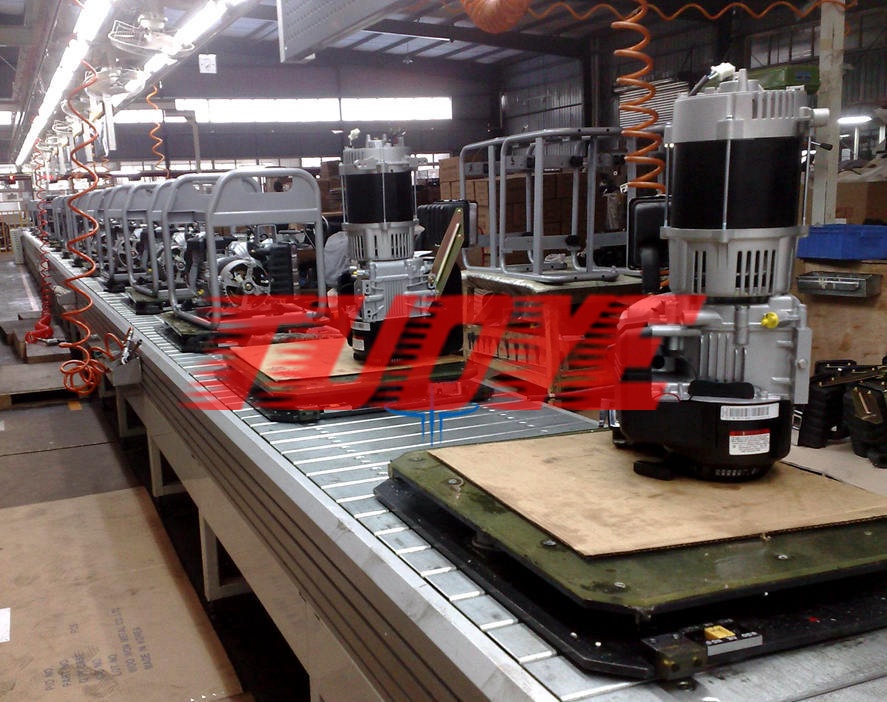
A water pump looks like a simple product, but two gates decide quality on the line: stator-rotor concentricity and seal reliability. A water pump assembly line (also called a water pump production line or pump assembly line) is designed around exactly those two gates; Tuoye's pump assembly lines in Wenling, Taizhou, Zhejiang, China serve the batch assembly of centrifugal, inline, submersible and domestic circulation pumps.
Run through the pump families first: by principle, centrifugal, positive-displacement and jet pumps; by construction, inline, submersible, self-priming, multistage and canned-motor pumps. For all the variety, the process skeleton of a pump production line is the same — the motor end runs stator winding, rotor and bearings; the pump end runs impeller, wear rings, mechanical seal and casing; and when the two ends meet out of concentricity, vibration and noise arrive immediately and the shaft seal fails early. So on higher-speed pumps, dynamic balancing of the rotor assembly is a standard step — never cut it. Finished pumps then pass insulation withstand, air-tightness and run-in tests one by one; on a pump assembly line the test stations often occupy more floor than the assembly stations, and the proposal stage must reserve it.
2. Process Flow (see photo)
The photo shows the final section of a water pump assembly line, plate chain with green pallets: pump sets (motor plus casing) travel straight on the pallets through six to eight stations; assembly stands and fixtures at the line side hold the casing steady, orange spiral air hoses feed the tools driving the bolts; lighting frames plus hanging fans keep the shop bearable in summer; racks and cartons at the line side take the off-line packing directly — packed as finished, no second handling. Assembly sequence: casing and motor on line → stator assembly (winding press-fit, shrink fit) → rotor and bearings → impeller assembly and clearance setting → mechanical seal → casing-motor docking and fastening → wiring and grounding → insulation withstand test → air-tightness or hydraulic test → run-in and performance sampling → appearance check, packing, off-line. Pumps that require it dock a balancing machine in the rotor section — measured and marked before final assembly.
3. Customization & Service
Customization on the water pump assembly line: pallet fixtures built per pump type with quick-change support — one plant often runs several pump families on one line; stator shrink-fit and bearing press stations integrable; the test section lays out pressure, air-tightness and performance benches with automatic data logging; line speed VFD-adjustable throughout. To propose a pump assembly line, Tuoye takes three inputs — pump family range, capacity and workshop conditions — and returns layout, equipment list and quotation. Equipment is pre-assembled and trial-run before shipping, commissioned on site through trial production, with operation and maintenance training. Warranty one year; pallets, fixtures and pneumatic components supplied long-term. The two most common retrofits on older water pump production lines: adding test stations and adding data recording — paper records nobody can flip through make audits painful. For a centrifugal or domestic pump assembly line quotation, send the pump parameters and the proposal comes back with lead time attached.
One more pass on test-section floor area: test stations on a water pump assembly line carry water circuits, wiring and drainage, each occupying more than double an assembly station — planning a pump production line at a 60/40 assembly-to-test split beats a 50/50 split followed by expansion. Do not compromise on cleanliness at the mechanical-seal station either — one grain of grit on a seal face is a leaker in the field; the seal station on a pump assembly line should have its own bench and glove work, which is exactly why the stands and fixtures in the photo sit apart. Dynamic balancing by model: mandatory for rotor assemblies of high-speed and multistage pumps, batch-sampling acceptable for low-speed household pumps — where this step lands on your pump assembly line, Tuoye states a clear conclusion in the process analysis, so no customer spends money they need not.