
1. Product & Industry Overview
Heavy tricycles do the "fully enclosed" business — passenger runs, school pickup and street-stall duty in county towns and townships, the cabin keeping weather out — so the process center of a heavy-duty tricycle assembly line shifts from frame to cabin and trim. The line (also called an enclosed trike production line) covers final assembly from frame on-line to whole-vehicle off-line; vehicles follow GB 7258, electric right-hand trikes adding GB/T 24158. The types: fully-enclosed passenger cabins with front-and-rear seats, doors and wipers carry the fullest assembly load; heavy cargo trikes pull a tonne or so with reinforced frames and axles under half-enclosed cabs; leisure trikes stay light and short-wheelbase; fuel and electric powertrains run in parallel, with small hybrids emerging. Quality control on a heavy tricycle production line sits in frame weld strength, cabin sealing and glass work, and brake-lamp systems — a leaky cabin earns exactly one customer verdict: "it drafts", and a return.
2. Process Flow (see photo)
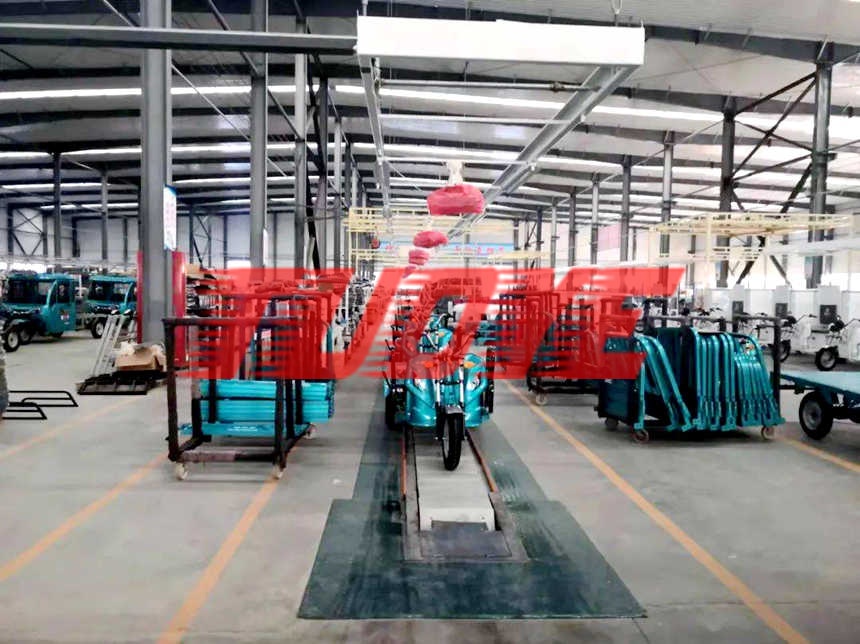
Look at the photo of this heavy-duty tricycle production line's final assembly: floor-embedded track carrying traveling trolleys, teal-enclosed cabin trikes (windshield, steering-wheel front end, passenger box) queued along the line; overhead, yellow chain track spans the shop, red carriers delivering frames and cabin sheet parts straight from sub-assembly, black multi-tier racks stacking same-color frames and side panels on both flanks, and a differently-liveried model visible at right — multi-variety mixed production is the norm, 15-25 stations at one vehicle per position. Assembly sequence: frame on line (trolley-located) → powertrain marriage (engine or motor, gearbox / controller) → propeller shaft and rear axle → steering and brake lines → cabin assembly marriage → doors, glass and window mechanisms → trim (headliner, seats, dash) → harness, lamps and wipers → wheel assembly → whole-vehicle test (brakes, lamps, insulation) → off-line tuning. Glass stations on the cabin trike assembly line run tempered-glass batch checks, with sealing strips and locating fixtures as double assurance.
3. Customization & Service
Customization: traveling trolleys located per frame wheelbase, quick-change across passenger and cargo types; overhead chain points and rack routes jointly tuned with the sub-assembly layout; glass and sealing stations as dedicated positions, the whole-vehicle test line configured per model. Tuoye — in Wenling, Taizhou, Zhejiang, China — delivers the heavy-duty tricycle assembly line from in-plant pre-assembly and commissions through trial production, warranty one year, trolleys, plate chain and carrier parts supplied long-term; retrofits adding overhead feeding or cabin-section stations are taken too. For a cabin trike production line proposal, send the model range (power type, enclosure form) and daily capacity — floor-track construction and the chain's division of labor get fixed on the layout.
The cabin section is the rhythm bottleneck on heavy-trike lines: cabin marriage, glass and trim take nearly half the line's labor. The working answer on heavy-duty tricycle production lines: build the cabin as a module — glass and doors pre-installed — then marry it on the main line, and the beat straightens out at once; the sub-assembled cabin's checking fixture is made to whole-vehicle locating holes so marriage lands in one pass. Mixed production delivers by color zones — chain racks and body share a number, and nothing mis-colors; brake-line stations run set torques with pressure-hold records. Cabin trikes carry people on public roads, and on these safety items a heavy-duty tricycle assembly line makes no discounts, ever.