
1. Product & Industry Overview
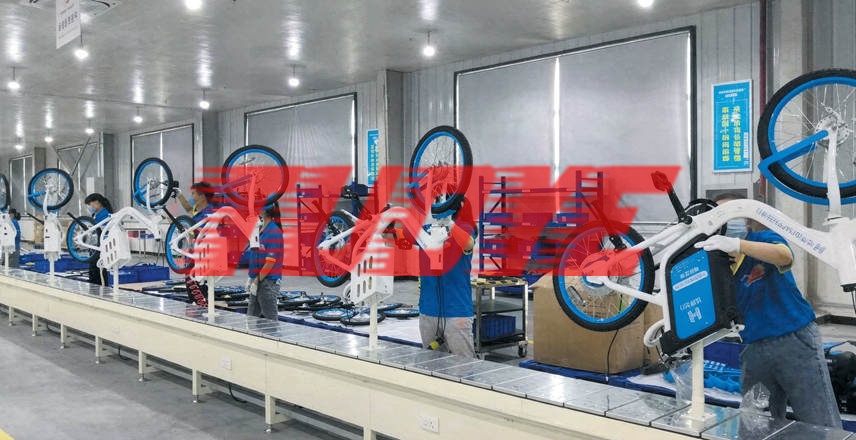
Bicycle orders run to two poles — domestic commuters at thin-margin volume, and shared-bike tenders that drop several hundred thousand units in one contract — and a bicycle assembly line prepares its capacity and poka-yoke for both rhythms. The bicycle assembly line (also called a bicycle production line) covers final assembly from frame on-line to whole-bike verification; safety follows the GB/T 3565 series, with brakes and frame/fork strength as hard figures. The types: shared bikes run maintenance-free designs (solid tires, shaft drive, aluminum frames), with smart locks and solar panels as the new assembly items; 26-inch commuters carry the daily volume; mountain bikes add gears and suspension forks with more assembly and tuning stations; city leisure and folding bikes serve the niches. Quality control on a bike assembly line sits in bottom-bracket and headset press-fit precision and brake adjustment — the feel of brake and shifter is something every user's hand judges in a second.
2. Process Flow (see photo)
Look at the photo of this bicycle production line's final assembly: bench-style stations in a row along the wall, white-column fixtures holding blue-and-white bikes inverted — wheels up, exactly right for fitting bottom brackets, chainwheels and chains; at the right-hand station an operator fits handlebars and baskets to a front-wheeled bike, smart-lock boxes already hung on frames, blue three-tier racks holding parts totes mid-line, air screwdrivers suspended from under the bench tops — an estimated 12-15 stations at one-to-two minutes a bike. Assembly sequence: frame on line (inverted, located) → headset and bottom bracket press-fit → fork assembly → wheel sets fitted and secured → drive train (chainwheel, chain, freewheel) → handlebar and seat post → brake assembly and adjustment → derailleur tuning (geared models) → smart lock and lights (shared models) → bike righted → off-line check (braking force, wheel trueness, chain tension) → packing or caged dispatch. On a shared-bike assembly line, the electrical station adds lock network testing — scan-to-unlock passes unit by unit.
3. Customization & Service
Customization: flip fixtures located to bottom-bracket and head-tube positions with quick-change (shared and MTB frames differ widely); press stations with vertical presses and force monitoring; verification stations with brake-force and trueness checks per model. Tuoye — in Wenling, Taizhou, Zhejiang, China — delivers the bicycle assembly line from in-plant pre-assembly and commissions through trial production, warranty one year, fixtures, plate chain and air-tool parts supplied long-term; temporary line expansions before shared-bike tender deliveries are taken too. For a quotation, send the models (wheel size, drive type) and daily capacity — verification-section configuration aligns to the order's acceptance standard.
Shared-bike deliveries have a signature: short windows, huge batches. The bicycle assembly line organizes as main line plus sub-assembly — wheels and handlebars built on branches and merged in, the main line doing only marriage and verification, capacity flexing through sub-assembly shifts. Don't build the inverted fixtures too rigid: head-tube angles vary a few degrees across frames, so make the fixture V-blocks adjustable and model changes never re-cut tooling; chain tension and braking force get data-recorded at the off-line check — those two records are exactly what shared operators sample at acceptance, and a bicycle production line whose paperwork passes first try sees the contract's final payment land fast.