
1. Product & Industry Overview
A high-voltage switchgear cabinet runs two-to-three hundred kilograms and tens of thousands in value — a high-voltage switchgear assembly line is not the same class as low-voltage lines, with loading, hoisting and test isolation all built to medium-voltage standards. The line (also called a KYN28 production line) covers final assembly from cabinet frame on-line to ex-factory inspection; products follow GB/T 3906 for AC metal-enclosed switchgear with GB/T 11022 common requirements, primary-circuit insulation and temperature rise heading the ex-factory tests. The types: KYN28A-12 metal-clad drawout (center-mounted) cabinets with vacuum breaker trucks dominate 12 kV distribution; XGN box-type fixed cabinets serve fixed installation; ring main units pair load-switch-fuse combinations for cable branching and compact substations; 40.5 kV cabinets run a size bigger, station spacing and test clearances scaled up. Quality control on an HV switchgear assembly line sits in four places: truck insertion engagement precision, busbar joint torque and contact-face treatment, five-prevention interlock reliability, and cabinet grounding continuity.
2. Process Flow (see photo)
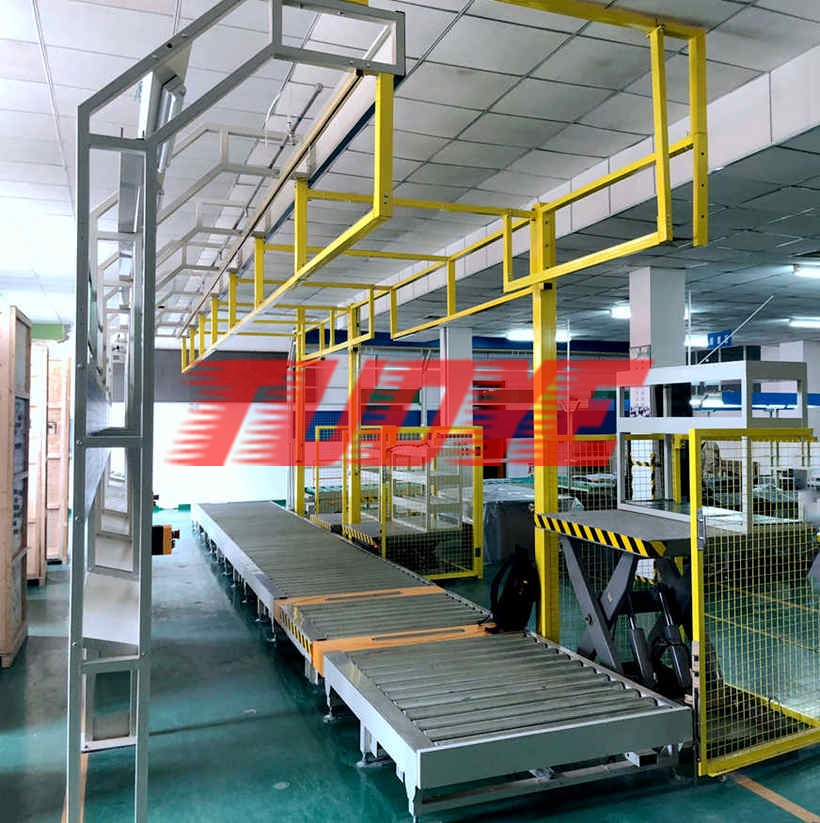
Look at the photo of this high-voltage switchgear production line's cabinet flow: a heavy roller line in silver-gray segments braced with orange beams, ending at a scissor lift platform (yellow-black hazard striping, double-box steel) that hands cabinets between different working heights; overhead, a yellow gantry with KBK track walks the hundred-kilogram-class parts — breaker trucks, busbars; diamond-mesh safety fencing encloses the hoisting zone, green epoxy floor with yellow zoning, 5-7 heavy stations overall. Assembly sequence: cabinet frame on line (extrusion skeleton pre-welded) → truck compartment and breaker contact-box fitting → breaker truck assembled and insertion engagement checked → busbar assembly (contact-face treatment, torque fastening, conductive paste) → current transformers, surge arresters and other primary components → secondary wiring and terminal strips → shutters and five-prevention interlocks (misoperation guards, live-truck prevention and the rest) verified → mechanical operation test → insulation resistance and power-frequency withstand → ex-factory inspection, packing, dispatch.
3. Customization & Service
Customization: roller loading rated to transport weight (around half a tonne per cabinet), lift travel per station height differences; KBK points coordinated with the crane's duties, test stations isolated and interlocked per voltage class; stations fitted with hung torque wrenches and busbar-fabrication docks. Tuoye — in Wenling, Taizhou, Zhejiang, China — delivers the high-voltage switchgear assembly line from in-plant pre-assembly and commissions through trial production, warranty one year, rollers, lift platforms and crane-track parts supplied long-term; for plants mixing LV and HV production, sectioned designs by loading and test requirements are done too. For a proposal, send the cabinet range (voltage classes, drawout / fixed) and monthly capacity — the test section's protection and instrument list comes as one package.
One investment an MV line never skips: the five-prevention verification station. On an HV switchgear production line, every cabinet's interlock hardware runs full-travel action tests with records — when misoperation accidents happen in service, the trail ends at those ex-factory records. Busbar fastening posts torque values on boards with marker lines, one glance showing what was done; the withstand test zone takes code isolation, interlocks and grounding, with rise-and-fall voltage curves recorded automatically. Do these solidly on the HV switchgear assembly line, and grid-supplier and plant audits — plus supervision sampling — pass with dignity: that is the footing big orders stand on.