
1. Product & Industry Overview
A disconnector breaks no load current — its job is the "visible break point": maintenance safety rests entirely on that visible blade, and the process precision of a disconnector assembly line lives in contacts and gang mechanism. The disconnector assembly line (also called a high-voltage isolator production line) covers final assembly from base on-line to ex-factory testing; products follow GB/T 1985 for HV AC disconnectors and earthing switches, with insulation and temperature-rise tests as hard ex-factory gates. The types: indoor GN series (GN19, GN30 class) ship with switchgear and drawout gear in the largest numbers; outdoor GW series serve substations and lines, a class up in icing and pollution ratings; earthing-switch models add a blade and interlock, plus the adjustment and verification of gang interlocking. Quality control on an isolator assembly line sits in three places: finger pressure uniformity, three-phase gang synchronism, and main-circuit contact resistance — practically every hot-blade fault roots in those three.
2. Process Flow (see photo)
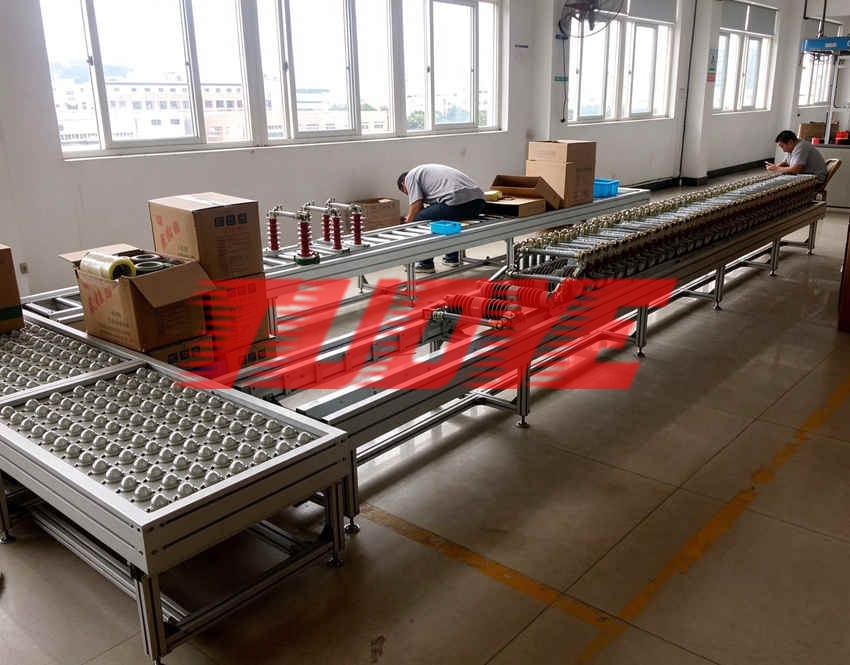
Look at the photo of this disconnector production line's final assembly: an aluminum-extrusion speedchain running straight, a curve transfer section on the left joining ball tables for pallet turning and off-line work; on line, red-brown post insulators (epoxy-cast, skirted) stand in threes on their bases with metal contacts and pull-rod mechanisms taking shape, twenty-to-thirty sets in production in rows; yellow cartons of insulators and fasteners at the line side, one operator at the end head-down on inspection records, crane beams visible beyond, 10-14 stations overall. Assembly sequence: base on line → post insulators fitted (torque-fastened) → stationary contact and fingers → conducting blade fitted → contact pressure springs adjusted → operating mechanism (crank arms, links) → three-phase gang adjustment (synchronism spread controlled) → earthing blade and interlock (earthing models) → contact resistance and mechanical operation test → power-frequency withstand → nameplate, packing. The gang-adjustment station on the high-voltage isolator production line carries synchronism gauges — three-phase spread out of tolerance gets adjusted on the spot.
3. Customization & Service
Customization: pallets serialized quick-change to base hole patterns and current ratings; contact-pressure stations with pressure gauges, gang-adjustment positions with synchronism fixtures; the withstand test zone isolated and grounded per voltage class. Tuoye — in Wenling, Taizhou, Zhejiang, China — delivers the disconnector assembly line from in-plant pre-assembly and commissions through trial production, warranty one year, pallets, speedchain and gauge parts supplied long-term; retrofits adding test stations or earthing-blade interlock sections are taken too. For a quotation, send the voltage and current ranges and monthly capacity — the test section's instrument list and safety kit come together.
There is a veteran's saying about finger assembly: half a blade's life sits in finger pressure. On a disconnector assembly line, finger springs get gauge-checked group by group — uneven pressure closes into local heating; insulator fastening runs at set torque, because over-torqued skirted parts carry hidden damage, and only station discipline holds these two. Conducting faces get cleaned and coated before assembly — most contact-resistance failures trace to fingerprints and dust on the faces; the isolator assembly line fits lint-free wipes and locating dust covers at this station, cost nearly zero, first-pass yield immediate. And packing ships insulators-upright: lie a unit down in transport and chip one skirt, and the whole set goes back for withstand re-testing.