
1. Product & Industry Overview
Screen plants fear two things: exhibition orders crowding into the same delivery window, and a burn-in room that cannot keep up. The LED display assembly line exists to solve both — after the LED boards come off the SMT shop, everything else (module assembly, light-on testing, burn-in, cabinet building) happens on this line. The trade also calls it an LED display production line or LED module production line, and the screen type sets the line's shape: indoor fixed-install and outdoor advertising screens run high-volume paced lines; rental staging screens live on quick-lock cabinets; fine-pitch conference screens bring small modules and dense stations; transparent and flexible screens in malls are small-batch, many-variety work. Pallet sizes and cycle time on an LED display production line must be set per screen type.
The industry also runs on batch discipline: LED modules demand same-batch LED beads and same-batch calibration, so the line demands batch isolation — one batch of modules finishes the assembly section, enters the burn-in room rack by rack, then comes out for re-test and pixel calibration as a whole batch, never mixed. Burn-in at 24 or 48 hours, and modules per batch, directly size the buffer zone and burn-in docking positions on the LED display assembly line.
2. Process Flow (see photo)
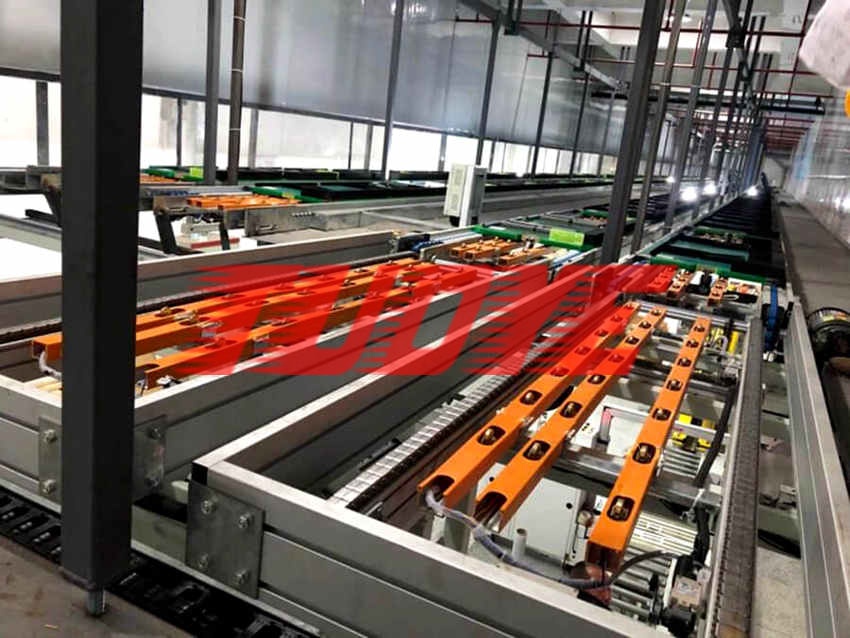
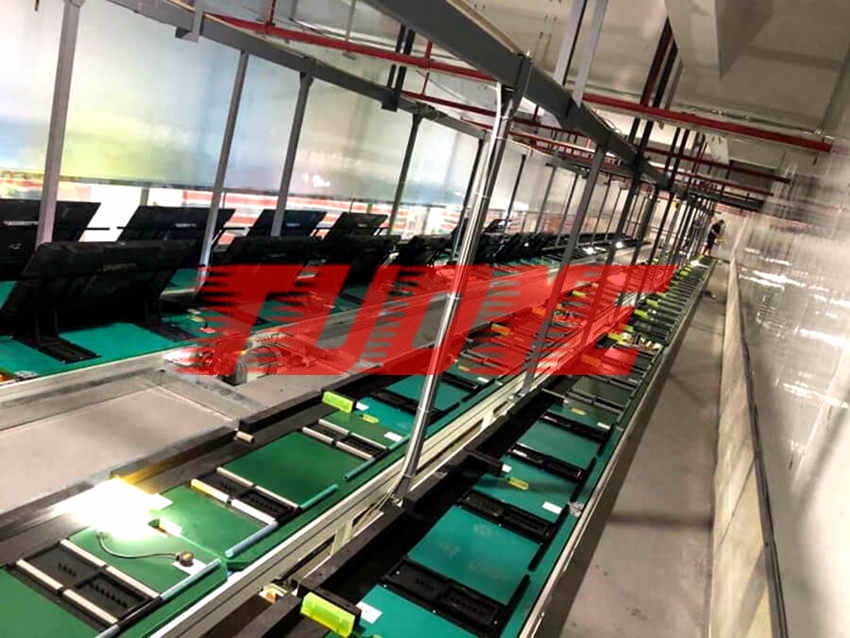
The photos show two sections of one LED display assembly line. First: a two-tier speedchain structure — on the lower tier, orange multi-slot pallets carry modules along aluminum-extrusion track while the upper tier returns empty pallets, one pallet holding two to three modules across, operators working from both sides; black drag chains carry power along the line, and the drive/tension station with stoppers at the end parks pallets precisely at stations. Second: green ESD pallets with a row of standalone bench zones, where operators pull modules off for close work and push them back on completion — the densely packed section in the distance is light-on testing and burn-in.
Process sequence: LED board and bottom shell marriage (magnetic columns, screw locking) → power and ribbon-cable connection → module light-on first check → whole rack into burn-in room → out of burn-in, re-test and pixel calibration → cabinet assembly (modules onto frame, locking, connectors) → full-cabinet light-on → packing and storage. Outdoor models add a waterproofing test station on this LED display production line. ESD is a hard rule throughout — ESD pallet tops, wrist straps, grounding chains, none of it skippable; beads wounded by static show mottling only after the screen reaches the site, and by then the loss is far more than one module.
3. Customization & Service
The LED display assembly line is customized to screen type and workshop: module size sets the pallet cutouts, burn-in duration sets the buffer scale, and the two-tier structure halves the footprint; light-on, calibration and burn-in docking stations plus SOP boards and MES scanning are all selectable. To propose the line, Tuoye — in Wenling, Taizhou, Zhejiang, China — needs three inputs — screen types and module specs, daily output program, workshop conditions. Equipment ships after in-plant pre-assembly and trial runs, is commissioned through trial production, carries a one-year warranty, with pallets, stoppers and chain parts supplied long-term. For an LED display assembly line quotation, send module dimensions and daily volume, and proposal, price and lead time come back together.
Years of building lines for screen plants leave two notes worth keeping. First, the burn-in room door should face the line end — racks of modules in for burn-in and out for re-check, and with no crossing flows the batches never tangle. Second, plan the light environment of the calibration station early: pixel correction feeds on controlled ambient light, and a glass curtain wall facing the calibration position makes the measured data untrustworthy. An LED display assembly line may look like mere conveying — batch management and ESD protection are its real value.