
1. Product & Industry Overview
Every July and August, a boiler plant's hiring ads arrive with its orders — rushing goods before heating season is the industry's calendar. A wall-hung boiler assembly line assembles heat exchanger, burner, pump and controls into complete units to cycle time; the trade also calls it a wall-hung gas boiler production line. Sort the types before configuring the line: conventional and condensing boilers differ by a stretch of internal labor — the condensing type adds a flue-gas heat-recovery condenser and reaches thermal efficiency around the 105%-of-lower-heating-value class (the grade-1 band in the GB 20665 efficiency standard); combi boilers add domestic hot water changeover, with more hydraulic parts than heating-only units; 18-40 kW is the mainstream household band, and pallets sized to this range fit the widest model mix on a gas boiler assembly line.
Every boiler must clear three gates before leaving: gas tightness (pressure method or leak fluid on the gas circuit), water pressure (hydraulic withstand on the water circuit), and ignition & combustion (burning condition and flue-gas check), with CJ/T 228 as the long-standing industry reference. Labor differs sharply by type: condensing models add premix-burner and condensing-heat-exchanger assembly and inspection stations, so the wall-hung boiler assembly line reserves about twenty percent more cycle for them than for conventional ones. The line end must give these three gates full station space, with burn-in sampling behind them — these sections pace at 3-5 minutes per unit, and only at that beat do staffing and tooling balance out.
2. Process Flow (see photo)
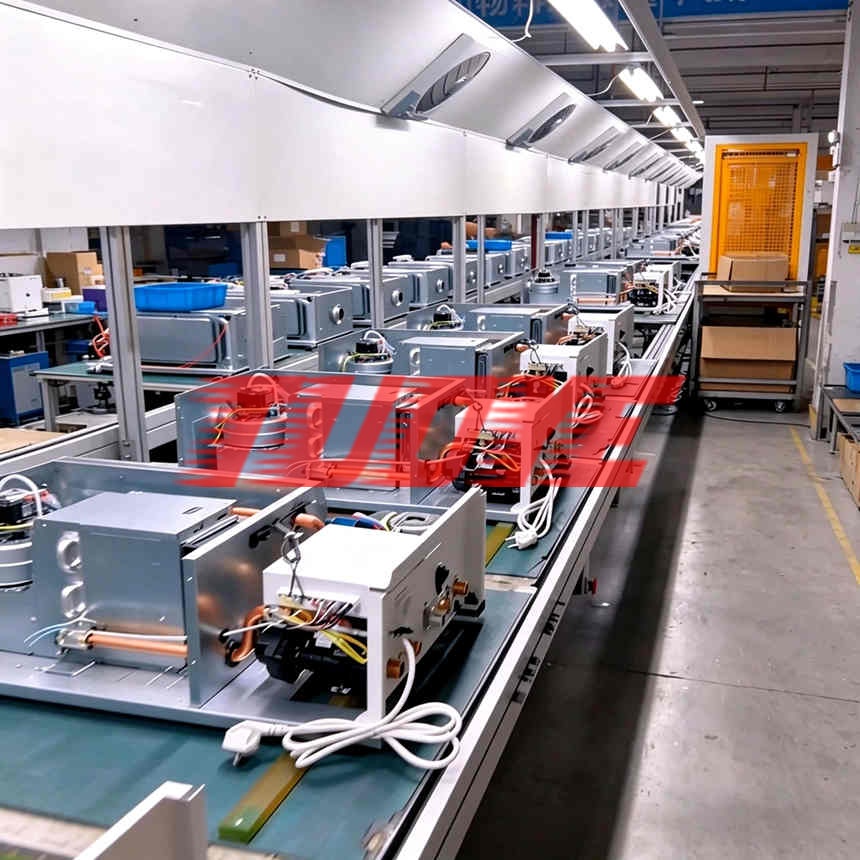
Look at the photo of this wall-hung boiler assembly line: dual speedchain lanes running parallel, green-faced pallets at one boiler per board; copper water fittings already reach out from the base, fan and pump assemblies seated, white power harness bundled and routed, outer panels still open — the mid-to-late final assembly stage of internal fastening and gas/water connections. Continuous lighting bridges overhead push illumination right into the cabinets, flow-through racks in the left rear stack totes for replenishment, and yellow railing at the line end fences an independent test zone. Assembly sequence: base pan on line → main heat exchanger and plate exchanger in → burner and fan → pump and three-way valve → gas and water copper connections (brazed or quick-insert, then leak-checked) → control wiring and harness dressing → gas-tightness test → water-pressure test → ignition and combustion tuning → burn-in sampling → shell closing and packing. The dual-lane pattern runs main units on one lane, pre-assembly and rework on the other, never blocking each other; a single lane saves floor but leaves little swing in peak season — choosing between them on a wall-hung gas boiler production line comes down to how mixed the model range is.
3. Customization & Service
The wall-hung boiler assembly line is configured to boiler range, daily program and workshop: station air, water and gas interfaces (or nitrogen simulation) fitted to the test requirements, test zones independently enclosed. Tuoye proposes the line from Wenling, Taizhou, Zhejiang, China, ships after in-plant pre-assembly and trial runs, commissions through trial production, warranty one year, pallet and rack parts supplied long-term; peak-season speed-up retrofits of existing lines are taken too. For a boiler assembly line quotation, send the model list and capacity requirements over.
Two notes from building boiler lines. First, flooring and drainage at the water and gas test stations — testing discharges a lot of water on a boiler production line, and without proper floor drains and slope the shop floods and the line underframe rusts out first; reworking the floor costs more than building the line. Second, run every test interface on quick couplings with nitrogen bottle banks simulating gas — compliant with safety and still fast enough for the beat; when a wall-hung boiler assembly line runs double shifts in peak season, these two configurations decide whether capacity holds.