
1. Product & Industry Overview
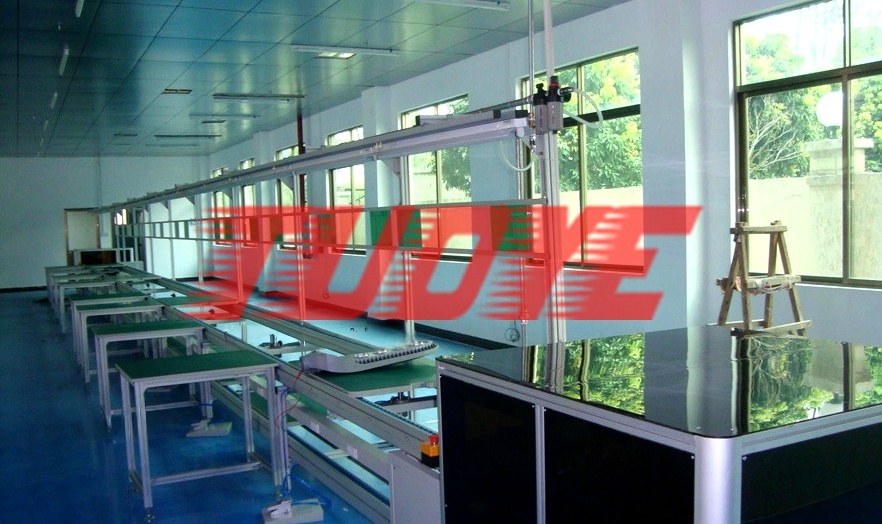
Street lighting orders follow municipal and rural brightening projects — urgent batches, tight deadlines — and the flexibility of a street light assembly line decides whether the peak-season project orders can be caught at all. The street light production line (the trade also says street lamp assembly line) covers two process blocks: pole fabrication and luminaire assembly. Poles run the sheet-metal route — coil flattening, CNC cutting, cone bending on heavy press brakes, seam welding, grinding and patching, hot-dip galvanizing and powder coating — and that anti-corrosion pass is the root of pole life. Luminaires run the assembly route — board, driver, sealing, burn-in, station by station. The types: modular LED street lights scale board count by power class, riding the long-running sodium-lamp replacement wave; one-piece heads integrate lenses and heat-dissipation chambers; smart heads add single-lamp controllers and IoT modules. Quality control on an LED street light assembly line sits in the thermal contact of board locking, the driver's protection rating, whole-lamp waterproofing and burn-in — every unit lights and burns in before ex-factory, with luminous flux and color temperature sampled into the records.
2. Process Flow (see photo)
Look at the photo of this street light production line's luminaire section: a green belt conveyor running the shop lengthwise, aluminum-extrusion track above carrying pneumatic components and air lines, green plate-shaped luminaire workpieces flowing neatly on belt and track; green workbenches line up in parallel, 6-8 stations divided by lamp type; the black bench equipment in the foreground is the burn-in and test cabinet, luminaires cycling in and out; blue epoxy floor, white walls and tall windows — a freshly built shop. Assembly sequence: incoming board check → thermal grease and board locking → driver installation and wiring → lens and gasket assembly → shell closing and locking → waterproof check → light-on first test → to burn-in cabinets for on/off aging (24 h and up) → photometric sampling → labeling and packing. The heavy sheet-metal machines of the pole line — cutting, bending, welding — sit in a separate bay, their logistics planned around pole lengths.
3. Customization & Service
Customization: belt line and workbenches by head-size class, burn-in cabinet capacity as daily program times burn-in duration, photometric sampling expanded per project orders. Tuoye — in Wenling, Taizhou, Zhejiang, China — delivers the street light assembly line from in-plant pre-assembly and commissions through trial production, warranty one year, belts, tooling and cabinet parts supplied long-term; luminaire-line expansions and pole-section integrations are done work. For a quotation, send head power classes and daily program — the burn-in and test section's equipment list comes itemized.
Luminaire and pole logistics must live apart: poles run ten-odd meters, the pole zone turns them over with cranes and long-material carts, and the belt line of the luminaire section never crosses the pole lane — first rule of light pole production line layout. Never underestimate burn-in heat: with cabinets concentrated, extraction and power distribution are rated at full load, on a dedicated circuit in the street light production line's electrical design. Export models on the LED street light assembly line add driver-swap and label stations — voltage standards verified before the burn-in section. For a whole-plant plan spanning both sections, hand Tuoye the pole length range and head power classes, and the two sections come capacity-balanced together.