
1. Product & Industry Overview
Fans are low-ticket and fiercely seasonal — an electric fan assembly line must produce the whole year's volume in three months, so relocatability and expandability are the two most practical items on the purchase list. The fan assembly line (also called a fan production line) covers whole-unit assembly from desk, pedestal and bladed-oscillating fans to tower fans; the tower fan, with its soft airflow and small footprint, keeps gaining volume in home and office settings and anchors today's line configurations. Performance follows GB/T 13380 for AC fans and regulators with airflow tested per the annex method; safety runs under the fan-specific household appliance requirements, with tilt-stability testing for floor-standing classes; energy efficiency and noise carry their own standards. The types: the tower fan's core — a crossflow wheel in a column shell — differs completely from bladed fans and takes its own sub-assembly section; pedestal fans hinge on oscillation links and height poles; desk and bladed-oscillating models are compact and fast-moving. Quality control sits in motor-and-wheel balance, oscillation/tilt mechanism mesh, and live-part insulation and protection — every finished unit powers on for burn-in.
2. Process Flow (see photo)
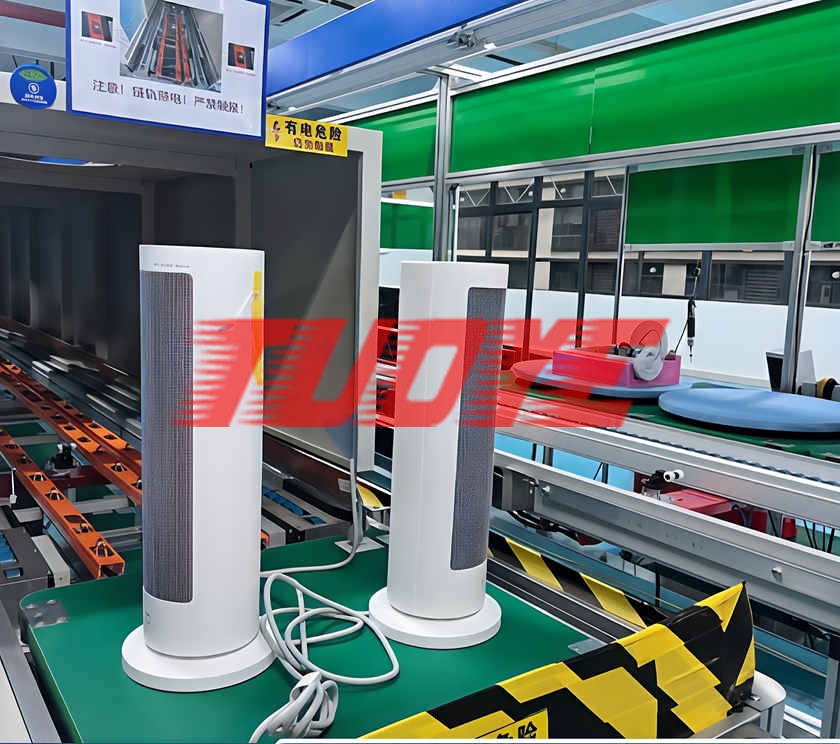
Look at the photo of this fan production line's combined layout: on the left, an orange speedchain section carrying pallets; on the right, a green workbench line running parallel, white tower-fan columns standing on round-base fixtures mid powered test — power cords coiled on the bench, cores running; yellow-black hazard striping with shock-hazard signage marking the live test zone at the bench edge; pink trays at the right hold wheels and motor assemblies waiting, air-tool hangers within reach, the two lines cycling 3-4 stations per group. Assembly sequence: motor and crossflow wheel sub-assembly (balance-checked) → column shell and core assembly → base and control board → power cord and switch wiring → whole-unit closing → insulation and withstand test → powered burn-in run → airflow and noise sampling → cleaning, labeling, packing. On the standing fan assembly line, the oscillation station carries a visual board — a mis-meshed gear set costs more to rework than to assemble.
3. Customization & Service
Customization: speedchain-and-bench combinations per model section, live burn-in zones isolated per safety code, airflow sampling stations per sampling frequency. Tuoye — in Wenling, Taizhou, Zhejiang, China — builds the electric fan assembly line for peak-season double-shift expansion and off-season relocation, ships from in-plant pre-assembly and commissions through trial production, warranty one year, pallets, benches and air-tool parts supplied long-term. For a tower fan or pedestal fan line quotation, send the model structures and peak daily capacity — the seasonal scheduling plan comes detailed.
Seasonal production leans on line versatility: double shifts at full load in summer, one line running many models in the slack — with quick-change tooling done properly on the fan production line, off-season orders for desk and bladed-oscillating fans board without re-laying the line. The tower fan line's core sub-assembly stands alone, with one or two balancing machines per capacity — poor balance is the number-one source of tower-fan noise complaints; the pedestal fan assembly line's oscillation station adds mesh listening, jammed gears bounced on the spot. Size the fan production line's burn-in section at 1.2 times peak program, and never let the test section become the bottleneck in the rush season — a lesson worth retelling every year before summer.