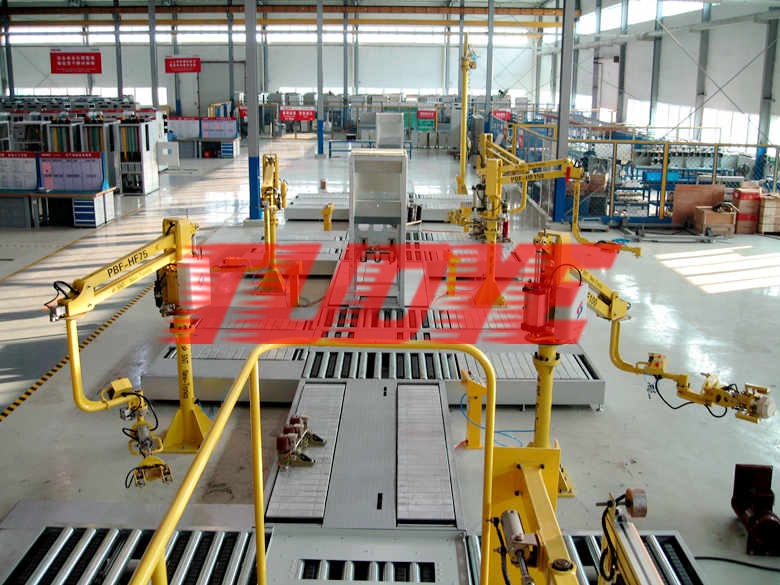
1. Product & Industry Overview
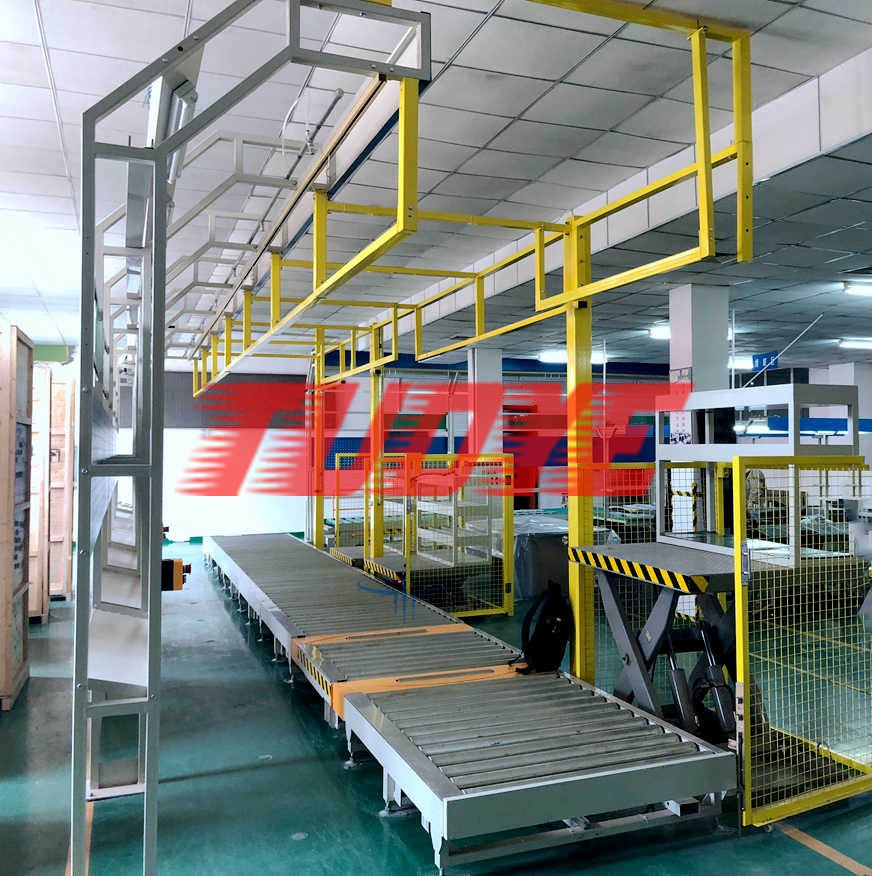
Panels at a switchgear plant are heavy and large, so lesson one of a switchgear assembly line is getting the cabinet onto the line with dignity. The switchgear assembly line (also called a switchgear production line or distribution cabinet assembly line) covers panel on-line, primary and secondary circuit assembly and factory checks; Tuoye's switchgear assembly lines in Wenling, Taizhou, Zhejiang, China cover the common types — GGD fixed panels and GCS/MNS withdrawable panels.
Most of a panel's value sits in the electrical assembly craft: copper busbars go through cutting, bending, punching, embossing and tinning; joint faces hold down contact resistance and temperature rise through embossing, bolted clamping and conductive paste — a badly made joint heats up in service and takes half a cabinet apart to trace. Primary components (breakers, switch-disconnectors, transformers) and secondary components (meters, relays, terminal blocks) are installed and wired to drawing, then phase sequence, clearances, insulation and power-on checks close it out. Structurally, GGD frames assemble from 8 MF cold-formed steel with local welding, while GCS/MNS load components into withdrawable units for interchangeable maintenance. These heavy, long-cycle operations decide the two schools of a distribution cabinet production line: fit a crane for lifting, or build the assembly stations generous — the photos show exactly one line for each school.
2. Process Flow (see photo)
The photos show two line forms of a switchgear production line. First, the roller line: panels ride the rollers through the flow, a scissor lift platform with yellow-black hazard striping mid-line handles height transitions, yellow safety netting fences the crane zone, and the overhead lifting frame with hoist brings panels and copper busbars in — the fit for plants with heavy tonnage and frequent crane work. Second, the speedchain pallet line: perforated metal pallets carry panels along aluminum-extrusion track, and the pallets can drop off-line to dwell — slow-assembling panels get pulled aside without blocking the ones behind; rows run parallel in a comb-loop layout, panels crossing between lines through transfer sections, with busbars and components pre-assembled right on the line. Assembly sequence: panel on line (frame welded) → primary busbar and neutral assembly (torque fastening, conductive paste) → breakers and other primary components → secondary components and wiring → withdrawable units (drawers) → insulation and power-on checks → factory inspection and off-line.
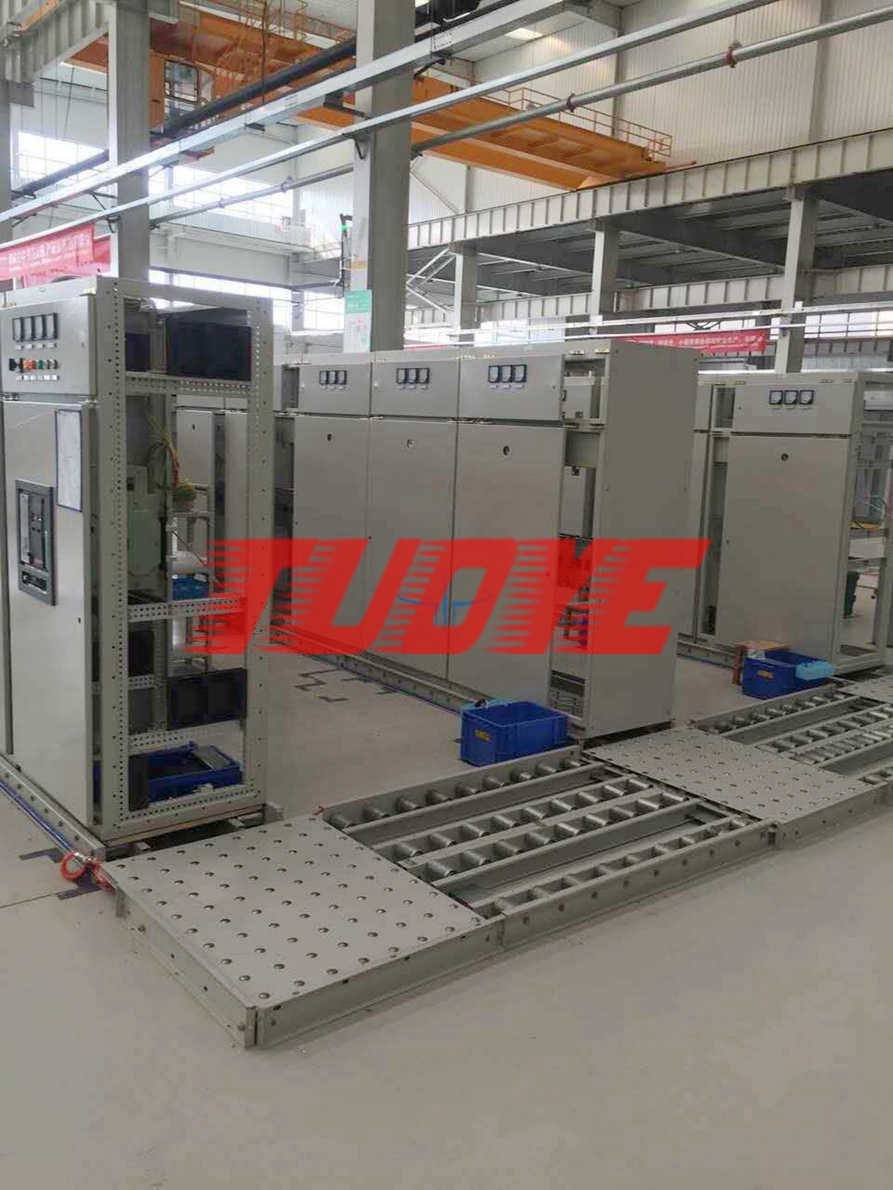
3. Customization & Service
Customization on the switchgear assembly line: roller, speedchain and plate chain combine per panel type and cycle; loading rated to panel weight at 1-3 t per point; lift platforms, transfer machines, turntables and crane docking sections follow the layout; stations can hang torque wrenches and reserve ports for busbar fabrication equipment. To propose a low-voltage switchgear assembly line, Tuoye takes three inputs — panel type range, capacity and workshop conditions — then delivers layout drawing, equipment list and quotation; equipment enters after pre-assembly and loaded trial runs, commissioned through to trial production. Warranty one year; rollers, pallets and speedchain parts supplied long-term. Retrofits of older distribution cabinet production lines — line replacement and speed-up, adding cross-transfer — are frequent jobs too. For a switchgear production line quotation, send the panel list over.
Roller or speedchain — an experience-based rule of thumb: heavy tonnage, frequent crane lifts, mid-range volume — go roller line plus crane, the lower-investment, tougher switchgear assembly line; many panel types, faster cycles, panels needing long dwell for careful assembly — go speedchain with pallets, where off-line dwell unblocks the flow and throughput of the distribution cabinet production line jumps a step at once. Tuoye builds both and favors neither — it depends on the plant's work. One quality-control suggestion: post the torque values for busbar joints on boards at the switchgear assembly line stations, and calibrate the torque wrenches on schedule with records kept — when spot checks on temperature rise come around, joint faces are the disaster zone, and a switchgear production line that does this well rarely fails the check. The scissor lift platform in photo one is the key piece docking the roller line to stations at different heights.