
1. Product & Industry Overview
The day the award notice arrives, the delivery countdown starts — a charger maker's capacity pressure lands entirely on the production line. An EV charger assembly line covers the whole flow from cabinet on-line, power module insertion and secondary wiring through gun-cable assembly to whole-charger inspection; the trade also calls it an EV charger production line or charging pile assembly line. Sort the types first: AC chargers serve 7 kW home and commercial slow charging — light structures, fast volume; 60-160 kW DC all-in-one chargers, with big cabinets and many modules, are the mainline product on the charger assembly line; split-type charging heaps separate power units from terminals, so the line runs in two sections; liquid-cooled supercharging brings its own piping-assembly rules.
Most of a DC charger's value sits in the power modules and electrical safety: power modules are typically two-stage PFC plus DC/DC, and every unit passes withstand-voltage, insulation and leakage-current tests (per the GB/T 18487.1 conductive charging system requirements) before entering high-temperature burn-in (60 ±2 °C at full load) and finishing with whole-charger error and function checks. So the station plan of an EV charger production line turns around three sections — assembly, testing, burn-in — and the three must be capacity-balanced.
2. Process Flow (see photo)
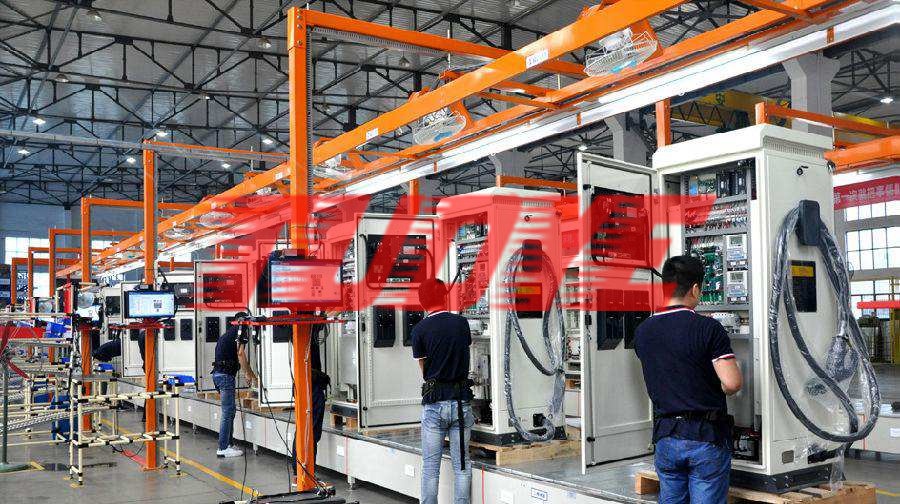
Look at the photo of this EV charger assembly line: large white pallets, one cabinet per pallet, DC charging cabinets riding the speedchain with doors open showing the power-module slot array, breakers and control units; orange trusses span the line carrying lighting and fans, the display on the red cantilever is an MES terminal scanning each operation, lean-tube racks at the side hold harnesses and hardware, and an overhead crane in the background lifts cabinets onto the line with operators working one side. Assembly sequence: cabinet on line (sheet-metal cabinet pre-welded) → grounding copper bar and busbar installation → power modules into cabinet (rail insertion, locking) → breakers, fuses, relays, energy meter → control board and secondary wiring (wire numbers, torque fastening) → charging gun-cable assembly and coiling fixtures → withstand-voltage and insulation test → into the burn-in room at full load → whole-charger function checks → door closing, packing, off-line. On a charger assembly line the gun-cable station needs hanging racks and coiling fixtures — high-power DC gun cables are thick and heavy, and a badly coiled cable chafes its jacket at the first transport vibration.
3. Customization & Service
The EV charger assembly line is configured to charger types and program: AC chargers run light pallets at fast cycles, DC chargers rated to cabinet weight; burn-in room capacity, test-bench docking, scanning poka-yoke and torque tools fit out per need. To propose a new-energy charger line, Tuoye — in Wenling, Taizhou, Zhejiang, China — takes three inputs — charger type range, daily capacity, workshop conditions. Equipment ships after in-plant pre-assembly and loaded trial runs, commissions through trial production, warranty one year, pallets and stopper parts supplied long-term; retrofits of older EV charger production lines — line replacement, speed-ups, added burn-in sections — are frequent jobs. For a quotation, send the charger list over.
Two notes from building charger lines. First, do not size the burn-in room for peak — burn-in positions at 1.2 times the daily program are enough; the burn-in room is the biggest investment item on an EV charger assembly line, and oversizing it locks up cash. Second, give the electrical test section insulated flooring and warning enclosures, and physically separate the high-voltage test zone from assembly — safety rules before output; on an EV charger production line this is one expense that cannot be cut.