
1. Product & Industry Overview
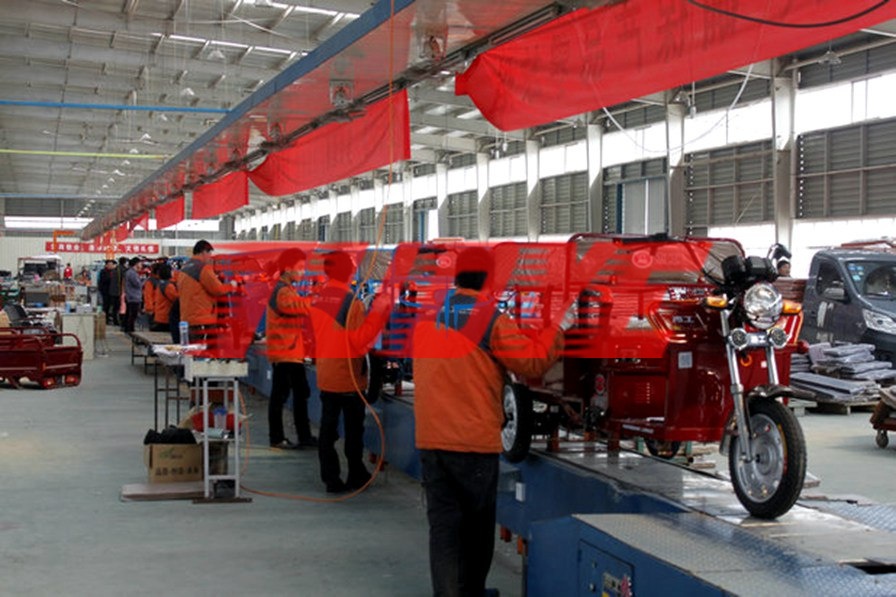
A tricycle assembly line is a complete production line that takes a tricycle from a bare frame to a finished vehicle rolling off the line — in the trade it is also called a tricycle production line or tricycle assembly line. Tuoye has been building tricycle assembly lines for years in Wenling, Taizhou, Zhejiang, China, with delivered projects covering final assembly lines for cargo tricycles, passenger canopy tricycles, leisure tricycles, and express-delivery and sanitation trikes.
Specifying a tricycle production line starts with breaking the vehicle type down: cargo tricycles carry heavy beds, so the frame has to be strong and the line needs generous stations for the rear axle and leaf springs; passenger canopy tricycles add a roof and glass fitting step; leisure and senior-mobility tricycles are dense in electrical parts, so the testing stations stretch longer; express and sanitation vehicles often call for custom stations for racks and roller shutters. The vehicle type alone moves the station count, line length and load rating of a tricycle assembly line by a wide margin — which is why this line is rarely a standard product: every configuration is worked out item by item against the vehicle drawings and the annual output.
2. Process Flow (see photo)
The photo shows a cargo tricycle final assembly line in plate-chain conveying with workholding pallets: the frame rides its pallet at constant speed while operators assemble in step from both sides, a dozen-plus stations in a single row, a line of station lighting overhead, the off-line zone right under the red banner at the end of the line, and finished vehicles parked on the open ground at right. The assembly sequence usually runs: frame on line → front fork and handlebar → motor and rear axle → controller and wiring harness → battery compartment → wheels and brakes → cargo bed and canopy → whole-vehicle testing and off-line. To raise output on a tricycle production line there are three proven levers: extend the line, add stations, or speed up the cycle rate (direct VFD speed control); if end-of-line defects cannot be pressed down, add a whole-vehicle electrical test station at the tail, so faulty units are reworked on the spot instead of reaching the dealers.
3. Customization & Service
Customization on a tricycle assembly line is concrete and practical: length is measured to the workshop, width set to the cargo bed, conveying speed VFD-adjustable; quick-change air ports, pneumatic tool suspension, parts bins and counting boards can all be added, and the test section can carry in-line voltage testing. Before proposing a tricycle assembly line, Tuoye asks for three things — vehicle drawings, annual capacity and a workshop floor plan; only when all three are in does a quotation mean anything. Equipment is pre-assembled and dry-run tested in our own plant before shipping, then installed, commissioned and run through trial production on site; the warranty runs one year, with long-term supply of wear parts such as workholding pallets, chain plates and stoppers. Retrofits are taken as well — many tricycle plants run old belt lines that can no longer be sped up, and we have done jobs from replacing plate-chain sections to adding test stations. For a tricycle production line quotation, send over your vehicle type and capacity, and the solution and lead time will come back together.
What customers ask most about a tricycle assembly line is length and price. Length follows the stations: a cargo tricycle final assembly line commonly runs 30 to 50 meters for an output around one hundred units per shift per day; price ties directly to the line type, station setup and test section — on the same tricycle production line, fitting in-line electrical testing or not, adding counting boards or not, can move the budget by a wide margin, so asking "how much is one line" alone means little; it has to be discussed against the configuration list. One more piece of field advice: leave a few meters of spare length at both ends of the tricycle assembly line and one extra run of air and power at each station. Tricycle plants switch models often; with enough margin, a new model only needs the stations re-arranged, not major surgery on the line — a rule proven on multiple electric tricycle assembly lines and far cheaper than after-the-fact modification. The workshop in the photo is worth copying too: parts bins sit within arm's reach of each station, operators walk no empty distance, and single-shift output naturally climbs.