
1. Product & Industry Overview
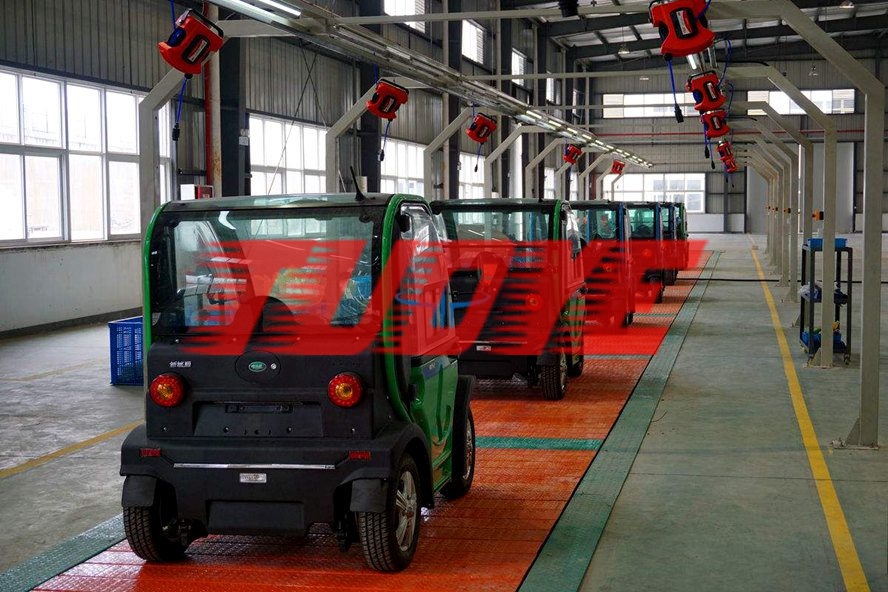
Launching a mobility scooter program means one unavoidable investment: the production line. A mobility scooter assembly line assembles chassis, steering column, battery pack, body panels, seats and glass into a finished vehicle to cycle time — the trade also calls it a mobility scooter production line or elderly scooter assembly line. Tuoye has delivered this line to several low-speed vehicle plants in Wenling, Taizhou, Zhejiang, China, running both canopy and leisure models.
The vehicle itself deserves a quick sketch: the chassis is mostly welded square tube, the front axle joins the two front wheels with simple damping, the body is closed or semi-closed, and the powertrain is battery plus motor. Simple as it sounds, the mobility scooter production line business has turned serious — low-speed EV technical standards tighten year by year, with hard limits on vehicle mass, speed and insulation withstand voltage; small workshop-style manual stalls increasingly fail them, while proper plants that install an elderly scooter assembly line with full end-of-line testing actually cut rework rates and protect their dealers. Leisure, utility (bed-equipped) and canopy types differ considerably in station layout, so the process has to be set against the main vehicle type before the line is configured.
2. Process Flow (see photo)
The photo shows a mobility scooter assembly line on red-topped plate chain: vehicles creep forward on workholding pallets in a straight line, six to eight stations in a row, the vehicles more complete toward the end; suspended station lighting overhead, blue multi-level racks at the side holding plastic parts and standard hardware, yellow floor lines separating people from vehicle lanes, and daylight windows bright enough. Assembly sequence: chassis on line → front axle and steering → motor, rear axle and drive → damping and brakes → battery pack and controller → harness and electrical parts → body panels and doors → seats, glass and trims → whole-vehicle testing and off-line. On an elderly mobility scooter production line the test station should cover insulation, withstand voltage and brakes — canopy models carry a lot of wiring, and any electrical fault that slips out becomes an after-sales bottomless pit.
3. Customization & Service
A mobility scooter assembly line is non-standard equipment: line length and station count follow capacity, and the cycle rate directly decides daily output; the line type can switch between plate chain and speedchain; whether to add a test section at the end — and how many test items — follows the plant's quality-control requirements. To quote an elderly scooter assembly line, Tuoye first asks for three things: vehicle drawings, annual capacity program and workshop dimensions. With those in, we deliver the floor layout and equipment list, including installation, commissioning and operator training. Warranty runs one year; pallets, pallet tops and chains are supplied long-term. Some plants upgrade existing lines — manual push-along stations converted to powered conveying, or a glass station added for canopy models — and that retrofit work is taken too. For a mobility scooter production line proposal and price, send the parameters over and the lead time comes with it.
Two questions come up constantly. First, "does an elderly mobility scooter assembly line really need a test section?" — yes, fit it. Canopy models are wiring-heavy; insulation, withstand voltage and brakes take a dozen-odd meters of line, but one defective vehicle that slips out costs more in return freight and dealer goodwill than the whole test section. Plenty of mobility scooter assembly lines skip it in phase one and add it in phase two, and the second construction always costs more. Second, "what about seasonal capacity swings?" — that is exactly what the VFD drive on a mobility scooter production line is for: full speed in the peak season, slowed down to keep the line alive in the slack, with stations staffed full in peak and rotated in the off-season. One more detail: the red pallet tops in the photo were color-matched to the customer's workshop scheme — tabletops, guardrails and pallets on a mobility scooter assembly line can all follow the plant's visual standard, which brand-building makers care about.