
1. Product & Industry Overview
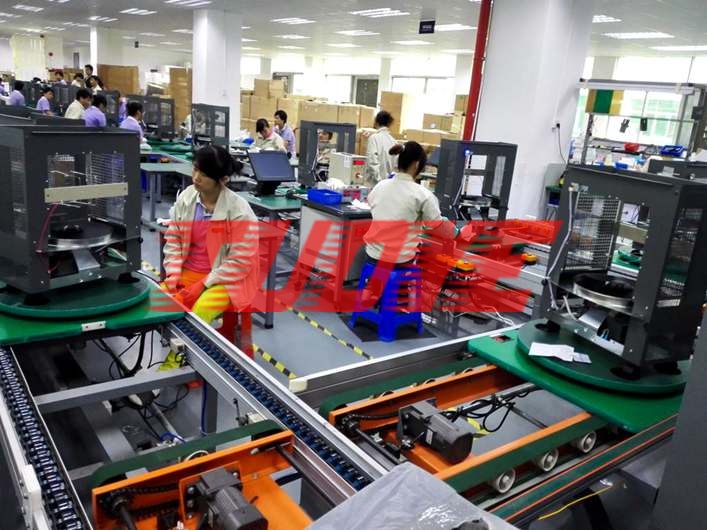
The air purifier market has run cold and hot — and every swing in demand forces a line to swing with it. The structure of an air purifier assembly line looks simple: base, blower, filters, shell, four sections done — but models turn over fast, and quick-change tooling is worth more than line speed. The trade also calls it an air purifier production line; the range spreads out: household tower units have long air paths and slim bodies; box units are compact and fast-moving; desktop units are small-part heavy with dense packing stations; commercial high-volume units are heavy with big blowers, so carrying and testing on the air cleaner assembly line are rated a class up; formaldehyde-specific models stack more filter layers, so their filter stations double.
The purifier's core is air path and filtration: the blower volute assembly decides airflow and noise; the pre-filter plus HEPA plus activated-carbon stack decides cleaning performance; CADR (clean air delivery rate), cumulative cleaning mass and noise are sampled per GB/T 18801. On the line, every unit gets a powered self-check and burn-in, with airflow and noise sampled by ratio — test stations on an air purifier production line are sized to the sampling rate, not one chamber per unit; chamber testing is sampling business. Commercial high-volume units draw real power, so their test-section supply and acoustic environment are fitted to the commercial class separately.
2. Process Flow (see photo)
Look at the photo of this air purifier assembly line: dual parallel speedchain lanes, green ESD pallets at one unit per board, black locating blocks locking the shells; at the left stations operators are dropping blower volute assemblies into shells — the blower marriage section; blue totes beside hold small parts like feet, seated ESD stools line the stations, yellow-green zoning paints the floor, and multi-tier burn-in racks queue the tested units in the distance. Assembly sequence: base and casters → blower volute assembly in (alignment, fastening, damping pads) → control board and sensor wiring → filter stack assembly → shell and panel closing → nailing and fastening → powered self-check and burn-in → CADR and noise sampling → cleaning and packing. On the purifier assembly line, the blower-marriage station carries torque-controlled electric drivers — over-tighten and the plastic posts crack, and every whistling air noise leaks out from exactly that station.
3. Customization & Service
The air purifier assembly line is configured to model range, daily program and changeover frequency: quick-change locating blocks, two-tier burn-in racks and station lighting selectable, with the dual-lane layout fitting multi-model plants. Tuoye — in Wenling, Taizhou, Zhejiang, China — delivers the air purifier assembly line with in-plant pre-assembly and on-site commissioning through acceptance, warranty one year, pallets and stoppers supplied long-term; plants with fast model cycles can order the full quick-change tooling set. For an air cleaner assembly line quotation, send the model list and program.
Two notes for purifier lines. First, make old and new model tooling quick-change locating blocks — one-minute board swaps: purifier model lifecycles are short, and an air purifier production line that cannot follow the product generation just gets re-bought every year. Second, size the burn-in racks at roughly a tenth of daily output with four hours per unit minimum — when peak season squeezes rack space, cut anything else before you cut burn-in; this account balances directly against reputation.