
1. Product & Industry Overview
Portable AC orders follow the northern hemisphere's summer — customers want goods in June, so the line must be turning by March. A portable air conditioner assembly line builds the all-in-one units with built-in compressors: no installation, exhaust hose out the window and it runs — which makes their assembly denser than window units and more integrated than split systems. The trade also calls it a portable AC production line; the models fall into three groups: household portables dominated by 1-2 HP class; industrial portables serving server rooms and construction sites, a size and test-duration class up; and heat-pump models with four-way valves, which add a reversal-valve assembly and test over cooling-only units. The station list on a mobile air conditioner production line follows this model mix.
The core process of any refrigeration line is "vacuum and charge": the system is evacuated and held to confirm leak-tightness, then refrigerant is charged by weight on electronic scales, controlled to the gram; before ex-factory come the safety tests — withstand voltage, insulation, leakage current — plus a powered run test. On a portable air conditioner assembly line, this equipment takes the bulk of the investment and the conveying line is the light part — do not build the budget upside down; plants running dehumidifiers and portable ACs on one platform just switch fixtures and charging parameters, and that line versatility is capacity flexibility.
2. Process Flow (see photo)
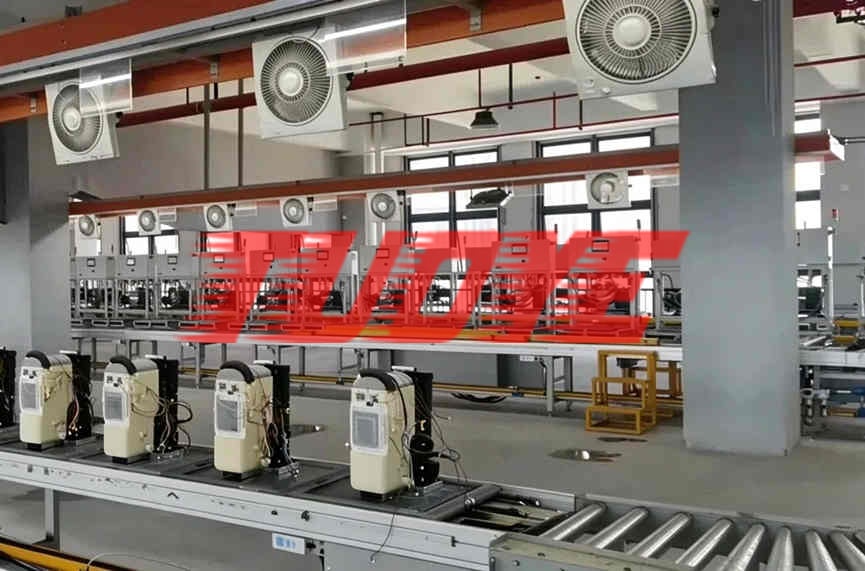
Look at the photo of this portable AC assembly line: on the lower tier, speedchain pallets carry off-white cabinets — compressor chamber outward, piping exposed, harnesses not yet dressed — the piping-welding and wiring section right after the heat-exchangers went in; above, a full row of gray test positions forms the powered run-test island, a dozen-odd slots side by side, each with its display window; big fans hang from the ceiling shedding the test zone's heat load; the roller tail takes units off line, and the stacked layout piles assembly and testing vertically, halving the footprint. Assembly sequence: base pan and compressor (damping mounts, bolts) → condenser and evaporator into chamber → piping welding → nitrogen hold & leak check → vacuum evacuation → metered refrigerant charging → panels and air ducts → safety tests (withstand, insulation) → powered run test (cooling capacity, current, noise) → cleaning and packing. On a portable AC production line, charging machines sit in ventilated positions with cylinder banks enclosed apart — safety procedure never takes a day off.
3. Customization & Service
The portable air conditioner assembly line is configured to model, daily program and test-island scale: leak-check method (nitrogen hold or helium) to the customer's standard, island slots counted backwards from burn-in duration. Tuoye — in Wenling, Taizhou, Zhejiang, China — delivers with in-plant pre-assembly and on-site commissioning through trial production, warranty one year, pallets and test couplings supplied long-term; adding test islands or expanding burn-in sections on existing mobile air conditioner production lines is taken too. For a quotation, send models and capacity requirements.
Two notes for refrigeration lines. First, size the test island's power supply at unit current times slot count plus 30% — in summer peak with every slot loaded, one tripped breaker idles the whole line for half an hour. Second, never shorten the vacuum hold time: the dozen minutes saved on a portable AC production line come back as half a day of re-brazing plus one freight bill, and that arithmetic reads clearest exactly in high season.