
1. Product & Industry Overview
A treadmill is half appliance and half machine — the console and electronics are its appliance heart, the deck and belt its machine body. A treadmill assembly line has to serve both halves: the mechanical sections care about torque and alignment, the electrical sections about connectors and testing. The trade also calls it a treadmill production line; the range falls into three classes: home folding machines (walking pads included) run high volume and fast changeover, so the fitness equipment assembly line is paced quick; light-commercial machines serve homes and studios alike, mid-spec; commercial machines weigh in above a hundred kilograms with big motors — tabletop loading and test-zone supply on the treadmill manufacturing line are rated separately for this class; export and domestic orders differ in voltage standard, so the test zone must switch.
A treadmill's quality reputation lands in two places: belt tensioning and whole-unit run-in. Every unit runs a powered break-in before leaving — speed curve, incline, e-stop, abnormal noise, the full pass; skip this step and every problem waits to sound off in the customer's living room. The test zone on a treadmill production line is wired to model power — commercial machines draw real current, so outlets and wire gauges must not be sized by household intuition; folding models get a fold-open-fold-shut action check unit by unit, and the test zone reserves operating space for exactly that motion.
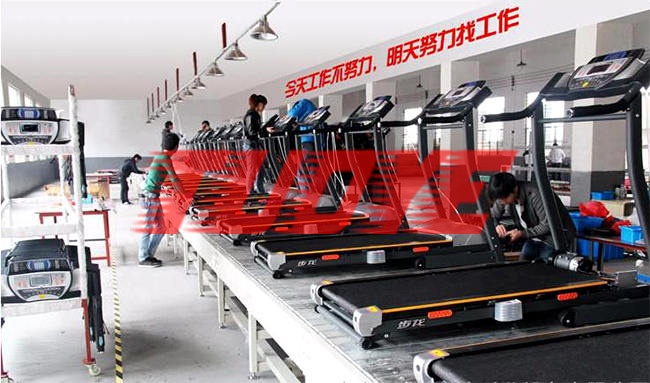
2. Process Flow (see photo)
Look at the photo of this treadmill assembly line: bench-type final assembly, long light-gray tabletops in a row, whole treadmills seated directly on top and advanced by hand; up close an operator leans in adjusting belt tension and fitting the bottom guard, mid-line another stands on a step ladder mounting uprights and consoles — the column work needs the height; white racks hold console boxes and parts, the open floor at the tail is the powered run-in zone, pendant lights run continuous over the tabletops, and dark-gray machines with orange trim line up one after another — the late final-assembly weather plain to read. Assembly sequence: deck sub-assembly (board, rollers, belt pre-tensioned) → frame and uprights → console and harness mating → handrails and trim guards → belt tension tuning → powered run-in test (speed, incline, e-stop, noise) → appearance check → off-line and packing. On a treadmill assembly line, the run-in positions lay damping mats — a machine running on bare concrete drowns its own abnormal noises in floor noise, and the listening judgment loses its reference.
3. Customization & Service
The treadmill assembly line is configured to model, daily program and workshop: bench lines start cheap and suit many-variety mid-volume work, upgrading to plate-chain conveying when volume enforces a hard beat; test-zone supply, damping mats and ladders come with the line. Tuoye — in Wenling, Taizhou, Zhejiang, China — delivers fitness equipment assembly lines with in-plant pre-assembly and commissioning through trial production, warranty one year, tabletop and roller parts supplied long-term; test-section expansions and plate-chain conversions on existing treadmill production lines are taken too. For a quotation, send models and program.
Two notes for fitness equipment lines. First, size the tabletop to the largest model plus two-person working margin — a commercial machine unfolds to nearly 1.8 meters, and the width saved at the start means the big models never board later; re-widening a treadmill assembly line is messier than building new. Second, order the stations "mechanical front, electrical rear" — dusty work like belt tensioning up front, fine work like console mating at the back: half the shop dust disappears, electrical defect rates follow down, and a treadmill manufacturing line's quality is ground out section by section exactly this way.