
1. Product & Industry Overview
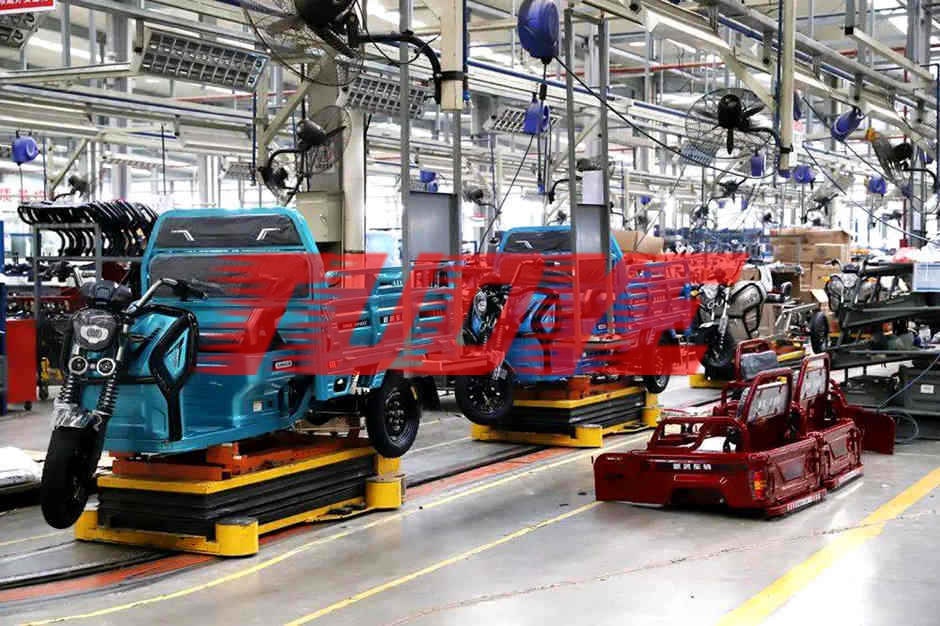
Electric tricycles are moving from the unregulated fringe toward compliance — catalog listing and motor-vehicle administration cover more models every year, and the test stations on an electric tricycle assembly line weigh heavier with each round. The electric tricycle assembly line (also called an e-trike production line) covers final assembly from frame on-line to whole-vehicle off-line; listed electric right-hand trikes run under GB/T 24158 for electric motorcycles with GB 7258 governing vehicle safety. The types: cargo e-trikes carry 300-800 kg with bed boards and canopy frames standard; delivery and sanitation models add racks and roller-shutter stations; passenger and leisure types build full enclosures with rear seats; motors split mid-mounted and direct-drive rear-axle layouts, the difference landing at the rear-axle station. Quality control on an electric tricycle production line sits in the three electrics — battery pack locking and harness routing, controller connector engagement, whole-vehicle insulation and charging checks — the three places where errors cost the most rework.
2. Process Flow (see photo)
Look at the photo of this e-trike production line's final assembly: yellow-edged black pallets carrying whole vehicles forward in steps along floor track; up close, a lake-blue cargo trike has reached head-to-bed marriage — motorcycle-style handlebar, instruments and black bumper bar all fitted, the bed with canopy frame; mid-line, the same blue model takes its bed boards, while two or three red frames and bed assemblies wait upstream, cartons holding front cowl parts; blue hose-reel balancers on the columns hang air wrenches, line-side racks stack fork and handlebar assemblies, industrial fans cool the line, an estimated 8-15 stations at 5-10 minutes a unit. Assembly sequence: frame on line (pallet-located) → front fork and handlebar → motor and rear axle assembly → controller and harness → battery bay and pack locking → brakes and wheels → bed and canopy → whole-vehicle electrical test (insulation, lamps, horn, charge port) → road test and off-line. Test stations on the e-trike assembly line include charger positions — a few minutes of full charging surfaces charge-circuit faults on the spot.
3. Customization & Service
Customization: pallets located per frame, quick-change across cargo and passenger types; battery on-line with assist hoists or slides; harness stations with routing-diagram boards; the test section carries whole-vehicle electrical benches and records per catalog requirements. Tuoye — in Wenling, Taizhou, Zhejiang, China — delivers the electric tricycle assembly line from in-plant pre-assembly and commissions through trial production, warranty one year, pallets, plate chain and balancer parts supplied long-term; peak-season station additions and belt-to-plate-chain conversions are common retrofits. For a quotation, send the model list (load class, motor layout) and daily capacity — test-station counts come checked item by item against the catalog models.
Two extra paragraphs on the harness station: e-trike harnesses run many connectors through tangled paths — this station on the electric tricycle assembly line takes routing slots and poka-yoke plugs, so a half-seated connector physically cannot latch, and missed-insertion rates collapse. Battery locking runs at set torque with paint-marker lines — one glance tells whether a bolt was missed; whole-vehicle insulation testing before off-line files high-voltage models separately. These few configurations on an electric tricycle production line are exactly what catalog audits and vehicle inspections check first — getting them right the first time beats a crash course before every audit, by a wide margin.