
1. Product & Industry Overview
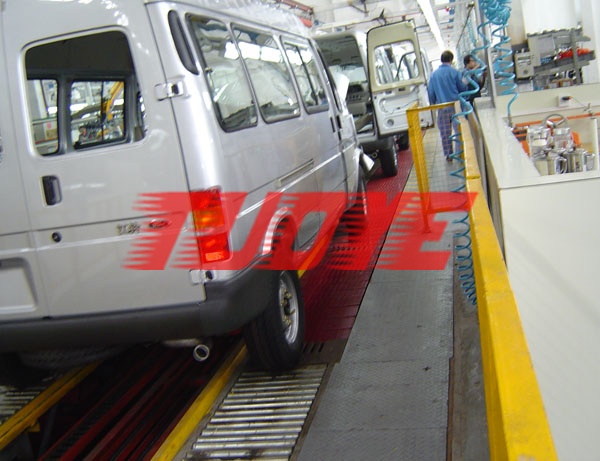
A commercial vehicle assembly line does heavy labor — curb weights run to several tonnes, so plate-chain loading, drive power and structural stiffness all have to be engineered for heavy duty; dress a truck production line in passenger-car thinking and it starts failing before long. The commercial vehicle assembly line (also called a commercial vehicle production line or truck assembly line) serves the final assembly of cargo trucks, tractors, buses and special vehicles; Tuoye's truck production lines in Wenling, Taizhou, Zhejiang, China are designed for heavy load and flexibility at once.
Commercial vehicle assembly does not follow the passenger-car script: parts are heavier and variants more numerous, and the "main line plus sub-assembly lines" pattern runs deeper — engine and gearbox join into a powertrain on the sub-assembly line first, while doors, instrument panels and frames are pre-assembled separately and fed to the main line for marriage. At the market-entry level, mechanized body trim lines and flow-line chassis assembly are already baseline requirements. New-energy commercial vehicles have added new stations to the truck assembly line — battery pack marriage and e-drive axle assembly are today the most-asked items in both retrofit and new-build projects.
2. Process Flow (see photo)
Look at the photo of this truck production line: a red wide-deck plate chain carries cabs and frames flowing together, metal grating walkways and service platforms along both sides for high-level work (commercial vehicles are tall — without walkways, the top bolts are simply out of reach); yellow guardrails run at working height, blue spiral air hoses feed suspended balancer tooling so the tools hang weightless — hundreds of large bolts a day without wrecking operators; line-side racks replenish to the JIT beat, electrical cabinets control the line centrally, and the off-line ramp at the end lets vehicles drive off. Assembly sequence: frame on line → chassis upside-down build (powertrain, propeller shafts, axles, air and brake lines) → frame flip → cab marriage → trim and glass → wheels and cargo body or upper structure → fluids → interior/exterior inspection → test line (brakes, headlamps, alignment) → road test and off-line. The bottleneck on a commercial vehicle production line is rarely assembly itself but line-side logistics — if the delivery sequence of heavy parts does not match the stations, the line stops waiting for material, so logistics lanes and assembly stations must be planned together.
3. Customization & Service
A commercial vehicle assembly line is delivered as a turnkey project: plate-chain width, loading and drive power rated to the vehicle types; flip machines, marriage hoists, torque-controlled tightening and filling equipment configured to the process; sub-assembly lines, test line and water-test line planned as a whole; electrics integrable with ANDON call, counting and cycle display. Before proposing, Tuoye takes three inputs — vehicle range (heavy, medium, light trucks, buses, special chassis), JPH target and workshop conditions — then delivers the general layout and section-wise equipment lists, with phased construction supported. Equipment enters in batches after pre-assembly and loaded trial runs, and on-site commissioning is accepted with trial vehicle production, maintenance crews trained. Warranty one year; chain plates, running gear, guardrails and drive spares supplied long-term. New heavy-truck lines, light-truck line speed-ups and NEV conversions of legacy commercial vehicle production lines — all three project types are taken; for a truck assembly line quotation, get in touch for details.
Two more paragraphs on line-side logistics, the easiest place for a commercial vehicle assembly line to trip. Heavy parts — powertrains, cabs, axles, tire sets — need one delivery-to-sequence sheet managing them end to end; one wrong sequence stops the whole commercial vehicle production line waiting for parts. Bodies-on-frame and third-party upper structures also need interface slots reserved for suppliers. Then the off-line ramp: grade and loading on a truck production line are rated to the largest vehicle, and tall cabs must clear the ramp headroom — numbers Tuoye measures one by one at the site survey. The photo, with two vehicles running the red wide plate chain at once, is exactly the confidence of heavy-duty design — with single-point loads above three tonnes, a truck assembly line runs a decade at full load without chain replacement, and on total cost that is the cheaper account.