1. Product & Industry Overview
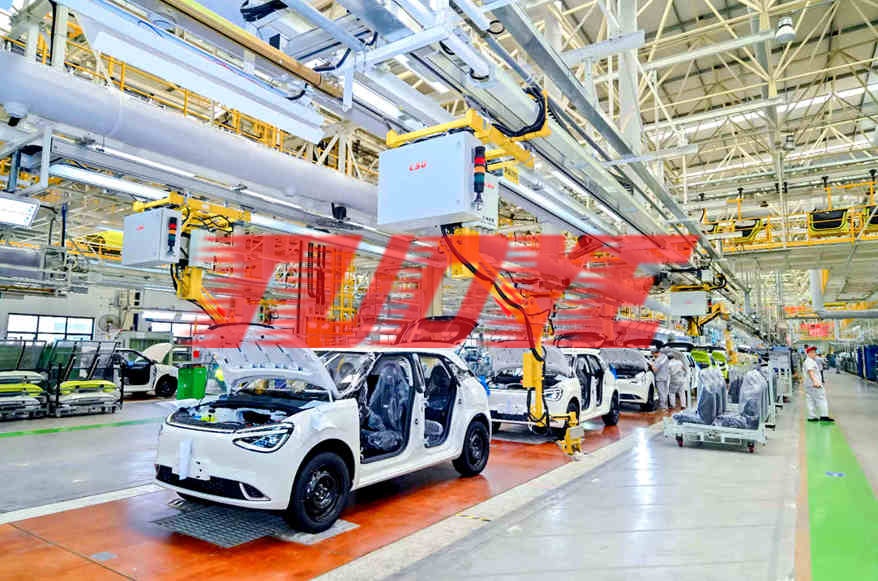
Using an overhead chain on an EV assembly line follows a simple logic: suspend the body in the air for conveying, and give the entire floor to assembly work and logistics — the workshop goes three-dimensional, with one overhead track serving what three floor tracks would. The EV assembly line (also called an EV production line or NEV assembly line) covers body conveying across the welding, paint and final assembly stages; Tuoye's overhead conveyor lines in Wenling, Taizhou, Zhejiang, China are engineered to the vehicle platform and cycle time.
EV manufacturing still runs the four big processes — stamping, welding, painting, final assembly — but the powertrain changed and final assembly changed with it: battery packs and e-drive systems replace engine and gearbox, and integral chassis marriage became mainstream — front suspension, battery and rear suspension marry the body simultaneously in one fixture set. The body-in-white travels from welding through paint to final assembly on overhead conveyor chains or AGVs; the pretreatment and oven stages around painting, with their high heat and humidity, are the overhead chain's home ground — suspended travel keeps the paint finish untouched while doubling as body buffer and cycle smoothing. That flexibility is exactly what an NEV production line is bought for.
2. Process Flow (see photo)
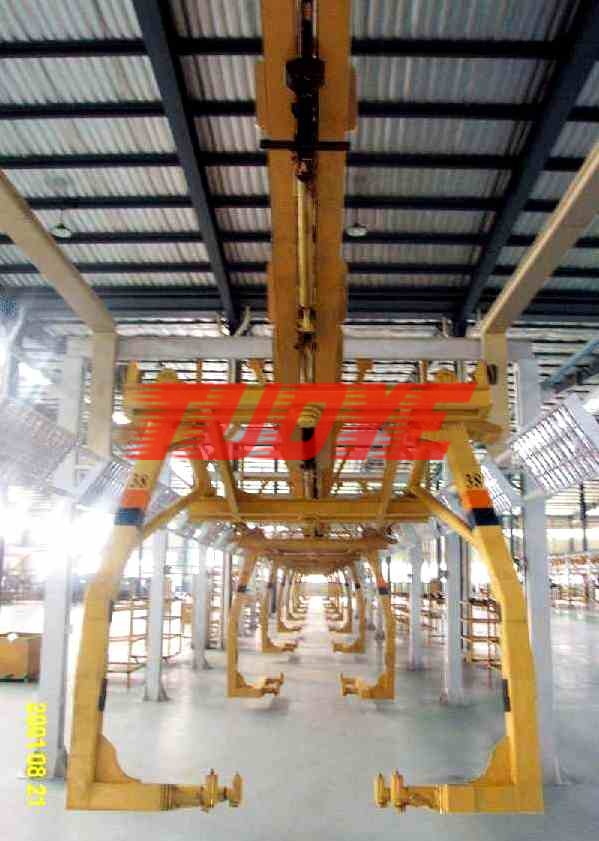
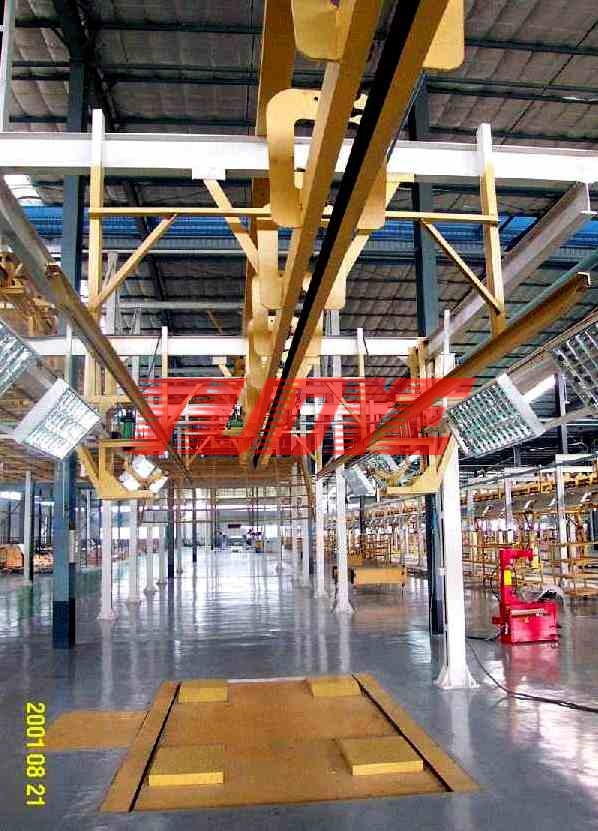
The photos show two sections of one EV production line. First: yellow overhead track laid along the plant roof steelwork, a string of sedan-frame carriers in sequence, conductor rail and collectors keeping the carriers powered, bodies hanging in the air in straight-through flow with work faces on both sides; columns and steelwork carry the track, station lighting frames lining the sides. Second: twin lines laid symmetrically with a central lane, yellow lift/turntable platforms on the floor handling body on-off line, and red control cabinets governing start-stop and cycle. Process flow: BIW onto carrier → overhead conveying into paint or final assembly stations → trim assembly (harness, instrument panel, headliner) → chassis marriage (battery pack, front and rear suspensions marrying the body) → body off line to floor-based final assembly → wheels, seats, doors → test line and water test → road test and off-line. On an EV assembly line, the marriage station is the precision-critical link — the docking error between carrier locating and floor fixtures must be held to the millimeter level.
3. Customization & Service
The overhead system of an EV assembly line is project-customized: track routing, lift sections and turntables follow the workshop and process; carriers are built to each platform's locating points and designed quick-change (a must for multi-model lines); conductor-rail capacity and collectors are calculated for live work on the line; one step further combines it with floor plate chain, EMS trolleys or AGV into hybrid conveying. To propose an NEV conveying package, Tuoye needs the vehicle platform, JPH capacity and plant steel structure conditions — and the track point loads must be cross-checked with the building designer; that step cannot be skipped. Equipment is pre-assembled and trial-run in our plant; after on-site track installation, load tests run before acceptance with trial body production. Warranty one year; carriers, collectors, chain and drive spares supplied long-term. Speed-ups and smart upgrades of older paint-shop overhead chains are taken too. For an EV production line proposal, come to the table for details.
One action that must happen early: the plant steelwork check. The carrier point loads of the overhead chain have to be calculated together with the building designer — track, body, carrier plus dynamic loads add up to several tonnes per rail run, up to a dozen-plus; if the steelwork falls short, you either reinforce or reroute, and no EV assembly line proposal should be frozen before that check. Then the carriers: on a multi-model EV production line, carriers are designed quick-change on locating points — one pin-set per model, a ten-minute switch; the synchronization accuracy between battery carriers and body carriers at the marriage station must be jointly commissioned with the floor fixtures, and that commissioning window has to be reserved in the project schedule. The yellow lift-turntable platform in the second photo is exactly for this — body on-off line and track changing on an EV assembly line all rely on it to bridge floor and overhead.