
1. Product & Industry Overview
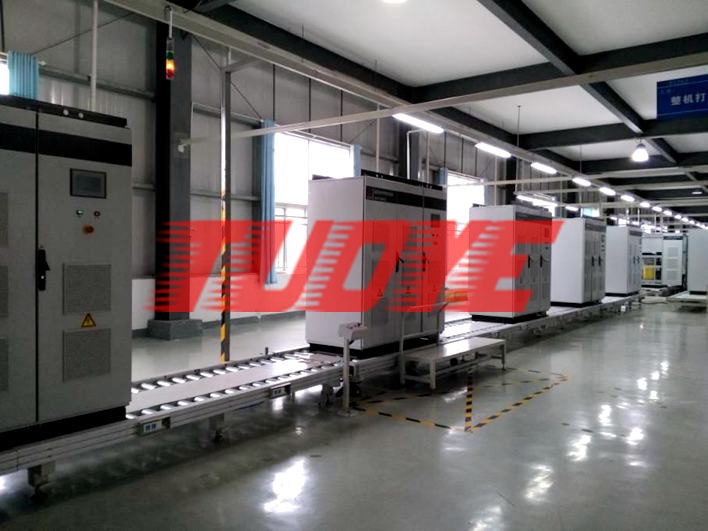
There is a saying in the switchgear trade: distribution boards are "primary" business, control cabinets are "secondary" business — and that one line decides what the two lines look like. A control cabinet assembly line builds the cabinets that live on their secondary circuits — PLC cabinets, VFD cabinets, soft starters and SVG compensation cabinets; the trade also calls it an electrical control cabinet production line. Sort the types: PLC cabinets carry the most ducting and terminal strips, with wiring labor dominating; VFD and soft-starter cabinets need heat dissipation and cable room around the power devices; SVG cabinets go modular plug-in, with yet another internal layout. A heavy-duty speedchain at one cabinet per pallet is the most universal backbone for an electrical cabinet assembly line.
The rules of secondary circuits are written in GB 50171: copper insulated wire no smaller than 2.5 mm² for current circuits and 1.5 mm² for the rest, with wire markers, ducting and terminal strips each indispensable; ex-factory units pass insulation resistance, power-frequency withstand and protection-action tests — three hard gates before power-on. Lighting over the VFD cabinet assembly line stations should be pushed to the maximum — wiring operators who cannot read wire markers double the rework rate.
2. Process Flow (see photo)
Look at the photo of this control cabinet assembly line: cabinets weighing hundreds of kilograms, one per white heavy-duty pallet, on twin parallel lanes. At the near end a cabinet's HMI screen is already lit, button stations and indicator lamps fitted — the powered debugging section; mid-line, cabinets have doors on and secondary wiring finishing; further on, bare frames take their copper busbars — the process flow reads itself at a glance. Section boards hang from the crossbeams, three-color ANDON lights sit on the columns, yellow-black hazard tape circles the inspection hold area on the epoxy floor, and corner guards wrap the columns. Assembly sequence: cabinet frame on line → primary copper and busbars (torque fastened, marks applied) → breakers, contactors, VFD drives and components → ducting and terminal strips → secondary wiring (markers sleeved, dressed and tied) → door HMI, buttons, indicators → wire-number verification → insulation and withstand-voltage tests → powered simulation debugging → factory inspection. On an electrical cabinet production line the HV and debugging sections take their own enclosures and audible-visual alarms — in high-voltage areas, the rules stand before output, always.
3. Customization & Service
The control cabinet assembly line is configured to cabinet range, weight and daily program: debugging-station power capacity, HV test enclosures, ANDON, wire-marker printing fitted as needed. To propose an electrical assembly line, Tuoye — in Wenling, Taizhou, Zhejiang, China — takes three inputs: cabinet list, capacity, workshop conditions. Equipment ships after in-plant pre-assembly and loaded trial runs, commissions through trial production, warranty one year, pallets and stoppers supplied long-term; volume retrofits and added debugging sections on existing electrical cabinet production lines are common jobs too. For a control cabinet assembly line quotation, send the cabinet range over.
Two notes for electrical assembly lines. First, put an inline wire-marker printer at the secondary wiring stations — pre-printed marker bags get mixed up, but printing and sleeving on the spot halves the error rate, and this small investment pays off immediately on a VFD cabinet assembly line. Second, feed the debugging section through an isolation transformer with regulation — workshop grids churned by welders and cranes put spikes into every withstand and calibration reading. This is the block most often cut when planning a control cabinet assembly line, and the one most regretted after.