
1. Product & Industry Overview
When module prices fall, installed capacity climbs, and inverter makers' order books fill — the bottleneck usually sits not in assembly but in burn-in. An inverter assembly line builds the heart equipment of PV and storage; the trade also calls it an inverter production line or solar inverter assembly line. The range spreads out: string inverters serve residential and commercial rooftops in the largest numbers; central inverters go to ground-mount stations at megawatt scale, assembled by modular power units; storage PCS and hybrid inverters carry battery interfaces, adding a class of bidirectional charge-discharge test stations — the station list on a PV inverter production line is checked separately by power class and test items.
Power-electronics assembly runs on three iron rules: ESD, torque, burn-in. IGBT and SiC power modules fear static, so full-line ESD is standard; the seating of power modules against heatsink housings and the torque values of main-circuit copper are written into the process files; units pass withstand-voltage and insulation tests, then run full load on the burn-in line — pre-test, burn-in, post-test, a three-gate structure. On a storage inverter assembly line, burn-in stations often outnumber assembly stations — that is not over-configuration, it is the yield law of power electronics.
2. Process Flow (see photo)
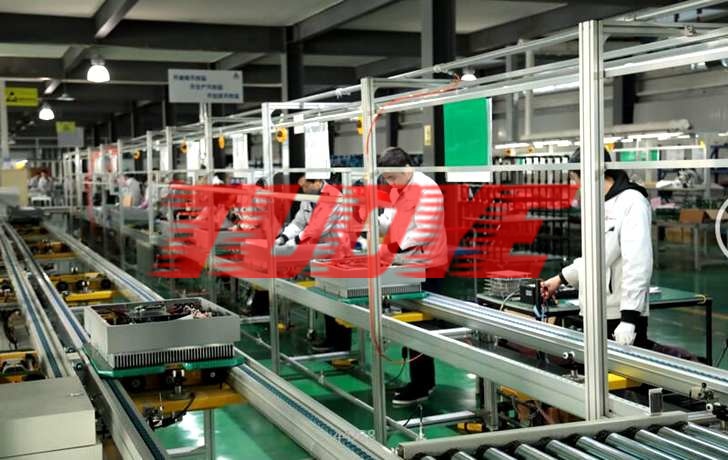
Look at the photo of this inverter assembly line: a free-cycle speedchain with dwell pallets — operators park the pallet at their station, assemble at their own pace, and release when done, the right rhythm for power-electronics units with long single-station labor and many variants; aluminum gantry frames span the line, one SOP process card per station hanging from the beams, air lines and lighting routed on the frame; on the pallets, inverters in silver finned heatsink housings line up — the one on the left has its lid open, harnesses and magnetics visible inside, the wiring stage right after power-module assembly; the roller section at right takes units off line, and operators wear white ESD smocks. Assembly sequence: heatsink housing on line → power modules and driver boards (thermal interface, torque-controlled fastening) → control and sampling boards → inductors and transformers (magnetics) → main-circuit copper and internal wiring → whole-unit fastening check → withstand and insulation test → lid closing → into the burn-in line under load → performance test (efficiency, protection functions) → packing. On the solar inverter assembly line, the HV and burn-in sections take enclosures and warnings — in high-voltage areas, rules stand before output.
3. Customization & Service
The inverter assembly line is configured to power class, daily program and burn-in scale: SOP frames, MES scanning, torque tools and wrist-strap monitoring selectable, burn-in line capacity calculated as daily program times burn-in duration. Tuoye — in Wenling, Taizhou, Zhejiang, China — delivers PV inverter assembly lines with in-plant pre-assembly and commissioning through trial production, warranty one year, pallets and chain parts supplied long-term; expanding burn-in sections on existing inverter production lines is frequent work. For a quotation, send power classes and program.
Two notes for power-electronics lines. First, calculate burn-in capacity before building — the classic miss on an inverter assembly line is a big assembly section with too few burn-in slots, product piling up at the burn-in door and the two sections permanently out of balance. Second, ESD discipline must cover people, not just equipment: wrist-strap monitors belong at the stations — hand out smocks without monitoring, and static-damaged units surface in burn-in a month later, with ugly blame and uglier data. That little monitor is the most direct return on investment an inverter production line can buy.