
1. Product & Industry Overview
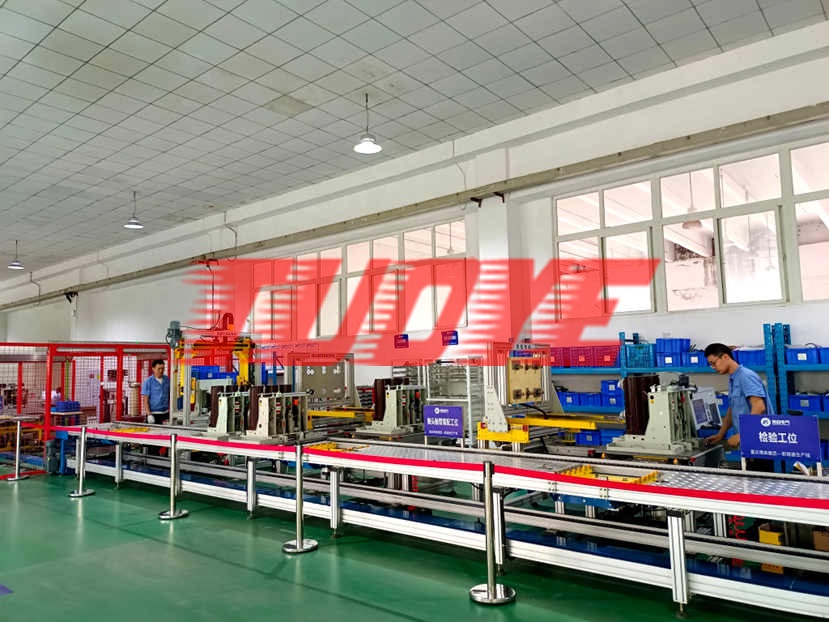
Every medium-voltage switchgear cabinet takes one breaker truck, and wherever switchgear plants expand, breaker orders follow — VS1-class vacuum circuit breakers are the highest-volume core component of 12 kV distribution cabinets. The vacuum circuit breaker assembly line (also called a VCB production line) covers final assembly from mechanism frame on-line to whole-unit characteristic testing for VS1/VD4-class indoor HV vacuum breakers; the product runs under GB/T 11022 and GB 1984, with rated currents 630-3150 A and short-circuit breaking 20-40 kA matched to the cabinet. The types: VS1 (ZN63A) with spring mechanism in drawout form holds the mainstream, VD4 sharing the platform in part; by pole technology, solid-embedded poles seal the interrupter in epoxy — fewer process steps, reliable insulation — against assembled poles; above 2500 A, contacts and heat-dissipation structures both strengthen. Quality control on a breaker line sits in three places: interrupter and pole assembly cleanliness, the uniformity of tulip-contact finger pressure, and mechanical characteristics (open/close times, three-phase synchronism, closing bounce).
2. Process Flow (see photo)
Look at the photo of this breaker assembly line's final section: a wide speedchain on aluminum frames with red-white edging, white pallets with yellow locating pins carrying breaker bodies station to station; on the left, a yellow-framed servo press in red mesh guarding runs the press-fit operations for contact seats and pins; mid-line, a silver-gray flip fixture turns the body for two-side working, the right-hand section carries test-station boards, blue racks feed in EU tote boxes, 10-14 stations overall. Assembly sequence: mechanism frame on line → pole columns and vacuum interrupters assembled → primary circuit connection (upper/lower contact seats and tulip contacts) → insulation pull-rods and drive links → spring operating mechanism (charging motor, open/close coils) → secondary plugs and auxiliary switches → mechanical characteristic adjustment and test (times, synchronism, travel, overtravel) → main-circuit resistance and power-frequency withstand → chassis truck assembly and insertion commissioning (drawout type) → nameplate, packing. On the breaker assembly line, characteristic tests record curves unit by unit; bounce and synchronism out of tolerance get the mechanism adjusted and retested at the same station.
3. Customization & Service
Customization: pallets serialized quick-change to frame and pole-center distances (a 630 and a 3150 frame differ a good stretch); press machines with force-curve monitoring; characteristic test benches per voltage and current class; truck assembly with insertion rails per chassis model. Tuoye — in Wenling, Taizhou, Zhejiang, China — delivers the vacuum circuit breaker assembly line from in-plant pre-assembly and commissions through trial production, warranty one year, pallets, speedchain and test-bench parts supplied long-term; retrofits adding automatic characteristic testing or MES traceability are taken too. For a proposal, send the specification range and monthly capacity — the test-section instrument list comes configured with it.
One safety floor no breaker line crosses: the power-frequency withstand station is built to HV-lab standards — isolation, interlocks and grounding, no entry during tests, power cut on any opened door — and this set belongs in the drawings from proposal stage. Tulip-contact finger springs get gauge-checked group by group: uneven pressure means local heating at closing. Interrupters travel from unboxing to assembly inside clean stations — a dusty ceramic shell is an insulation hazard waiting. VS1-class drawout models add the truck insertion commissioning pass: the breaker assembly line verifies truck-to-contact-box engagement on-line, so units reach the switchgear plant ready to load — component-supplier reputation is built exactly there.