
1. Product & Industry Overview
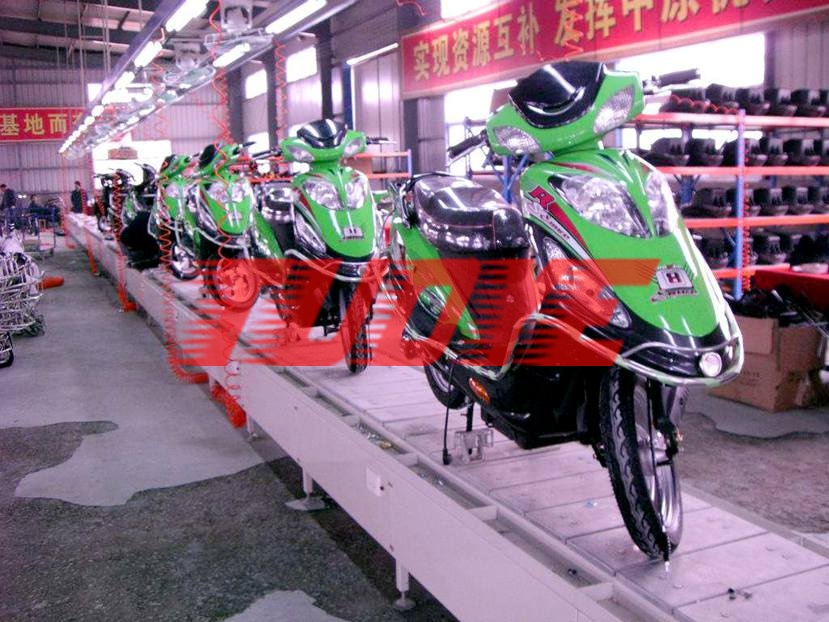
Since the new national standard landed, the test stations on an electric bike assembly line have moved from "optional" to "mandatory". An electric bike assembly line (also called an e-bike production line or electric bike assembly line) assembles frame, front fork, motor, battery, controller and plastic parts into a finished vehicle to cycle time; Tuoye's e-bike production lines in Wenling, Taizhou, Zhejiang, China have landed projects across national-standard bikes, e-motorcycles and sharing-fleet custom models.
Sort the vehicle types out first, because the line processes genuinely differ: electric bikes under the new national standard are speed- and weight-limited with pedals, and off-line checks cover vehicle mass, overspeed alert tone, insulation and withstand voltage; electric mopeds and e-motorcycles follow the motor-vehicle homologation route, with higher power and braking demands; sharing-fleet bikes add a positioning head unit and battery-swap structure. Sub-niches — heavy-load carriers, folders, delivery bikes — each bring their own plastic-part layouts and battery compartments. So before configuring an e-bike assembly line, list the product catalog and the tests each model must pass, then fix the stations — especially the test section: if its length is not reserved, there is no room to add it later.
2. Process Flow (see photo)
The photo shows a short-layout single electric bike assembly line: white workholding pallets carry complete vehicles along plate chain, five or six main stations, the vehicle more complete the further down the line, essentially finished at the end; the line is metal-extrusion construction, red spiral air hoses and junction boxes feed each station, a lighting frame overhead keeps the lux up, and racks beside the line stack frames and boxes of plastic parts. Assembly sequence: frame on line → front fork and handlebar → motor and rear wheel → controller and harness → battery installation and connection → brake and drive adjustment → plastic parts and seat → static whole-vehicle checks → dynamic roller testing → appearance inspection, packing and off-line. Cycle times on an e-bike production line commonly run from tens of seconds to just over a minute, and the pace is pressed by two levers: line balancing (no single station should queue) and line-side material feeding (if parts cannot keep up, a fast line counts for nothing).
3. Customization & Service
Common options on an electric bike assembly line: wheel sub-assembly line and frame pre-assembly line hung off the main line, plastic-parts kiosk stations; the test section integrates insulation resistance, withstand voltage, lighting, brake and roller testing, with bar-code binding to the frame number and archived test data — with that in place, dealers take delivery with confidence. To quote an e-bike production line, Tuoye first maps the model type (national-standard bike or e-motorcycle), daily capacity target and workshop length × width, then issues the floor layout and equipment list; parallel twin lines and U-shaped layouts have both been built. Equipment is pre-assembled and trial-run before shipping, commissioned on site through trial production. Warranty one year; pallets, chain plates and pneumatic parts supplied long-term. Retrofits of older electric bike production lines are frequent too — speeding up, adding test stations, and adding bar-code traceability are the three most common jobs. For a proposal and lead time on an electric bike production line, just send the parameters.
A few plain words. First, do not cut the test section. Vehicle mass, overspeed alert and insulation withstand are hard items for national-standard bikes; an e-bike assembly line spending a third of its length on testing is normal, and the money saved by cutting it gets paid back double sooner or later. Second, sharing-fleet custom models (battery-swap structure, head unit with positioning) need different stations from household bikes — settle the product roadmap before configuring the electric bike assembly line, not just the models in front of you. Third, sizing capacity: 200-300 units per day per line is the common scale for an e-bike production line; once the balancing sheet is drawn, the bottleneck station is obvious at a glance — Tuoye attaches the cycle-time calculation to every proposal, and that sheet tells you whether the electric bike assembly line is worth its price. The short single line in the photo suits a start-up plant; plants with room go straight to twin parallel lines, where logistics feed both sides more smoothly.