
1. Product & Industry Overview
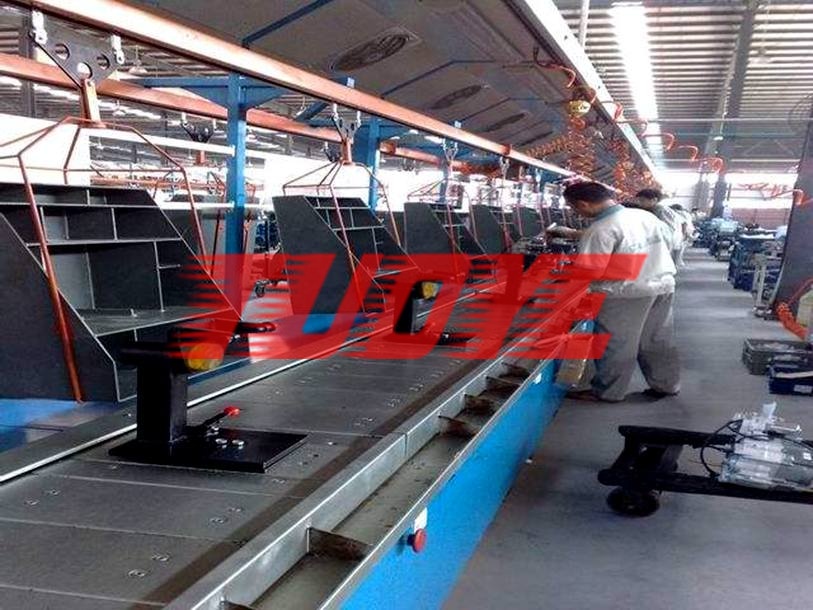
Engine assembly fears two things above all: tightening without numbers, and cleanliness out of control. A motorcycle engine assembly line is designed against exactly those two — built from a main line, sub-assembly lines and station tooling, it assembles crankshaft, crankcases, cylinder and head, clutch and magneto in sequence into an engine that can pass the hot test. The trade also calls it a motorcycle engine production line, and the same line concept serves general-purpose gasoline engines and small power units.
Sort the engine types first: scooter engines are CVT and compact; street-bike engines carry geared transmissions across a wide displacement span; underbone engines use automatic clutches on the economy end. Cooling splits into air, water and oil. On a motorcycle engine assembly line these differences mean different pallet fixtures, different crankcase-marriage processes and different tightening torques — a 50 cc underbone and a 400 cc street bike are two entirely different station plans. So the engine production line proposal must do a process analysis per engine family, and the key stations (crankcase marriage, cylinder-head tightening) must carry torque-controlled tooling and poka-yoke; a line that lives on veteran feel never holds its quality.
2. Process Flow (see photo)
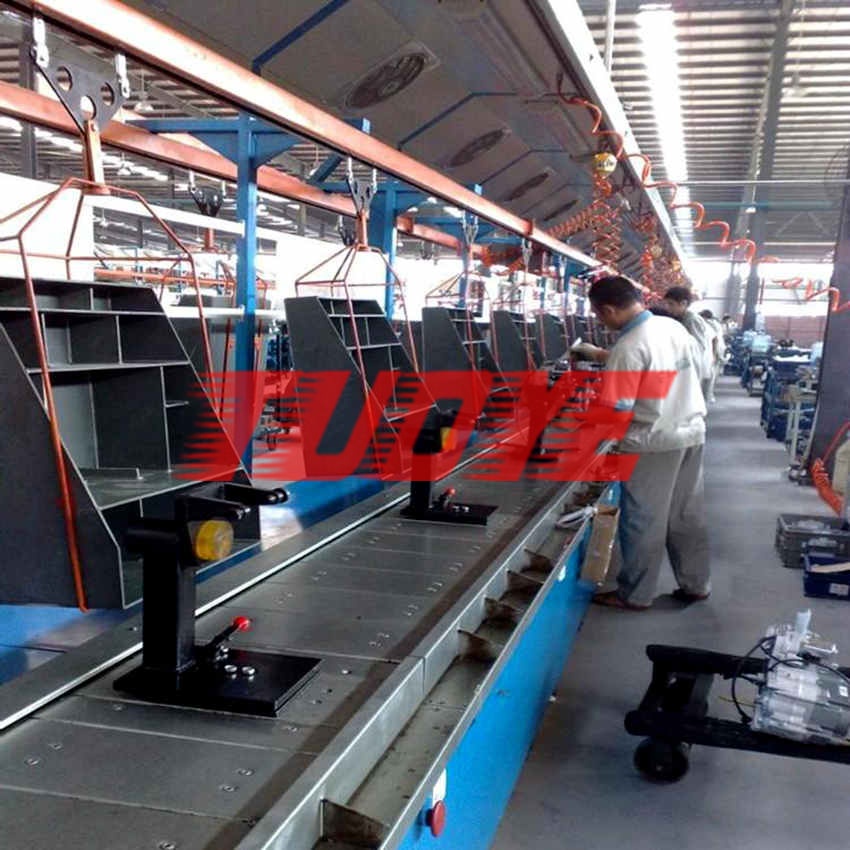
Look at the photo: engines sit on metal workholding pallets with locating bolt holes, flowing along plate chain; black dedicated fixtures and stands hold the units, stop-and-locate mechanisms park each pallet precisely at its station; e-stops and pneumatic hose reels run along the line, and the lighting bridge overhead pushes illumination to full. Look further up — above the line runs an overhead conveyor chain, hanging cylinder blocks and other heavy parts down to the stations: a two-level layout of "overhead feeding, floor-level assembly" that occupies zero floor space. Assembly sequence: crank & connecting-rod sub-assembly and press-fit → left case on line, crank bearing press-fit → right case marriage (sealant, torque-controlled tightening) → gear train and clutch → cylinder and piston → cylinder head (sequential torque control) → magneto and starter → carburetor or EFI → leak test → break-in hot test and off-line. On an engine assembly line, foreign-object control and tightening data are the two lifelines, and the hot-test station needs quick couplings pre-built for cooling water, fuel, exhaust and oil pressure.
3. Customization & Service
A motorcycle engine assembly line is built per engine family: pallet fixtures, marriage press equipment and torque-controlled tightening systems all follow the model range; the line end can take leak testing and hot-test benches with acoustic treatment; plants moving upmarket add smart electric screwdrivers and MES data capture, so every single bolt's torque can be looked up. To propose an engine assembly line, Tuoye — in Wenling, Taizhou, Zhejiang, China — needs three inputs — engine family range, annual capacity program and workshop conditions. Equipment is pre-assembled and trial-run in our plant, then commissioned on site through trial production, with operators and maintenance staff trained. Warranty one year; fixtures, pallets and stoppers supplied long-term. General-purpose engine assembly lines and retrofits for model changeovers on existing lines are taken too. For an engine production line quotation, send the engine documentation and the proposal, price and lead time come back together.
Two pieces of field experience for anyone specifying an engine line. First, cleanliness: the motorcycle engine assembly line fears foreign objects most — pallet returns should carry blow-off and chip trays, the sealant station at crankcase marriage should be isolated, and the tightening stations must ban unrelated parts from piling up. These small things cost little, but when a hot test turns up an untraceable rattle, the bill nearly always traces back to them. Second, hot-test couplings: the hot-test station on an engine production line should pre-build four quick-coupling circuits — cooling water, fuel, exhaust and oil pressure — couple, test, decouple, and the cycle time holds; the acoustic treatment belongs on the enclosure around the test zone, or the noise data never reads true. The overhead feeding chain in the photo is a genuine plus: cylinder blocks arrive from above and the entire floor lane on the motorcycle engine assembly line stays with logistics — the classic "sky chain, floor chain" setup, equally convenient to retrofit into older plants.