
1. Product & Industry Overview
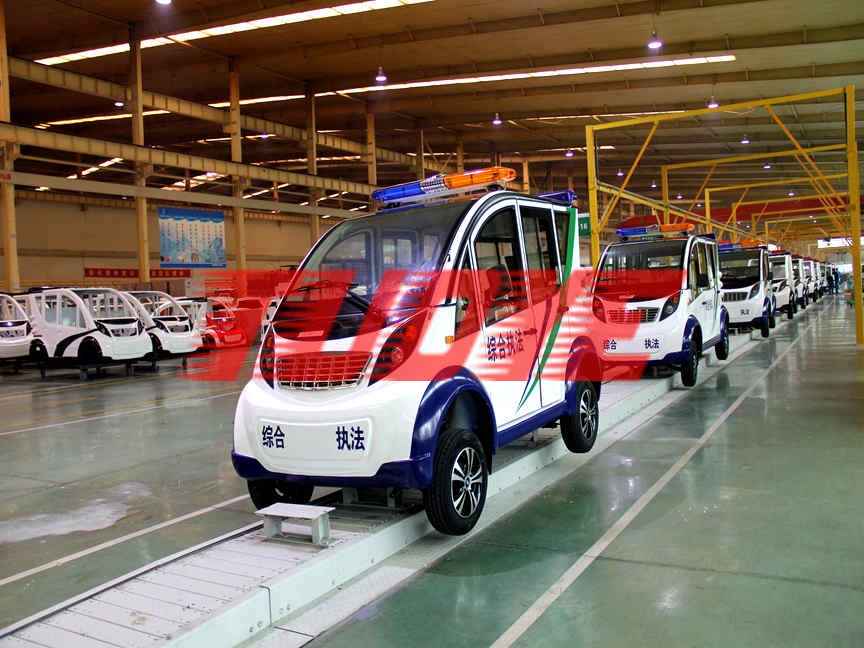
City management, scenic areas, campuses, industrial parks — the buyers of electric patrol vehicles keep diversifying, and the model range of the electric patrol vehicle assembly line widens with them. The patrol vehicle production line (also called an electric patrol vehicle assembly line) completes the final assembly of 4-wheel low-speed patrol vehicles from chassis to whole-vehicle off-line; these vehicles fall under the special-purpose in-plant motor vehicle class, technically per GB/T 21268 for non-road sightseeing vehicles, with use-phase registration under the special equipment rules. The types: 2/4/6/8-seat patrol vehicles by crew; open bodies with rain canopies are the mainstream form; police liveries, warning lights and PA systems fit out per the purchasing authority; cargo-patrol and fire-patrol variants extend the family. Quality control on an electric patrol vehicle assembly line sits in battery-electrics and brake-steering — battery pack fixing and harness protection, brake line sealing, steering clearance setting — and every unit passes a road test before delivery.
2. Process Flow (see photo)
The photo shows the off-line section of this patrol vehicle production line: a low-floor plate chain running flush to the ground, whole electric patrol vehicles in queue — 8-10 units in city-enforcement livery with warning lights, bumpers and seats all fitted, lined up in the buffer zone awaiting road test and dispatch, a body-panel buffer laid out on the left for panel turnover; the low plate chain suits exactly these low-chassis, frequently boarded vehicles — operators step across the line working comfortably. Assembly sequence: frame chassis on line → rear axle and motor assembly → steering gear and front axle → brake lines → battery pack installation and wiring → controller and instrument harness → body panels and canopy → seats and flooring → warning lights, PA and other dedicated equipment → whole-vehicle debugging and road test. The road-test station on this utility vehicle line checks brakes, lights and top speed per GB/T 21268, and the patrol vehicle line's tail carries a preparation zone — labeling, charging and inspection in one flow.
3. Customization & Service
Customization follows vehicle type and duty: plate-chain loading sized to the largest model (8-seat or cargo), police-equipment stations laid per the fitting list, paint pre-treatment and film stations optional. Tuoye — in Wenling, Taizhou, Zhejiang, China — takes three inputs for the patrol vehicle line: vehicle range, daily program, workshop conditions; equipment ships from in-plant pre-assembly and commissions through trial production, warranty one year, plate chain, tooling and electrical parts supplied long-term. For a quotation and lead time, send the vehicle configuration table — the multi-seat compatibility plan comes with it.
Patrol vehicle deliveries run seasonal: buyers order in clusters before spring and the tourism season, so installation and commissioning of the utility vehicle line must be scheduled backwards into the slack months. Two production details: first, give body-panel stations full buffer racks — painted parts fear dents, and delivery is metered to the stations; second, keep battery assembly and charging zones apart on the electric patrol vehicle assembly line, the charging zone fitted with ventilation and fire protection — auditors visit these two spots first. In the patrol vehicle production line proposal, the road-test area is sized to the model's top speed — loop track or straight acceleration lane, decided together with the model range.