
1. Product & Industry Overview
At a motorcycle plant, engines, frames and body panels each run their own sub-assembly — and they all meet at final assembly: the value of a motorcycle assembly line is squeezing these several part flows into one beat. The motorcycle assembly line (also called a motorcycle production line) completes final assembly from bare frame to finished street motorcycle; vehicle safety follows GB 7258 and off-line inspection runs per GB 38900. Note this is the whole-vehicle line — distinct from engine assembly lines and electric scooter lines: engine lines do the precision work of crankcases, cylinder heads and gear trains; scooter lines are panel-heavy with CVT drives; street-bike lines run exposed frames, chain drives and heavy hoisting — each with its own station logic. The types: 125-250 cc commuters run big volume at fast beats; 400 cc-and-up machines carry long labor and many torque points; off-road and retro models share lines in small batches, switching on quick-change fixtures. Quality control sits in three places: engine mounting torque, brake system assembly, and chain drive alignment.
2. Process Flow (see photo)
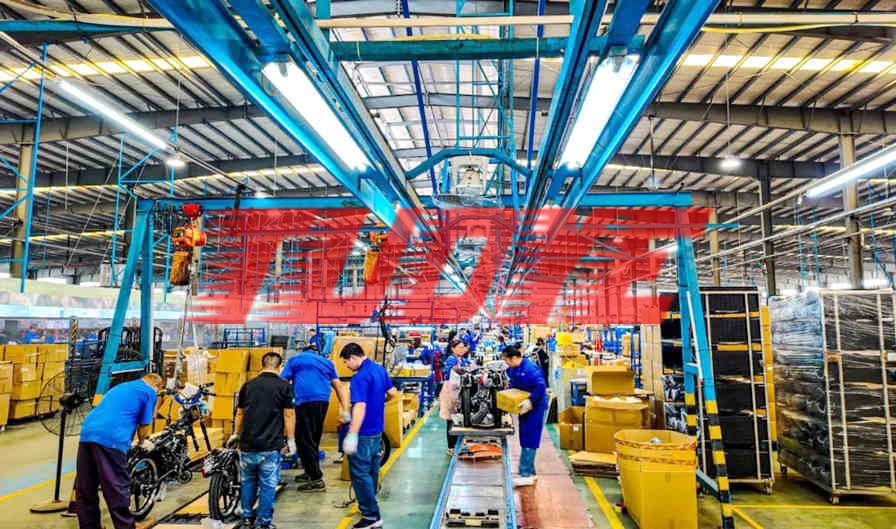
The photo shows the front final-assembly section of this motorcycle production line: red plate-chain track running flush to the floor, a blue overhead rail along the line with electric hoists — tanks and engines lifted from sub-assembly straight to the stations; the bare street frames in view carry front forks, tanks waiting; 15-25 stations working both sides, frames located and traveling in plate-chain fixtures. Assembly sequence: frame on line, fixture-located → harness routing → engine hoisted and seated (mounting points torque-controlled) → carburetor or EFI → frame panels and tail lamp → front fork and handlebar → tank installation → drive chain assembly and alignment → front and rear wheel marriage → brake bleeding and control adjustment → fluids filled → whole-vehicle off-line test (axle load, speedometer, brakes, lamps). The engine-hoist station on a motorcycle final assembly line gets an assist hoist — an engine weighs tens of kilograms, and lifting it by hand is both slow and injuries waiting to happen.
3. Customization & Service
Customization: plate-chain fixtures made to frame tube diameters and models, quick-change across two or three models on one line; hoist points and rail routing follow sub-assembly logistics; the off-line test line carries roller benches per displacement band. Tuoye — in Wenling, Taizhou, Zhejiang, China — delivers the motorcycle assembly line from in-plant pre-assembly and commissions through trial production, warranty one year, fixtures, plate chain and hoist parts supplied long-term; commuter-line speed-ups and added test lines are frequent jobs. For a quotation and lead time, send the model range and daily program — the mixed-line plan and test-section configuration come verified together.
Poka-yoke on a motorcycle line deserves small money: tanks, instrument versions and panel colors — the easily confused parts — get scan-verified at the station, mixed builds stopped at the source; the rework cost of one wrong unit buys three scanners. On hoisting: hoists with balancers, slow gear from lift to landing, bolt holes aligned first time; fixtures on the motorcycle production line split A/B by frame tube diameter — commuter and mid-large models share a line with one pulled pin. Plants asking for motorcycle assembly line retrofits: measure the existing plate-chain width and column span and send them — most times the main line stays untouched, and reworking fixtures and hoists alone lifts the speed a full notch.