
1. Product & Industry Overview
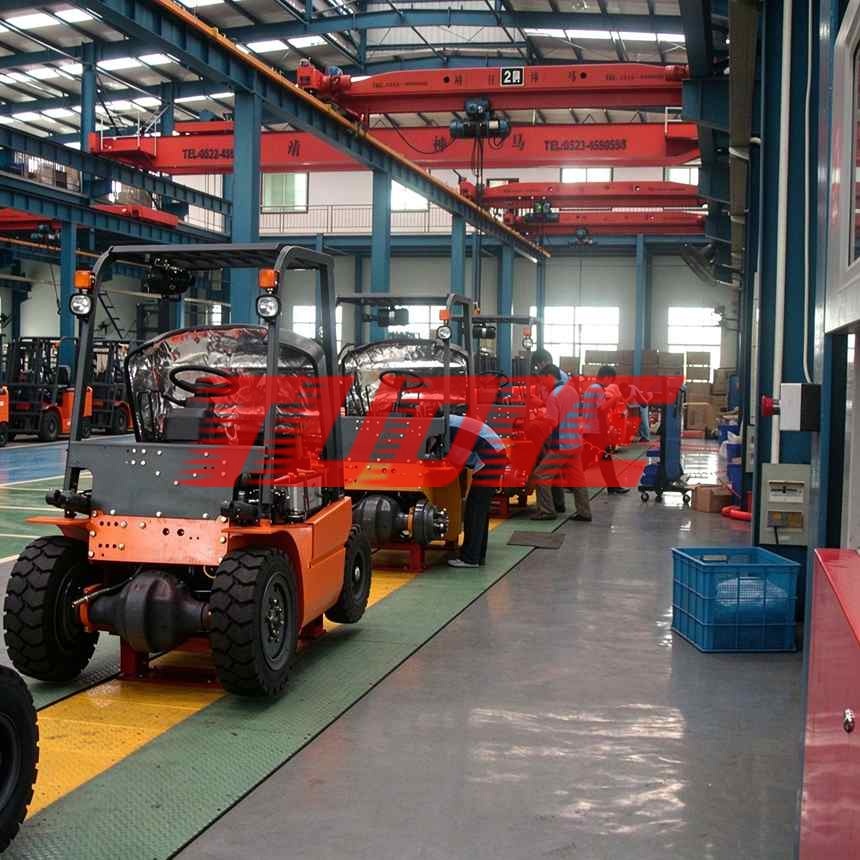
A forklift is a heavy industrial unit, and a forklift assembly line is organized nothing like an appliance line: cycles count in hours, stations count in whole trucks — a 3-ton counterbalance forklift stops at a dozen-odd stations on its way down. The forklift assembly line (also called a forklift production line) completes frame, axles, powertrain, hydraulics, mast and whole-truck testing; IC and lithium trucks sharing one line is now the norm, so the power-bay stations are built compatible. The types: counterbalance trucks from 1 to 10 tons are the backbone, IC and lithium each with their range; warehouse-class reach and very-narrow-aisle trucks run small volumes but high precision; rough-terrain and side-loaders go custom and small-batch. Quality on an industrial truck assembly line concentrates in hydraulics and mast: the cleanliness and sealing of control valves, cylinders and hoses decide truck reliability, and mast chain tension with roller clearance decides lift smoothness. Factory testing runs per JB/T 3300 for counterbalance forklifts — lift speed, mast tilt, brakes and steering, item by item.
2. Process Flow (see photo)
The photo shows this forklift manufacturing line in heavy-unit mode: fixed stations on floor plates, trucks advancing section by section rather than flowing continuously, a bridge crane moving each unit between stations — the 2 t crane in view is lowering an axle assembly into marriage; the 2-3 t IC counterbalance truck sits in mid-to-late final assembly, axles and tires on, overhead guard in place, harnesses and pipes waiting; 8-12 stations blocked out by system, each with its air service units and tool hangers. Assembly sequence: frame on line → drive and steer axle assembly → powertrain seated (engine/motor plus gearbox) → hydraulics (tank, gear pump, control valves, piping) → mast assembly and chain tensioning → electrical harness → overhead guard, seat, counterweight → fluids filled and bled → whole-truck test and off-line. The mast station is the longest single station on a forklift assembly line — the assembly order and clearance setting of inner/outer masts, fork carriage and lift cylinder are written straight into the process cards.
3. Customization & Service
Customization follows model tonnage: crane tonnage and rail gauge, floor-plate loading, mast marriage tooling, and the test stations (lift, brakes and steering combined). Tuoye's industrial truck assembly line proposals, from Wenling, Taizhou, Zhejiang, China, take three inputs — model range, daily program, workshop crane conditions — with station cycles calculated from whole-truck labor hours. Equipment ships from in-plant pre-assembly and commissions through trial production, warranty one year, tooling, hydraulic components and mast hoists supplied long-term. For a forklift production line quotation and lead time, send the tonnage band and annual capacity; fixed stations versus slow plate chain, crane transfer versus AGV — the proposal compares them plainly.
Hydraulic cleanliness on a forklift assembly line deserves its own rules: tanks, hoses and fittings accepted against cleanliness classes before assembly, piping pre-installed and capped, opened only at machine marriage — miss that, and the test-bench failure rate climbs immediately; the lesson has repeated too many times on industrial truck assembly lines. The mast marriage station gets dedicated hoists and locating stands so inner mast, outer mast and fork carriage align in one pass, chains tensioned symmetrically — the mast station holds a quarter of the whole forklift manufacturing line's labor, and when this station runs smooth, the whole line's beat is steady. Tuoye issues a test-section configuration table with every forklift production line — how lift, brake and steering benches lay out and how much floor they take, itemized before delivery.