
1. Product & Industry Overview
In peak season an e-moped plant rolls hundreds of units a day off the line, riding on mixed-flow scheduling over plate chain. An electric scooter assembly line starts at the painted frame and finishes with a scooter that can ride out of the shop — frame, harness, wheels, plastic panels and whole-vehicle testing in one pass. The trade also calls it an electric moped production line; sort the types first: electric motorcycles and mopeds follow motor-vehicle administration (the GB/T 24158 general technical conditions family), with test records that must match the certificates; luxury scooters carry many plastic panels and lamps, so appearance stations dominate; heavy-load carriers reinforce frame and rear axle with their own torque class; small batches of delivery and sanitation fleet vehicles mix in between — fixtures and tools on the e-moped line must switch quickly.
Two-wheeler assembly is marked by many plastic parts, much wiring and constant model variety — purple, pink and black frames running mixed on one line is the everyday picture, color following the order book. Before off-line, every vehicle passes electrical safety checks (insulation, brakes, lamps); keep the data from these stations on file — when market regulators come knocking, it is a complete traceability record. Model changeover lives on quick-change fixtures and trolley scheduling; three-to-five models sharing one electric scooter production line is the industry norm.
2. Process Flow (see photo)
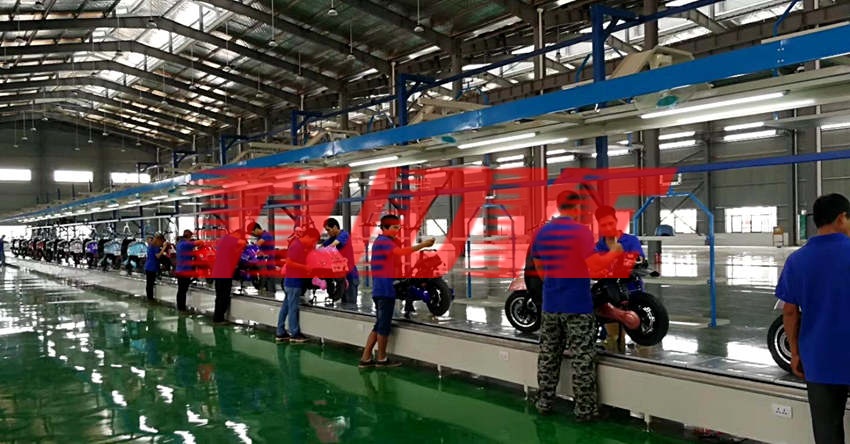
Look at the photo of this electric scooter assembly line: twin plate-chain lanes side by side, the white continuous tabletop wide and flat, frames seated directly on it with simple pallet locators; multi-color frames flow mixed — purple, pink, black queued by order, bare frames in the distance and near-complete vehicles up close, the process direction plain at a glance. Blue trusses overhead carry continuous lighting strips, operators work single-side, the green epoxy floor reflects clean, and the line runs 18-25 stations at 60-90 seconds a unit. Assembly sequence: painted frame on line → main harness routing → front fork and front wheel → handlebar and instruments → controller and battery bay → rear shocks and seat bucket → motor connection → plastic panels and lamps → brake and lamp adjustment → whole-vehicle electrical test → off-line ride check. On an e-moped assembly line, the battery-bay station gets insulating mats and torque wrenches — most two-wheeler incidents trace back to loose connectors and chafed wiring, and poka-yoke at exactly these two points is worth the thought.
3. Customization & Service
The electric scooter assembly line is configured to model range, daily program and workshop: twin lanes, traveling trolleys and air ports as needed, with continuous lighting along the whole line. Tuoye, in Wenling, Taizhou, Zhejiang, China, delivers the e-moped line with in-plant pre-assembly and trial runs, commissions through trial production, warranty one year, chain plates and pallet boards supplied long-term; peak-season speed-ups and added test sections on existing electric scooter production lines are taken too. For a quotation, send the model list and program.
Two notes for two-wheeler lines. First, kit the plastic parts before they board — nine jams out of ten on an electric scooter assembly line are parts-hunting jams; fit one-trolley-per-vehicle traveling racks and the assembler never leaves the station. Second, leave two vehicle-lengths of buffer before the test stations: whole-vehicle checks run one-to-two minutes each, and a 60-second line without buffer tangles at the tail — in peak season, that buffer strip is what keeps order at the end of the line.