
1. Product & Industry Overview
Since the new national standard switch, an electric two-wheeler assembly line carries more compliance stations than before: anti-tampering, BeiDou positioning, whole-vehicle mass limits — ex-factory test items checked off one by one. The electric two-wheeler assembly line (also called an electric bicycle production line or e-moped assembly line) covers the full final assembly from frame on-line to whole-vehicle off-line testing; electric bicycles run under the current GB 17761 with 3C certification, while electric mopeds and motorcycles follow motor-vehicle administration under GB/T 24158 — the two classes need different test benches, and Tuoye, in Wenling, Taizhou, Zhejiang, China, asks for the product family before proposing anything. The types: standard e-bikes are light, speed-limited, pedal-equipped; mopeds and e-motorcycles carry more power and license as motor vehicles; delivery fleet bikes bring dedicated battery-bay and quick-swap requirements. Frames split into strut and step-through forms — strut frames are heavy, and the hoist-fed front section of the line cannot be skipped.
2. Process Flow (see photo)
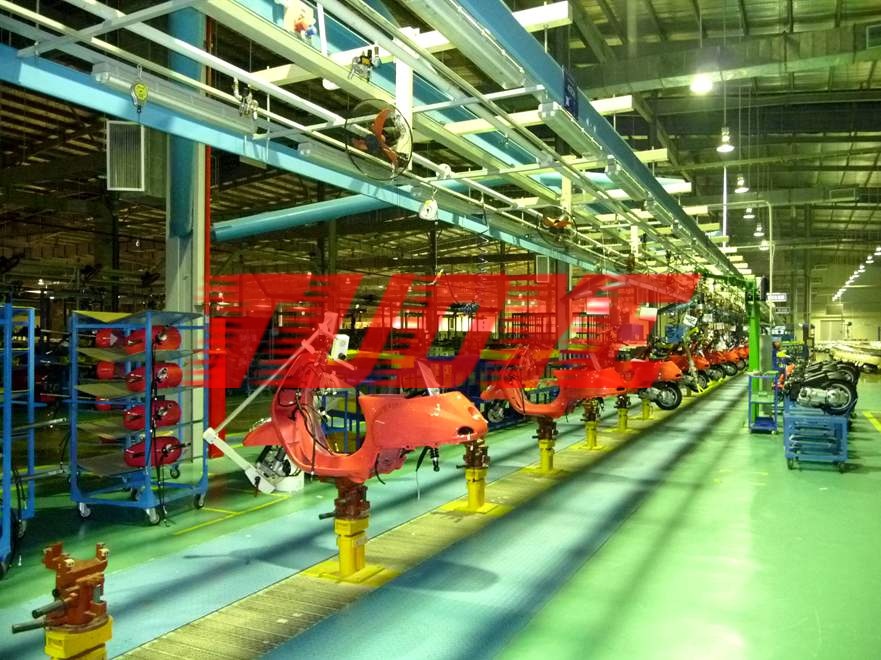
The photo shows the heavy-class layout of this e-bike assembly line: a floor plate chain running in a pit track, yellow lift-type traveling brackets carrying red strut frames forward, each bracket's clamping head made to the frame's main tube diameter; overhead, a blue rail with electric chain hoists lifts frames and motors straight from the parts zone to the stations — no pushing, no carrying; front forks and wheels already on, panels not yet — the marriage state of the front final-assembly section, 20-30 stations working one or both sides. Assembly sequence: frame on line (bracket located) → harness routing → motor assembly (hub motors built into wheels, mid-drives at the bottom bracket) → controller and harness docking → battery bay assembly → front and rear wheel marriage → brakes and controls → panels and lamps → whole-vehicle test and off-line. The tail of the electric bicycle production line carries whole-vehicle test benches per certification requirements, with anti-tamper items governed by dedicated stations right on the line.
3. Customization & Service
Customization on an electric two-wheeler production line: brackets and clamping heads made per frame model with quick-change support; hoist points load-checked against the plant steelwork; the test section fitted separately for e-bike versus e-motorcycle benches. Tuoye delivers the whole line with in-plant pre-assembly and on-site commissioning through trial production, warranty one year, brackets, plate chain and hoist parts supplied long-term; peak-season station additions are routine. For a quotation and lead time, send frame drawings, daily program and workshop span — pit construction versus flat floor, loop or straight hoist rail, all compared inside the proposal.
Two-wheeler lines share one logistics subject: frames, motors and batteries are big and space-hungry, and the e-moped assembly line needs matching buffer slots and delivery lanes beside it — once line-side stacking turns messy, the beat turns with it. Two hoist-rail rules of thumb: choose electric chain hoists with VFD — the slow gear is what lands a strut frame precisely; and run the rail straight from sub-assembly to main line, few bends. On the electric bicycle production line, the battery-bay station is a focal point of certification audits — battery pack numbers and controller anti-tamper records must be callable right at the line side; reserve these interfaces at proposal stage and the audit needs no last-minute homework.