
1. Product & Industry Overview
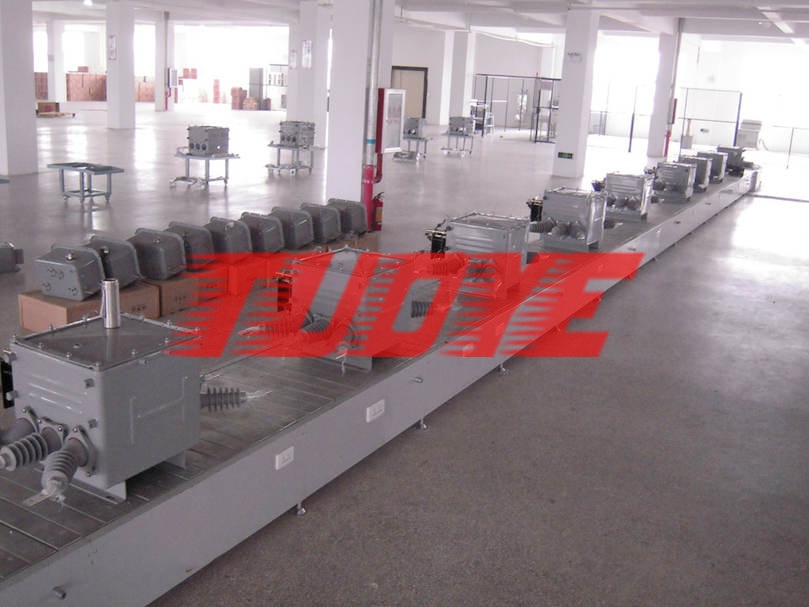
With distribution automation stretching into county and township lines these past years, orders for pole-mounted switch assembly lines climb with it — one pole-mounted vacuum circuit breaker hangs on a 12 kV overhead line, and switching, isolation and short-circuit protection all rest on it. The pole-mounted switch assembly line (also called a pole-mounted breaker production line) completes whole-unit final assembly from tank on-line to characteristic testing; the product runs under GB/T 11022 common requirements for HV switchgear and GB 1984 for AC circuit breakers, with 12 kV / 630 A as the distribution mainstream. The types: ZW32 series run cylindrical, ZW20 series box-type cast housings — the box form moves the volume; pole-mounted load switches switch without protecting, a price class down; and the grid's push for integrated primary-secondary pole switches — FTU control units and transformers married to the body — has weighted the secondary stations of the pole-mounted switch production line considerably. Quality control sits in three places: vacuum interrupter assembly cleanliness, main-circuit contact resistance, and mechanical characteristics (open/close times and three-phase synchronism).
2. Process Flow (see photo)
Look at the photo of this pole-mounted switch assembly line: bench-style line with steel deck in yellow-black edging, white station number boards in a row; the gray tank's three silicone rubber bushings with shed skirts and stainless lifting lugs plainly visible — the signature of a ZW20 box-type pole-mounted vacuum circuit breaker; carton positions on the left hold parts waiting, an estimated 12-15 stations working single-side, mostly manual mating. Assembly sequence: tank (frame) on line → partition plates and flexible links → vacuum interrupter installed → main circuit connection (contacts, busbar fastening) → spring or permanent-magnet operating mechanism → outgoing bushings and support insulators → secondary control unit and aviation sockets → mechanical characteristic test (open/close times, synchronism, travel) → power-frequency withstand and circuit-resistance test → lifting hardware, nameplate, packing. Integrated primary-secondary models add FTU joint commissioning at the secondary station, telemetry and telesignaling checked item by item.
3. Customization & Service
Customization: stations sized to the model range, ZW20, ZW32 and pole load switches sharing one line; mechanical characteristic test benches per voltage class, with the withstand section's safety isolation and grounding done separately per code; joint-commissioning and powered burn-in positions for integrated models designed per agreement. Tuoye — in Wenling, Taizhou, Zhejiang, China — delivers the pole-mounted switch assembly line from in-plant pre-assembly and commissions through trial production, warranty one year, benches, tooling and test-bench parts supplied long-term; retrofits adding characteristic-test positions or FTU commissioning sections are taken too. For a pole-mounted breaker assembly line quotation, send the model range and monthly capacity — the test-section instrument list comes configured with it.
One layout lesson: never crush the checks into one spot at the line tail — set mechanical characteristics, withstand voltage and circuit resistance as three separate points, so upstream stations catch and rework defects in place instead of unboxing at packing. The bushing station keeps a clean working position — skirted insulators fear knocks and dust, and one scratch makes a downgraded unit. The power industry pins delivery dates hard, so installation and commissioning of the pole-mounted switch production line schedule backwards, leaving a window for type-test sampling units — everyone building distribution lines plans to this rhythm.