
1. Product & Industry Overview
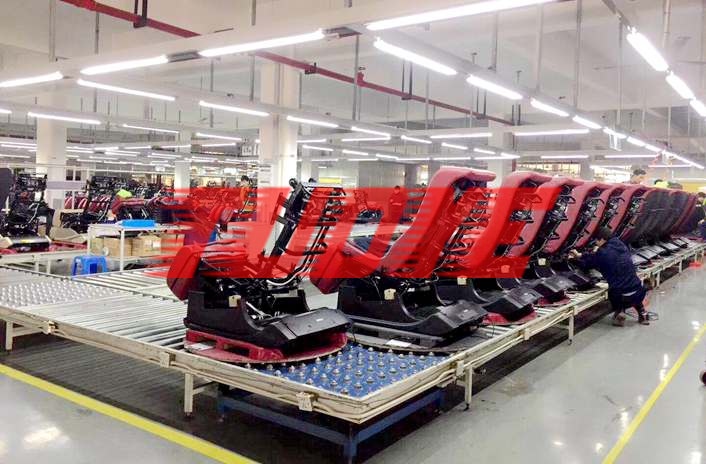
A massage chair is one of the rare "big guys" among home appliances — over a meter long and dozens of kilograms, it cannot realistically be carried between stations by hand. So the first job of a massage chair assembly line is letting the finished unit ride: roller conveying with frame pallets, each pallet located to the model, one chair per pallet flowing to the line end. The trade also calls it a massage chair production line; the models fall into three camps: household luxury units with 4D mechanisms, SL rails and body detection carry the finest operations; commercial shared units add coin/scan systems and reinforced wear-resistant upholstery; capsule models bring shrouds and more appearance-part stations. A massage chair manufacturing line must mix all three, and cycle flexibility matters more than line speed.
The chair's structural trio is mechanism, rail and electronics: mechanisms divide into 2D, 3D and 4D; rails into L and SL types (SL rails run 130-140 cm, covering neck to upper thigh); before off-line every unit passes mechanism travel, tapping frequency and noise checks per the national standard, and commercial models — with reinforced upholstery and structure — run a longer assembly labor than household ones. The station plan of a massage chair production line follows "frame first, appearance after": mechanism and rail go onto the base and run in properly before the upholstery goes on; reverse the order and rework means tearing down the whole chair.
2. Process Flow (see photo)
Look at the photo of this massage chair assembly line: white square-tube welded frame pallets on a roller line, one chair per pallet in a row — red-brown upholstered units mid-flow; one unit sits tilted partway down — that is the flip station, with manual flipping jigs for fitting bottom guards and calf assemblies; on the left a roller lane returns empty pallets, blue totes hold small parts, operators work from one side, and continuous light panels run overhead. Assembly sequence: base frame on line (mechanism, rail and motors sub-assembled first) → whole-chair marriage (backrest, seat frame, calf massage unit) → control wiring and joint debugging → full flip-over (bottom guards, casters) → upholstery fitting and armrests → whole-unit run test (full mechanism travel, airbags, noise, e-stop) → cleaning, packing, off-line. On a massage chair assembly line the flip station is the key: a jig lets two operators turn a dozens-of-kilograms chair in one motion — no waiting for a crane, and the beat never waits.
3. Customization & Service
The massage chair assembly line is configured to model range, daily program and workshop: pallets with locating blocks per model, flipping jigs, lifts and line-side racks selectable; plants with a high commercial share should plan upholstery sewing stations next to the line. Tuoye — in Wenling, Taizhou, Zhejiang, China — delivers the massage chair production line with in-plant pre-assembly and trial runs, commissions through trial production, warranty one year, pallet and roller parts supplied long-term; speed-ups and added flip stations on existing massage chair assembly lines are taken too. For a quotation, send model documentation and capacity requirements.
Two spots deserve attention when building a whole-chair line. First, upholstery labor fluctuates — upholstery fitting is hand craft, and a line paced on average labor will jam; put one buffer position before and after this station so fast and slow work have room. Second, size the packing zone for the actual carton: big boxes plus pallets plus forklift flows need turning radius — miss this in planning and the shop jams at the door every peak season, and the massage chair assembly line's capacity chokes right there at the packing end.