
1. Product & Industry Overview
When a traditional sanitaryware plant goes smart, its line must clear three water gates — sealing, flow, whole-unit flushing; fail those, and every pretty feature becomes an after-sales ticket. The smart toilet assembly line is laid out around exactly those gates: bowl on-line, water-circuit assembly, electronics assembly and unit-by-unit testing, one line end to end. The trade also calls it a smart toilet production line; sort the types first: integrated units — ceramic bowl plus electronics in one — carry the fullest process; smart bidet seats ship alone to retrofit installed toilets, running lighter lines and faster cycles; instant-heating models add a heating module in the water path and longer test times; high-trim units with auto-lid, foam shield and auto-flush need every function item counted onto the electronic bidet assembly line station by station.
The water circuit is the toilet's heart: pressure regulator, flow meter, instant-heat module, diverter valve and spray wand strung together, and before ex-factory the seal test, aged flow test and whole-unit function check are each mandatory — with test data feeding MES traceability, under GB/T 23131 for the product and GB 4706 for electrical safety as the floor. That is why testing stations on a smart toilet production line take a visibly bigger share than on traditional sanitaryware lines; do not cut test positions by old-rules-of-thumb.
2. Process Flow (see photo)
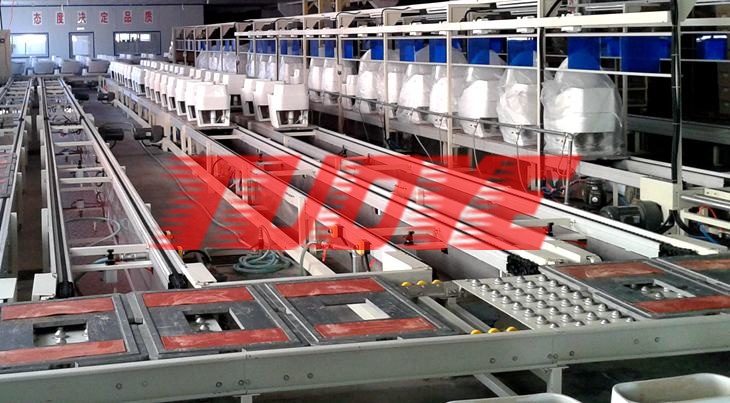
Look at the photo of this smart toilet assembly line: a multi-tier speedchain in vertical layout — on the lower level, metal pallets (red wear-proof facing, locating-hole arrays) carry bowls through the assembly stations, while on the inter-tier conveying runs white bowl bodies bagged in dust covers — dust protection for large parts is the sanitaryware rule; the orange lift-transfer section at the end merges pallets between lines, racks feed parts continuously along both sides, and assembly, buffering and testing stack across three levels, halving the footprint. Assembly sequence: bowl or seat unit onto pallet → cistern components → water-circuit assembly (pressure regulator, flow meter, instant-heat module, diverter valve, spray wand) → electronics (heated seat, sensors, control board) → seal test → aged flow test → whole-unit function check (flushing, heating, lid, drying, item by item) → grounding and withstand voltage → cleaning and packing. On the smart toilet assembly line, water testing runs on filtered recirculating water with quick couplings — never dead water forced through: scale blocks the flow meter and every reading after that is untrustworthy.
3. Customization & Service
The smart toilet assembly line is configured to model type (integrated or seat), daily program and water/electric supply: test-station counts rated to water-circuit complexity, with recirculating water systems, quick couplings and dust tooling standard or optional. Tuoye — in Wenling, Taizhou, Zhejiang, China — delivers the smart toilet production line with in-plant pre-assembly and on-site commissioning through trial production, warranty one year, pallets and test couplings supplied long-term; retrofits adding smart models to existing sanitaryware lines are taken too. For a quotation, send the model list and capacity requirements.
Two notes for sanitaryware plants. First, treat the test water — filter and soften it: on a smart toilet production line the flow data is the product's reputation, hard water pushes misjudgment rates up, and the rework costs more than building a water-treatment loop. Second, the bowl weighs tens of kilograms — rate pallets and lift-transfer sections at the 60 kg class; the money saved undersizing them on a smart toilet assembly line comes back as daily transfer-machine repairs, and every stopped day slips a day of delivery.